City Admits Zoning Is a Barrier

A recent story in The Kansas City Star on an effort at housing reform in Lee’s Summit makes an important and necessary admission: the problem is government regulation.

The city is growing in population. That is good. But the supply of housing is not keeping up with that growth. That is bad. As a result, housing prices are rising and pricing out long-time residents. That is also bad.

The good news is that city staff issued a report with some recommendations, including relaxing the city’s restrictive zoning codes. Tracy Albers, the city’s development services director, offers a remarkably free-market reform proposal. According to the Star:

[Albers] said that the city’s influence on which new housing types are built in Lee’s Summit is “limited”. City staff can’t control interest rates or construction costs, she said, but they can woo developers, invest in other projects that make people want to live in Lee’s Summit, create more permissive zoning policies and “make the development process as predictable as possible.”

Unfortunately, despite the proposal having many free-market ideas, there are some red flags. Wooing developers and investing in projects feel like euphemisms for taxpayer subsidies. But those don’t appear to address the problem Lee’s Summit is having. They have plenty of people, and the city is growing. The problem is that the city’s rules and regulations are getting in the way of the market’s ability to accommodate that growth. Remove those barriers, and let’s see what happens.

A Better Way to Teach History with Jon Bassett and Gary Shiffman


Susan Pendergrass speaks with Jon Bassett and Gary Shiffman, founding partners of 4QM Teaching, about their Four Question Method for teaching history and social studies. They discuss why so much history instruction fails to build lasting knowledge, the four questions that structure a well-taught history lesson (what happened, what were they thinking, why then and there, and what do we think about that), why “knowledge first” matters for both literacy and civic discourse, and how their approach could help address declining civics and history knowledge among young people.

Listen on Spotify

Listen on Apple Podcasts 

Listen on SoundCloud

Episode Transcript

Susan Pendergrass (00:00): Thank you so much for joining us on the Show-Me Institute podcast. We’ve got John Bassett and Gary Shiffman. You guys are the founding partners of 4QM Teaching, which we’ll talk about later. But you guys were both, both of you have been classroom teachers, is that right?

Gary Shiffman (00:16): Yeah.

Jon Bassett (00:16): Yeah. So I was a classroom teacher for thirty-four years. I taught at a Catholic school in the South Bronx. I taught at sort of a medium-sized suburban school in Boston and then a large comprehensive high school outside of Boston, in Newton, Massachusetts. And that’s where I met Gary. And the story goes that I ended up hiring him in two thousand and one to teach in the department that I was chair of, and that kicked off a long and productive argument. Gary, you want to tell her about the argument?

Gary Shiffman (00:55): I guess, yeah. So I was a career changer. It was two thousand two, by the way. Historians, get that right.

Susan Pendergrass (01:02): And the argument continues.

Gary Shiffman (01:04): The argument continues. This is how we are. This is just it. So in 2002, I was an ex-political science professor. I didn’t get tenure at the University of California, San Diego, where I was teaching. I was a classroom teacher too, just had no idea what I was doing. Anyway, I decided I wanted to be a high school teacher, so I applied to lots of jobs, many, many jobs. I had a wife and two kids. My wife was employed, but we needed me to have a job, so I applied to a lot of jobs and I got exactly one job interview. And that was with John at Newton North High School. So I went in and did a demo lesson to show that I was qualified to take this job. And he asked me after the demo, he says, so tell me about the lesson you just taught. Reasonable question. And I said, can I tell you what I would do next time? And that got me the job. Because I had the inkling by the end of the demo, I didn’t really know what I was doing and I needed to learn. And he knew that going in, because I was a university professor without any real training in teaching, so obviously I didn’t know anything. And so he hired me. Well, John can tell you the story about why he hired me, but anyway, he hired me and I was there at Newton North for four years, and then I got the job of department chair, the same job he had, but I had it in a neighboring town, Brookline, where John happened to have gone to school and where my wife went to school, which is why we were living there. And so I got to be back in my hometown, Brookline, Massachusetts, chair of the department there, and I’d had that job for seventeen years. Well, I quit in twenty twenty-three to work on this.

Susan Pendergrass (02:41): Yeah, so here you guys are. And I think that you’ve started a nonprofit that we’re here to talk about today, but I think that a lot of our best ideas in education come out of the classroom, obviously. Teachers have a very entrepreneurial spirit oftentimes, if we can find ways to harness it, and I think it’s so great that you have. But at the Show-Me Institute, we have been talking in recent weeks about these polls that have been coming out that show that people are feeling more positively about socialism and less positively about capitalism. And some folks are very upset about it. We’ve had one of the pollsters on, Emily Ekins from the Cato Institute, to talk about their findings. And part of their poll found this growing interest in socialism, but also found that, I think, 40% of respondents didn’t know how many branches the federal government has. And a very high percentage didn’t know what we had just celebrated the two hundred and fiftieth birthday of, or which country we went to war with in the Revolutionary War. I mean, it’s just a really troubling lack of historical content knowledge. And then you ask this question, how do you feel about socialism and capitalism? And so people have been saying, do you think people even know what socialism and capitalism are? I don’t know, but I would guess probably not if they don’t know how many branches we have. And so, you know, then it’s like, what do you do? I’ve looked at the Missouri social studies standards. They’re pretty thin, and we don’t really report test scores, and there’s no real accountability. It’s not part of our accountability system. So I suspect kids are learning less and less about history, civics, government. And now you have stepped in to sort of address this problem. Is that right?

Jon Bassett (04:29): Yeah, I mean, I would say this is not a new problem, and we certainly would not guarantee that if history were taught well, everyone would reject socialism. I don’t know about that. But your anecdote about people not knowing who we fought against in the Revolution, we actually have an anecdote about that in our book. When I was teaching the American Revolution, and I was doing a bang-up job because I was teaching this great story, and I’m teaching the story of Lexington and Concord, and halfway through, these two girls in the back raise their hand and they say, wait a minute, Mr. Bassett, we’re fighting against the British? And I was like, my god. And so I think a lot of history, our big insight, we think, is that a lot of history is badly taught, because history teachers aren’t really exactly clear on what they’re doing when they’re teaching history well. And we argued for over a decade about what good history teaching looks like. And to make it both memorable and engaging, you have to be clear about what question is on the table in any given lesson or any given part of a lesson. And so that was our insight, that we’ve broken down into four questions that x-ray the discipline of social studies, and we think that it can both engage kids and make it memorable, but also provide insight into the structures of the disciplines themselves.

Susan Pendergrass (06:00): Okay, so let’s go through the four questions. How do you take these in order to teach a lesson about the American Revolution?

Gary Shiffman (06:07): Question one. What happened? It turns out that you cannot think about things you don’t know about. You could make stuff up, I guess, but you can’t think about it. And so if you take that question seriously, what happened? You think, all right, my kids need to know what happened. American Revolution. What happened? They need to know who was involved and what they did, right? They need to get that story in some way. And then to avoid the calamity in John’s classroom where the girls don’t know what’s going on, right? These are good kids. They want to know. They asked, right?

Susan Pendergrass (06:39): They needed that.

Gary Shiffman (06:41): They need to know, and they need to not just get the story, they need to tell the story back. So when we ask question one, we’re not just saying what happened, and we’re not just framing lessons around that. We actually have a methodology for doing that, for asking and answering that question. We call that skill narration. It’s a thinking skill. It’s hard. If you don’t think it’s hard, try it yourself. You’ll see there’s plenty to criticize about any first performance, right? So by focusing our method on question one, what happened, you’ve got to learn a story, you’ve got to tell it back, and there’s a rubric, there’s criteria for telling it back well. Now what we’re doing is not only getting kids up the chain toward real knowledge, but we’re actually working memory. I would say in answer to your last question, part of the problem is, we just wrote a blog post for the American Enterprise Institute. We were invited to submit a chapter on social studies. And our argument is we need a barn clearing in social studies the way they did it in early literacy, which was that scientists, cognitive scientists, psychologists who study learning know a lot about how human memory works. Unfortunately, many educational theories have no idea. So we’re trying to align our method with what we know about how human memory works. If you say nobody remembers anything from school, well, that was bad teaching. The problem is that the overall infrastructure for our field has not incorporated that science yet. We’re trying to incorporate the science. We want to incorporate the science, just like literacy. We need to clean house a little bit and focus on the activities that will actually create enduring knowledge, long-term memory, for kids.

Jon Bassett (08:19): Right. And so one of those is learning a story and telling it back. And so that’s question one. Everything starts from that. That story has some interesting people in it who made some interesting decisions that might seem strange or odd or consequential. Question two, we pause the narration and we try to dive into the heads of people who drove that story forward, and we ask, what were they thinking? So the guys who signed the Declaration of Independence, they took an enormous risk. You know, Ben Franklin, we must hang together or we will surely hang separately, right? And they pledged their lives, their treasure, and their sacred honor on a war against the world’s most powerful country. What were they thinking? This is question two, and this is the thinking skill of interpretation. So we read primary sources, we would read the declaration, and try to figure out, okay, what’s in the heads of the guys who wrote that and signed that? And then Gary was the guy who convinced me that question three exists. Gary, talk about question three.

Gary Shiffman (09:18): Sure. I just want to point out, question two deepens the story, because you’ve learned the story, you’ve learned what happened. Now we’re really going to know those characters well and know their thinking. It’s a post hole. It helps us remember the story, because now we’ve really spent time with Franklin or Jefferson or whoever, right? So question three is a stepping-back kind of question. And the question is, why then and there? So there have been anti-colonial rebellions for a long time. There have been wars of independence for a long time. There have been wars in general for a long time. But they don’t happen all the time, they happen sometimes, under some conditions. So I came from a political science department. I was a political scientist before I became a history teacher, and political scientists are weird. They’re a weird bunch, kind of like economists this way. They actually don’t care about the American Revolution. They care about revolutions in general. Under what conditions do revolutions occur? So you can marry that study, the study of the conditions under which stuff happens, to our study of narrative history. And you can do it very nicely, because once you know about a case pretty well and you know the people, the revolutionaries involved in that case, you’re only a stone’s throw away from, huh, does stuff like that happen all the time? So it turns out that Nova Scotia, a British colony, now part of Canada, was a fourteenth colony. Thirteen colonies rebelled. Nova Scotia was invited to join, and they said, thanks, but no, we’ll sit this one out. Jamaica was a British colony in the New World, and it turns out they also decided, nah, we’ll sit that out. How come? Why there, in the 13 colonies, but not in these other British colonies? And it turns out the pattern’s not that complicated. They needed British security, or the colonials were going to be killed because they were minorities, or vulnerable to whatever. There are lots of plausible answers to why Nova Scotia and Jamaica went one way and the 13 colonies went the other way. The point is to put on the table for kids questions like this, so they learn the thinking skill of what we call explanation. How do you consider changes or differences that might explain a different outcome in time? Like, once you know the British colonists in the 13 colonies were pretty happy being British until they weren’t, what changed? Or they were different from Nova Scotia, Virginia and Massachusetts were different from Nova Scotia. In what ways? And what you’re learning to do is what political scientists and economists do all the time. We should try to identify the factors that may make a difference in outcomes in the world. Turns out to be super fun with kids if you set the puzzle up right and you’ve got the question really clear.

Jon Bassett (11:48): And it’s also one of the things where, you know, we say all the time, you need to study history so you can understand the way the world works today. But we often don’t really cash that out. And question three cashes that out, because you can say, okay, why then and there for the American Revolution? Under what conditions do we get revolutions? Let’s look at some contemporary cases. And so we do that a lot in our curriculum. Question four is, what do we think about that? And this is where we get to exercise judgment. And we’ll focus in on a particular person or a particular policy, a particular decision, and we’ll say, well, was this the right thing or the wrong thing? Under what conditions is it right to do this thing? And we phrase the question with a “we,” not because we expect everyone to agree, we absolutely do not, but we are going to discuss this question in community, in a classroom community, and we’re modeling civic discourse here. So, you know, was the American Revolution justified? Some people think yes, some people think no, right? Why would you think that? What are your principles for justifying revolution? And then, under what conditions is it right to take up arms against your long-standing government? And so that’s sort of the payoff question.

Susan Pendergrass (13:04): And I saw that you’ve written about the same concept with Truman dropping the bombs on Hiroshima and Nagasaki, which I can imagine would be a much more enriched conversation about judgment, right? Like, was it right?

Jon Bassett (13:17): Well, the reason it’s question four for a reason, which is that if you just go, well, Truman and the bomb, well, if we haven’t studied that very much, I’ll just give you an answer: well, you should never bomb civilians. Never? Yeah. But if you’ve done the whole story of World War II and you’ve done question two on Truman, and you know something about the underlying context and conditions, then usually you get, one of my favorite moments teaching question four was with this kid who was kind of struggling and asking it, and he’s like, that’s a hard question. There you go.

Susan Pendergrass (13:54): Yeah. Well, would you have said then, before, when what we need barn clearing about is that kids were given an original source document like the Declaration of Independence and told, what do you think? Like, were they going from here to here? Or what was the problem, that we were skipping some of these steps?

Gary Shiffman (14:17): Well, yes, we’re absolutely thinking about those steps. And teachers, so the dominant view of pedagogy was students need to talk as much as possible. Student discourse. And students need to talk, don’t get me wrong. We absolutely need to get kids to think out loud, to write their thoughts, to revise a lot. They need to be involved in their learning. Of course, that’s obvious. But if you give a kid a document that they find virtually impenetrable, because it was written hundreds of years ago by people with very different norms about English prose, among other things, who don’t know anything about the context, and you say, read this and now tell me what you think, think about how many of the four questions you just skipped. They don’t know what happened. You have to do what happened first. Second, it’s a very difficult document. When we do documents, when we ask kids to interpret a meaningful artifact from the past, we go very slowly. We’re going to take a piece of the document they can read in one sitting. Really read. We’re going to contextualize it, which means we’re going to remind them of the story they know that puts it in context. We’re going to have them establish the plain meaning. Takes a lot of time. It’s work. They have to know what those words mean. They have to really look at those sentences and understand the syntax. Does it sound like work? Yeah, it is work. Next, they’re going to interpret, and this is, we’re going to teach them, we’re going to give them guidelines for doing that. What is the purpose the authors were attempting to achieve when they wrote this document in this way? They could have written it a different way. They could have written nothing at all. What do we know, based on the context and the words they wrote? What plausible claims can we make, based on textual evidence, about what their goal was? Furthermore, what were their assumptions? Things they thought were true about the world that you see they must have thought was true, even though they didn’t actually say it. They assumed things about how the British would react. They assumed things about how their American audience would react. They didn’t say, I think the audience is going to react this way. This is inference. But you can teach kids to do that if you go slow and you’re methodical and you practice it over and over again, which is exactly how we design our curriculum. So now we’ve done the story first. We’ve really taken that document apart and gone slowly. And we haven’t even gotten to the “what do you think” part yet. That’s question four. That’s a different lesson. I don’t care what you think yet. I care what you think about what they thought. That’s question two. But when we get to planning our own little insurrections, or deciding they’re always a bad idea, whatever we decide, that’s a separate lesson, which has its own protocols for thinking and for doing it right.

Jon Bassett (16:50): Yeah, I would say, Susan, when you said, are we skipping steps? Yeah, absolutely. I mean, a couple of the big ones, one of the big ones is knowledge first. And we have a slogan, we have laptop stickers that say “story first.” And a lot of teachers believe that. Or we sometimes work with teachers and we say, listen, kids have to get the story before they can think about it. And so we have question one lessons where kids get the story and they practice telling it back. And sometimes teachers tell us, well, if my administrator comes in and sees that my kids are just reading and taking notes on this story, or they see me lecturing and kids taking notes on the story, they’re going to tell me that’s low level and it’s not good pedagogy. And the problem is that it’s story first, not story only. And so knowledge first is just, we know this from cognitive science, but like Gary said earlier, that often doesn’t filter into the classroom. Another problem we see is document overload. And in history classes, people are told the kids have to do documents. So, we’ve seen lesson plans that call for middle school students to read four or five primary source documents from the 19th century in a single class period. And you can’t take it seriously if that’s what you’re doing. And so by having four questions and by having four lesson types, every lesson is just one thing. We’re going to learn the story today, kids. Today we’re going to dive into the heads of the signers of the Declaration. So we’re going to read a piece of that document slowly and carefully, the way Gary described. Today we’re going to look at underlying context and conditions. We’re going to work on a question three puzzle. That’s going to take the whole class period. We’re going to talk about what we think about that. Again, whole class period. Just the clarity of the questions and giving it the time it needs and respecting knowledge first. Those, I think, are the

Susan Pendergrass (18:57): Yeah, and I don’t want to belabor this point, but this is kind of why your stuff was appealing to us. But if you ask somebody what they think about socialism, and they say, is socialism free health care and free child care and rent controls, then yes, I like it. Because if you don’t know, if you don’t have any context for what it is, and I’ve had people say, well, are they learning about Stalin? And I’m like, probably not. I guess probably not, right? Because if you just associate it with what you’re hearing today, and the same thing with capitalism, well, I associate it with whoever, some of these very wealthy people who are around these days, maybe I don’t like that. And if you don’t have an underlying base of knowledge, then your opinion is just based on sort of what you see right in front of you right now. And that is skipping all of those steps. And I’m not saying anybody can’t have that opinion, that’s fine. It’s just that it’s coming from a place of not much underlying content knowledge. And I think that’s problematic. And I mean, we’ve seen similar things in reading, and I just wonder, what kind of happened? You know, we had A Nation at Risk in the eighties where they were like, we need to get back on track. And then we got kind of into whole language, and then we got into this interactive math, and then we got into like, history and how you feel about it. And now, is a pendulum swinging back where we’re like, science of reading and phonics? And we know, with all due respect to UCSD, Gary, like those kids don’t do math, can’t do math. And now we have a real problem with kids being able to do well on civics, like NAEP civics and history tests. So what happened? Did we just lower the bar too much? Or what happened, do you think?

Jon Bassett (20:36): Well, we squeezed history out, is one thing that happened. And the emphasis, you know, you mentioned in your intro that history’s not tested in Missouri. Okay, not tested. Then, if I’m a principal and my school is going to get a state rating based on test scores, it’s going to be math and literacy. And so we’re going to focus on those things and we’re going to squeeze out the other things. But

Gary Shiffman (21:01): And one of the reasons, by the way, we love Natalie Wexler, who is our patron saint. She wrote a book saying, look, people are in their classroom spending two hours a day teaching comprehension skills, which don’t really exist. How about teach some history? How about some knowledge? Teach kids stuff. Kids are sponges. Kids want to learn stuff. First of all, they want stories, right? Ever, I had two kids. I have vivid, wonderful memories of sitting them on my lap, reading them stories. When you finish a story, the first thing they say is, again. They want it again. They love dinosaurs and trucks and stars and Pokemon and whatever it is. They just want to know stuff. And if you go into school and you practice skills, my god, how stultifying, right? But it was driven by the misguided belief that if we can’t nail that literacy exam, we’re doing a bad job. But Natalie raises the question, what if the exam isn’t very good? You have flushed all the learning out of your system in pursuit of an exam that doesn’t actually tell you what you want to know.

Jon Bassett (22:05): Well, and the reason, that exam, it’s not that you can’t test, it’s not, we’re not against testing. The problem is that people lost sight of the fact that literacy is, at least in large part, it’s just knowing stuff. And so if you actually taught history and science well, that would improve literacy. Because literacy has two components. Can I sound out the word? And do I know what the word means? And it turns out that learning a lot of history is really good for that second part, because there’s just a lot of general knowledge that comes from history, and it literally builds vocabulary. But rather than saying, what are we doing today, we are vocabulary-building children? No, we’re going to learn some history. And then, as an ancillary benefit, that’s going to build some vocabulary.

Susan Pendergrass (22:55): So now you have this, 4QM, what are you hoping to do with it? Are you going to spread the word?

Gary Shiffman (23:01): We are hoping. We are hoping, Susan, thank you for helping us.

Susan Pendergrass (23:04): So how do you get this into classrooms? Honestly, we’ve talked about this a lot at the Show-Me Institute. Like, okay, we know we have a problem with content knowledge in these areas. We know the standards are not great. And they take the test, but that doesn’t count toward accountability. What do we do? Do we want better standards? Do we want better teaching? We kind of, to your point, we kind of know where to go with this science of reading thing, but we don’t really know where to go with this teaching history and social studies thing. So are you guys providing a pathway?

Jon Bassett (23:32): So I think what we’re trying to do is sort of do an end run around the institutions that currently dominate our field and are making what we think are pretty significant and long-standing errors. And so we’ve built a curriculum and we’re building more. We have a middle school U.S. history one curriculum fully built out, and then we’re selling subscriptions to that. We’re building a world cultures and geography curriculum, also for middle school, that’ll be completed within the next few months. And our idea, I think, is we’ve had success in schools and districts where there’s a mid-level administrator who’s like, things aren’t really great here, but I think they could be better. And they bring us in and we train teachers and we give them curriculum. And I think that’s sort of the current state of affairs, but Gary, you know, we have big visions. Gary wants to take on the College Board, and I think that would be great.

Susan Pendergrass (24:34): Yeah, yeah.

Gary Shiffman (24:35): Yeah. Well, so John’s exactly right. I mean, it’s interesting, I want to write a blog post in praise of middle managers. The unsung heroes are the people, they’re not the big bosses who have to deal with the public all the time. And then teachers are crucial, but individual teachers can’t change a system. But sometimes the middle managers can say, exactly as John said, I’ve got people who can teach, and I’ve got kids willing to learn, and I don’t have the right tools for them. If I got them the right tools and we all pulled in the same direction, things would get a lot better. And when those people step out and say, let’s try this, and they support it, and they don’t just throw… I mean, some administrators, of course, are going to say, I got your curriculum, what do you want, I got your textbooks, what do you want. That’s not what I’m talking about. I’m talking about people saying, no, we have to see this through. It’s a project. I have to make people see that it’s valuable. And sometimes it comes from teachers who convince administrators. Those are the best cases, actually. Some teacher says, my god, this is great, we’ve got to do this. But in any case, when they all push in the same direction… So that’s one level. But the capstones of the system, if we could get training programs, if teacher education involved training in good curriculum, the logic of it, how to deliver it, if you really went to grad school and learned the four-question method and then became a history teacher, yay. And then at the other end, the College Board writes these exams, and they’re fine, everybody takes, all the high flyers take AP, some schools make all the kids take AP. AP has a thinking skills list that’ll make your eyes cross. And the reality is, mostly it’s telling stories. Tell this story. Every once in a while they throw in and mention this document when you do it. But what if the College Board actually took thinking skills seriously and aligned their content, as we have, integrated the content and the skills, you’d give harder tests, they’d actually be more meaningful.

Susan Pendergrass (26:30): And do you have results in test scores? I hate to always just go there, but do you have results that are concrete?

Gary Shiffman (26:37): We have no science to support our intervention. No, neither does anybody else, by the way. Let’s be, all the science that drives the science of learning was done in labs on college sophomores. It’s all memory, it’s all cog-sci and all,

Jon Bassett (26:51): I mean, there’s the Fordham study that found additional time on social studies improved literacy scores in elementary and middle school. But that doesn’t say anything about the four question method. No, I think, so no, we don’t have a nice randomized, you know, half the kids took the four question method, half the kids did it regularly. We have a lot of anecdotes. Our most gratifying response from teachers is a combination of, often we hear teachers say, that’s what I’m doing. And it’s like, we like to say we didn’t really invent the four question method so much as we observed it. And so it’s clarifying for teachers. Then the second thing that’s really gratifying is we have a video up on our website of a Texas teacher who’s like, yep, I started doing 4QM, it was really hard, it was hard for me, it was hard for my students, they were complaining. So I stopped. I went back to what I was doing before, and I did that for a few weeks, and I was like, this is terrible. And I’m going back to the four question method, and I stuck with it. And by the time my kids took the mid-year test in January, I had the highest scores on that test that I’d ever had, because the kids are getting primary source documents like, yeah, no problem, I know what to do with that. I identify it, I contextualize it, I understand the plain meaning, then I do my inference, because they’ve practiced the skill and gotten better at it.

Gary Shiffman (28:11): So

Jon Bassett (28:12): We think the fact that it’s hard at first is actually evidence that it’s a real thing, that it’s worth doing.

Susan Pendergrass (28:22): Yeah, and one thing that I saw in something you guys, somebody, one of you wrote was that ironically, as kids are doing more of, like, read a primary document, tell me what you think, and tell me what you think, tell me what you think, the willingness to engage in conversation around controversial issues has gone down, right? Because everyone’s got a strong opinion, and people don’t want to jump in and talk about, like, the dropping of the bombs on Hiroshima and Nagasaki, maybe, or they don’t want to talk about, I think you mentioned race reparations. Why? What is the connection? They’ve been talking so much about how they feel about stuff, and then they don’t want to engage in conversations. Or do they not have facts? What do you think?

Gary Shiffman (29:01): I think it’s all of it. I think it’s knowledge and skills, both. But yeah, so your comment reminds me that there’s some obscure research on this. Read about people who read novels, and it’s impossible to disentangle all the factors, why do some people read a lot of novels. But apparently fiction can build empathy. And the idea is you’re just taking the perspective of lots of characters. In a well-written novel, when you get fully engaged, you have to think through the situation from a variety of points of view. And I do think that our question two lessons, they’re built around that model. You don’t have to like Jefferson or Franklin or King George or any of these people, but you need to try to understand what they were thinking. It’s called historical empathy. And I do think, one of the many pieces, lack of knowledge, social inhibition, the fear of being humiliated online, all of that stuff is real. But part of it is, if you don’t practice trying to understand what other people think, even if you don’t like them, how are you going to engage in civic dialogue? You’re just going to cartoon your enemies, right? You’re just going to stay in your silo. But if you have to… And by the way, so John hires me in two thousand two, I’m Jewish, I’m teaching in a school with a lot of Jewish kids, I’m teaching modern world history. And you know what we’re going to do? We’re going to try to understand what Hitler was thinking.

Susan Pendergrass (30:24): Yeah.

Gary Shiffman (30:25): And I go back to that because we’ve had pushback from people, like, that person’s kind of edgy. I’m like, excuse me, some of the most important teaching I ever did was telling my room full of students of all religions and ethnicities, including Jewish kids, we need to understand this because this is real. This actually happened. This is a real person. And none of us want this to happen again. But that’s a slogan. We need to understand how it happens and what the thinking looks like.

Jon Bassett (30:58): And one of the big insights of the method is, by separating question two and question four,

Susan Pendergrass (31:03): Right, that’s what I’m thinking.

Jon Bassett (31:05): it makes the whole conversation easier, right? Like, I’m going to ask, so in our, we have a document, from South Carolina in the Civil War, we have a document from a pro-slavery senator. We’re not going to read that because we think slavery is great. We don’t, we think it’s terrible. But we’ve got to understand what they were thinking. Right.

Gary Shiffman (31:28): That’s

Jon Bassett (31:28): Different question from, what do we think about that? So let’s practice on that. And then when we do get to a real question four, well, under what conditions is revolution justified? Or, one of my favorites, who gets a statue, right? I had a

Susan Pendergrass (31:44): I was just thinking.

Jon Bassett (31:45): four, Boston took down its Columbus statue. Was that the right decision or the wrong decision, right? And when you have practice understanding, working with empathy, and then we also frame our question four lessons really carefully and step by step. So, it’s not just throwing everybody in the mix. It’s so gratifying when you see kids who are able to disagree deeply and sincerely. And we always say the goal of a question four lesson is not to convince other people, it’s to understand each other. And so you want to build a border wall, I think that’s a bad idea, what are your reasons, what are my reasons, how do we talk about that? That’s, and the method helps to make those lessons much better and easier and safer for teachers, for students, for everybody.

Susan Pendergrass (32:43): And I think the key is putting that at the end, making that question four, not question one. Because I think a lot of times it is, “what do you think” becomes question one. And they can’t disentangle what they think with how other people thought. And I think that we really need to get away from that type of discourse. And no matter what, your timing is great, because I think you’re at a time when we are beginning to see that we need some new direction in this field. And I think your method looks great. So I appreciate you coming and telling us about it. Where can people find out more?

Jon Bassett (33:20): 4qmteaching.net.

Susan Pendergrass (33:23): You’ve been writing about it here and there. So I hope that people pursue looking into this, because I think it just makes so much more sense to me. And maybe we get some of the heat off the discourse.

Jon Bassett (33:36): More light, less heat.

Susan Pendergrass (33:38): More light, less heat. That’d be great. Thank you so much, Jon Bassett and Gary Shiffman. I appreciate it.

Jon Bassett (33:44): Thank you.

Produced by Show-Me Opportunity

What Does a Streetcar System Cost?

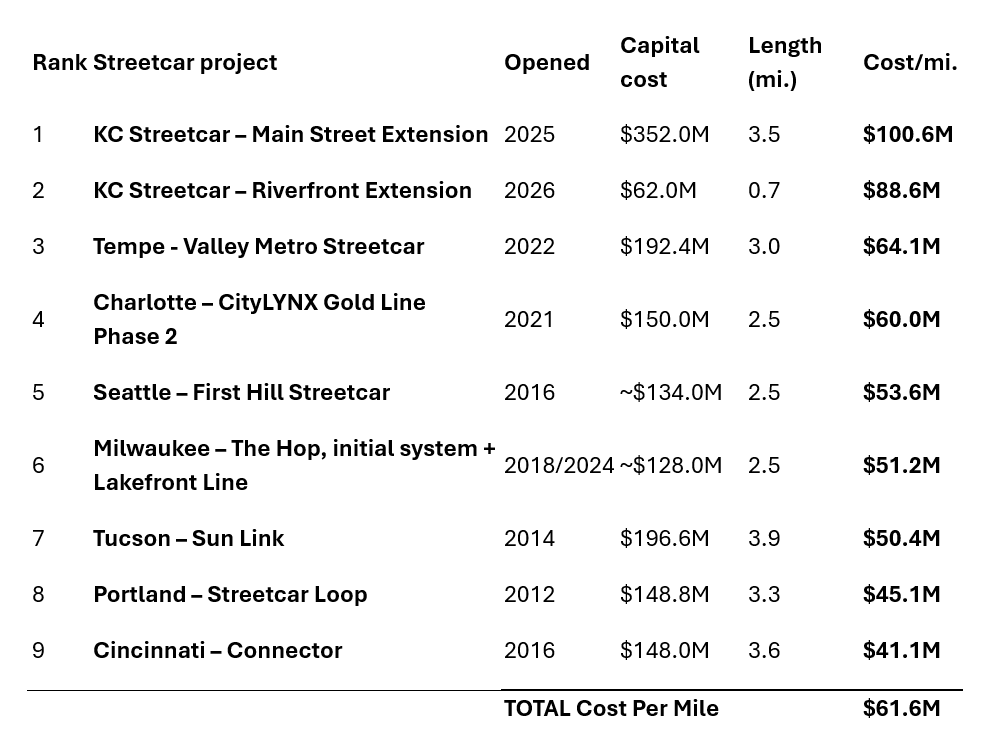
Kansas City just spent over $100 million per mile for its Main Street streetcar extension, making it the most expensive system per mile in the United States. Last year, Randall O’Toole estimated that the average streetcar cost per mile is around $91 million. It’s worth looking at some recent examples to see if that number is accurate.

Looking at recently opened systems (see table below), the cost per mile seems to be lower, at about $61.6 million. Note that I am excluding the yet-to-be opened Orange County line, which may run as much as $156 million per mile, and the Sacramento line (~$47.7 million per mile), which had been paused because of construction costs.

Former Kansas City City Manager Brian Platt told KCUR radio in 2024: “These things cost $150 million per mile.” That’s way off the mark, but important because Kansas City is considering a few other extensions to the streetcar line. If $150 million per mile is the baseline cost, streetcar passengers won’t be the only ones taken for a ride.

The KC Streetcar’s Sales Tax Claim

In a recent essay for the Missouri Independent, I responded to an op-ed in The Kansas City Star by former Kansas City Mayor Sly James. In the piece, he extolled the streetcar for helping the city grow, and claimed the streetcar is an opportunity to bring the city together.

The mayor’s piece was mostly fluff—and several assertions he made were flatly wrong. One of them involved the success of the streetcar to drive the city’s economic growth, using sales tax receipts as evidence.

I first learned of this claim after I authored a piece in the Star in July 2024. In that column—and here on the Show-Me Institute website—I used property tax assessment data provided by Jackson County. From 2014 through 2023, the total value of the streetcar transportation development district (TDD), which runs along the entire route of the streetcar, grew at the same rate as the county as a whole. If the streetcar were truly a driver of economic development, one would expect to see the values in the TDD rise faster.

The streetcar authority, in a May 6, 2019, press release, does provide evidence of increases in total market value within the TDD, but it doesn’t go the extra—and necessary—step of comparing it to the county. Such growth may seem impressive, until you realize it was happening in places nowhere near the streetcar.

Even if the streetcar TDD property values had risen faster than property values elsewhere, it’s possible that the cause was something other than the streetcar. It could have been due to the number of other development subsidies handed out along the route. But the data show us that there is no growth, regardless of the reason.

After the piece was published, streetcar supporters alluded to the growth in sales tax receipts within the TDD, but did not share any information to back up this claim. James refers to this too in his recent piece, writing: “Sales tax receipts generated within the Transportation Development District surged by more than 65% following the line’s opening — far outpacing citywide growth.”

It appears that the source of these data is a 2019 article in Metro magazine in which the head of the KC Streetcar Authority, Tom Gerend, writes:

Sales taxes within the streetcar’s downtown Transportation Development District, a revenue-generation mechanism, have increased by 65% compared with approximately 16% growth citywide over the same period. Downtown is growing at a faster rate than the city as a whole and proving to be a strong economic engine.

That claim is from a press release dated September 14, 2016, on the streetcar authority’s own website. It reports that sales tax receipts grew by 58% from 2014 through 2016, versus 16% citywide. That May 6, 2019, press release repeats the sales tax increase claim, except at 60%.

Let us assume some version of these numbers is true. The TDD is a small district, and it is entirely plausible that even two or three downtown venues saw a big growth in their sales tax receipts. That may account for such impressive growth in a small district that wouldn’t cause much of a ripple citywide. What it doesn’t tell us is whether that sales tax growth was throughout the TDD, or whether it was due to the streetcar. That’s clearly what streetcar supporters want readers to believe. They may believe it themselves.

It reminds me of what former Show-Me Institute researcher Joe Miller uncovered in June 2016: even the Federal Transit Administration pointed out that “Almost all [civic] representatives interviewed believed that streetcars positively affected the built environment, particularly in attracting new development. . . .  Few, if any, streetcar system operators seek information on their impact on economic activity, although most interviewed consider economic-related questions to be vital and desire further research on this topic.”

That’s damning.

Streetcar operators believe it; they just can’t prove it. Apparently they don’t even try.

Kansas City is considering expanding the streetcar system. We will likely hear all these economic benefit claims again. But until we see meaningful data, the claims can’t be taken seriously.

Missouri’s School Administrator Personnel Boom—Is It DEI?

Listen to this article

We just released our new report, Missouri’s 21st Century Public School Personnel Boom, at showmeinstitute.org. The report documents how the growth of Missouri’s teaching and administrative staff has greatly outpaced growth in student enrollment since the year 2000. In fact, student enrollment has declined slightly (-4 percent), while Missouri schools have added significantly more teachers (+13 percent) and more administrators (+35 percent).

The growth in administrators is especially pronounced. And a recurring question has come up since we released the report: Is the administrator boom attributable to the rise of diversity, equity, and inclusion (DEI) programs in public schools?

While it is possible that DEI initiatives account for some of the growth in administrators, most of it appears to be unrelated. How do we know? Because the administrator growth trend was well underway before DEI became widespread in public schools. DEI initiatives largely emerged as a distinct institutional framework in the mid- to late 2010s, but administrative staffing in Missouri schools had been increasing fairly consistently since at least 2000. From 2000 to 2015, prior to DEI becoming widespread, administrator positions grew by about 15 percent against flat student enrollment.

Could DEI have contributed to the more recent growth in school administrators? Perhaps. The growth rate has accelerated since 2015, which roughly coincides with the rise of DEI. But we do not have clear evidence establishing a connection between the two, and other factors could be responsible. For example, aside from the short-lived COVID recession, the economy has generally been strong over this period. When the economy booms and tax coffers are flush, we tend to spend more on everything, including schools.

Put differently, it is not obvious that there would be fewer administrators today if DEI had never taken hold in public schools. Schools may simply have found other initiatives or priorities to justify expanding their administrative staff, with the same underlying result.

Our report is meant to be informational. It documents what has happened: Missouri schools have added substantial numbers of teachers and administrators even as student enrollment has declined. But it does not tell us why this has happened. We hope the report spurs further inquiry into the reasons behind Missouri’s public school personnel boom.

Missouri’s Reading Scores Remain Low

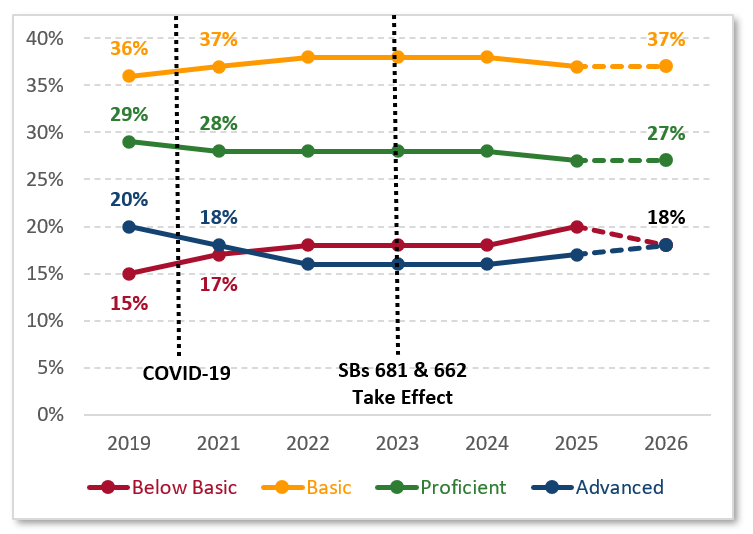
The preliminary results for the 2026 Missouri Assessment Program were recently released to the public. Student performance in mathematics was encouraging, as scores have now surpassed their pre-pandemic levels. Of course, it is still concerning that 27 percent of students scored below basic, and that only 44 percent scored proficient or advanced—meaning less than half of students had a firm grasp on grade-level material.

However, results for English language arts (ELA) were not as positive.

Technically, scores improved. There was a one-percentage-point increase in the number of students who scored advanced, and a two-percentage-point decrease in the number who scored below basic. However, over the last five years, scores have largely remained stagnant.

Not only did ELA scores remain below pre-pandemic levels, they remain below the post-pandemic dip in 2021.

Figure 1: Missouri Assessment Program ELA Scores, 3rd Grade through High School

There was an opportunity to pass proven early literacy reforms in Missouri last year. However, our legislators continued to insist on waiting for past legislation (Senate Bills 681 and 662) to take “full effect.” This raises two key questions:

  1. How long are we going to continue to wait as scores remain stagnant?
  2. Why wait on an unknown when we could pass early literacy reforms that have led to dramatic improvements in other states including Mississippi, Louisiana, Tennessee, Indiana?

One explanation is that Missouri school officials and lawmakers continue to misunderstand how dire the situation is. Missouri should see minor improvements from earlier legislation, but it won’t be enough. We need more substantial reforms, like mandatory third-grade retention and aligning teacher preparation programs with the science of reading. These more serious reforms have been integral to driving huge gains in other states.

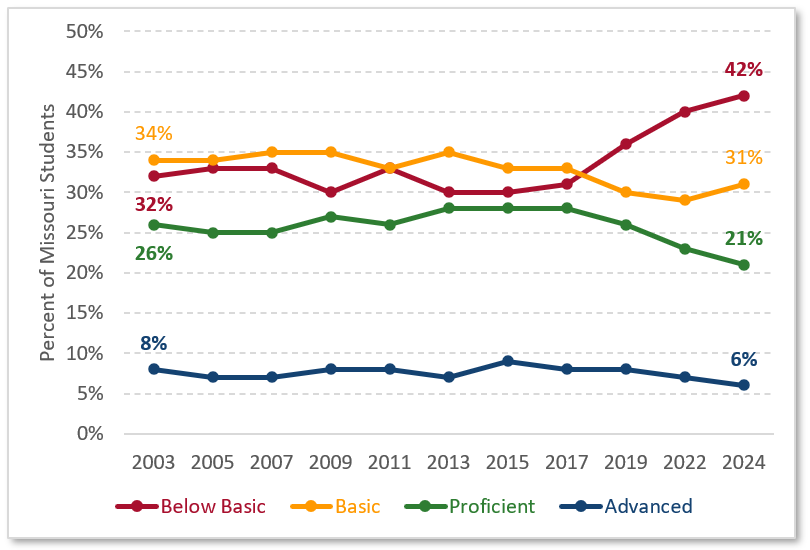
In 2024, 42 percent of Missouri’s fourth graders scored below basic on the National Assessment of Educational Progress (NAEP). In other words, 42 percent of our fourth graders can barely read.

Figure 2: Missouri’s National Assessment of Educational Progress (NAEP) ELA Scores, 4th Grade

We will have another chance to make meaningful reforms during the 2027 legislative session to help more students become confident, capable readers. Given where we are, small reforms with small potential aren’t enough.

Housing in St. Louis Is Affordable, and Has Been for a Long Time

I just saw “Meet Me in St. Louis” at the Muny a few weeks ago, so St. Louis at the start of the 20th century has been on my mind. Now MarketWatch has come out with a report saying that the Midwest in general, and St. Louis in particular, has long had the most affordable housing in America. The report goes back to 1890, and over that time period housing prices in St. Louis have only increased 6 percent more than inflation, which is an amazing statistic. Even in 1904, the Smith family spent a lot less money on their beautiful St. Louis home than they would have if they had moved to New York, like their overly ambitious dad wanted to.

There are several key reasons for St. Louis’s affordable housing; some are good, and some are bad. They all basically relate to supply and demand. We have long had plenty of supply in housing. Even when there was more demand to move to St. Louis, the city (and region) allowed enough housing to be built to meet that demand. However, over the past several decades, as Ness Sandoval has documented, demand to move to St. Louis has greatly diminished. The combination of a large existing housing supply, relatively low barriers to building new supply, and a lack of external demand to move here has resulted in the low cost of housing.

This has nothing to do with St. Louis’s status as an independent city. The report covers the region, not just the city. Baltimore is also an independent city not within a county, and just like St. Louis, it also has had a very high crime rate in recent decades. Its housing costs went up 477 percent relative to inflation.

I’ll let the readers debate the myriad reasons why there’s been an undeniable lack of demand to move to St. Louis over the past half-century (or more). Clearly, the region has many problems, and they’ve persisted for some time.

The explanations on the supply side are more straightforward. Wendell Cox wrote a paper for the Show-Me Institute on this topic. There are a few interrelated factors that keep housing costs down.

Back in the late 1800s and early 1900s, when there was a great deal of demand to live in St. Louis, the region built a lot of housing units to meet that demand. As demand and growth slowed substantially over time, that large housing supply was there to meet demand (in part). The MarketWatch article focuses a lot on this dynamic.

St. Louis local government is heavily fragmented into many municipalities and other taxing entities. There are downsides to fragmentation, but there are good things that come from it, too. One of the best things about our fragmentation is that it makes it harder for the region to agree on centralized plans that place too many limits on growth and burdens on builders. As a result, St. Louis has the most liberal zoning rules of any region in America. Hence, the region has continued to allow plenty of new housing units to be built in places like St. Charles County. This is, of course, a very good thing, and it is a key point in both Wendell Cox’s paper and my recent report.

It’s great that our housing is cheap, but it’s equally important that people actually want to live in St. Louis. The Smith family decided to remain in St. Louis due to the romantic entanglements of their teenage daughters and the looming opening of the World’s Fair. The World’s Fair strategy may have worked for the city in 1904. I don’t think we can count on it to keep people here again.

Missouri’s School Personnel Boom with Avery Frank and Cory Koedel

Susan Pendergrass speaks with Avery Frank, senior policy analyst at the Show-Me Institute, and Cory Koedel, director of education policy at the Show-Me Institute, about their new report on staffing and enrollment trends in Missouri schools over the past 25 years. They discuss why teacher and administrator hiring has grown steadily even as student enrollment declines, what teachers could be earning if staffing levels had stayed flat, the shift in school spending from instruction to support services, whether pensions play a role in the hiring trend, and more.

Read the Report and Visit the Data Dashboard 

Listen on Spotify

Listen on Apple Podcasts 

Listen on SoundCloud

Episode Transcript

Susan Pendergrass (00:02): We are once again gonna be doing a podcast on one of my favorite topics, which is not my favorite topic, actually, demographic changes happening in the state with kids and schools, and I certainly talk about it a lot, but Avery Frank and Cory Koedel are joining me to talk about a paper that you guys will be releasing soon that really puts this into pretty stark relief. Avery, if you could just give a quick summary of what this paper is and what your top line findings are.

Avery Frank (00:32): Well, this paper really was looking at what’s been going on with staffing and enrollment in the past twenty five years in Missouri. Because we know that some people have been saying we have a teacher shortage, and some people are concerned about enrollment. But we wanted to look at, okay, what’s actually the numbers saying about demographics in Missouri school districts. And what we found is generally that there’s a small percentage decrease in enrollment, so we have fewer students than we did 25 years ago. It’s been decreasing. It was a strong decrease after the pandemic. And teachers and administrators, their staffing levels have been steadily growing since 2000. It’s not been like a rapid climb one year. It’s been steadily growing since 2000. So we continue to hire more and more administrators and teachers for fewer students, and especially administrators. Administrators saw very strong growth since 2000.

Susan Pendergrass (01:30): So I wonder, Cory, I’ve been thinking about this because I’ve been talking about it for a few years, and I just got off the radio talking about it, and there’s another article in the Wall Street Journal about it. I feel like this is a major policy conundrum, that ultimately we’re seeing a decline in the number of children, which is going to be one day a decline in the number of people in this country, and the school system should be reacting, but I don’t see a reaction, and I wonder what you think. Is this like, are we in this weird gray area where people are like, great, teacher-student ratios are going down and my son only has eight kids in his math class, this is such a great thing for me. Are we just in this weird in-between time where we’ve decided that this could possibly be a good thing?

Cory Koedel (02:15): Well, that’s a tricky question. I will say, for as long as I can remember, and back before I was born even, every year we just spend more and more on schools. The real dollars just go up and up and up, and that can’t last forever. And an issue that the report points out is that we’re just putting more and more personnel resources in schools, and it’s really just not matching, historically, what the need actually is that schools really have.

The other interesting thing that’s going on is there’s this trade-off between how many people we’re hiring and how much we’re paying them. And the report puts that in stark contrast as well. There’s a lot of talk about teacher shortages, as Avery mentioned, and low teacher pay. Well, there’s no teacher shortage in the sense that we have more teachers per student than ever before. So you can argue about pockets of shortage, and I know Avery has some other work on that, but in terms of the overall workforce, we have more teachers than ever. We seem to be choosing to keep hiring more and more teachers and administrators, as Avery mentioned, rather than pay these people more. And so when there’s polling, people say they want to pay teachers more, but what school districts do instead is they just hire more and more people. So if you think about that pot of money available for salaries as fungible, you can either spend more per teacher or hire more teachers, and we’re consistently choosing the latter.

Susan Pendergrass (03:40): Why do you think that is?

Cory Koedel (03:41): That is a tricky question. I don’t have a good answer for why that is. In the report we talk a little bit about possibilities. The best example I can think of is there’s this perception that students today are much needier than before, and we need more people there to help manage them. The reason I kind of struggle with that explanation is that the data aren’t really consistent with that being a driver of what’s happening, in the sense that when there’s been disruptions of student behavior, so you think about the rise of smartphones, it’s not like a bunch more people were hired right when that happened. We were hiring more people even before smartphones came along.

Common indicators of student disadvantage are related to poverty. Poverty is actually lower today than for most of this century, and there’s been this growth in adult bodies in the schools this whole time. So I don’t know the explanation. I don’t have a good explanation, unfortunately.

Susan Pendergrass (04:42): Yeah, I think about it a lot. And I wonder if twenty years from now we’re not gonna go back to some of the charts you put in this paper and just see this lag, right? So the personnel will just catch up to the number of kids. ‘Cause I just don’t think this current trend can continue indefinitely.

Cory Koedel (04:59): Yeah, I mean, they’ve been going on a long time. I mean, the difference

Susan Pendergrass (05:03): Yeah, mm-hmm.

Cory Koedel (05:05): now is enrollment starting to decline, right? The earlier, like say pre-2000, but we’re really showing the trends from 2000 onward. Pre-2000, this was also happening. So this is really a continuation of a very long-term trend. Before the turn of the century, enrollment was growing, and teachers and administrators were growing faster, but they were both growing. Now we have this weird new dynamic where the student enrollment part is starting to actually fall, and teachers and administrators are still growing. So it’s shifted a little bit, but it’s been going on a really long time. I agree with you, at some point the buck has to stop, but it hasn’t yet.

Susan Pendergrass (05:41): So Avery, I know this is in the paper, and I just want to mention that there’s also a great companion dashboard where you can look at district-level data, but if we had kept student-teacher ratios the same, if they were the same in twenty twenty five as they were in two thousand, how much more could we be paying each teacher?

Avery Frank (06:03): If we fixed it just for the teachers, so if we only did, okay, we’re gonna have the same amount of teachers in two thousand as we do today, which would still be a lower student-teacher ratio because we have fewer students.

Susan Pendergrass (06:14): That’s right. So just the same amount of teachers.

Avery Frank (06:18): If we just kept the same amount of teachers, sorry for the long-winded answer,

Susan Pendergrass (06:21): No, that’s fine.

Avery Frank (06:22): we’d be paid teachers about eight thousand dollars more, and that’s not including if we held administrators the same as well, which is a pretty significant pay

Susan Pendergrass (06:29): So what if we held administrators the same?

Avery Frank (06:31): raise for each teacher. That’d be an average teacher salary increase of eight thousand dollars, so some of course could have more or less.

Susan Pendergrass (06:39): So in other words, the budget wouldn’t go up. The budget would be the same. And at this time we know student growth was going up towards the beginning of the early two thousands, but not so much since then, and now it’s declining. So I understand what you’re saying with teacher-student ratio, but what if we kept administrators the same? How much would we be able to be paying each administrator?

Avery Frank (07:03): If we kept administrators the same, it’d be about a two thousand dollar raise if we kept them the same from two thousand. Now, of course, there would be some pushback on the fact that we’ve had some special education increases which have called for more administrators, or we’ve had some things that do require some administrators. So there is a little bit of reason for there to be growth in administrators, but still, it would still be a significant pay increase. What’s honestly surprising to me in this paper as well is that we don’t even have to go all the way back to 2000, because some people would be like, well, a lot’s changed in twenty-five years.

Susan Pendergrass (07:41): Yeah, yeah.

Avery Frank (07:42): A ton has changed in twenty-five years. But if you go back just to twenty fifteen, if we use the same amount of teachers from twenty fifteen, we would still get a three thousand dollar raise for teachers, which I’m sure a lot of teachers would love, a three thousand dollar raise to their salary. That’s a pretty big raise, and that’s only from ten years ago that we’re seeing these staffing numbers. And we have significantly fewer students now than we did in 2015.

Susan Pendergrass (08:10): Yeah, I’ve heard some folks talking about this idea from the Edunomics Lab at Georgetown. When a district is in declining enrollment, what they can do about their expenses, one recommendation was, ask teachers, if there’s thirty-six third graders and you have three teachers, or you have two teachers and they each get eighteen kids, ask them if they want twelve kids or do they want a five to ten thousand dollar pay raise. And most of the time the teachers will pick the five to ten thousand dollar pay raise to keep the eighteen kids. So I wonder if this isn’t superintendents, administrators, and school boards making these decisions that go against what teachers want, because I suspect that teachers would prefer the higher salary. What do you think?

Cory Koedel (08:57): Well, I certainly think the way they talk, yeah, they would like the higher salary. I think the public wants to give teachers a higher salary. So I think that’s probably quite likely. And these class sizes are very low by historical standards already in most places, certainly in Missouri.

Susan Pendergrass (09:13): And I wonder what will happen, you know, the governor a couple of years ago appointed a task force to look into how we could change the way the state funds schools, the state portion, which is about half of state funding. And if they do what they’re supposed to do and make it more fiscally responsible, then I suspect that what the state’s paying will possibly go down, and certainly for some districts it will go down. And I wonder if that will be the wake-up call, where they realize that in a world that’s based on reality, where money doesn’t just keep going up every year, you have to make trade-offs instead of just assuming that there will always be more money in your account. What do you think, Cory?

Cory Koedel (09:58): Yeah. So my reaction to that is, the flip side of that is, without any constraints on funding, of course they’re just gonna keep over-buying resources, right? There’s no, the school district has no incentive to sit there. What are they supposed to do, just sock money aside and do nothing with it? They’re gonna spend it. So I do think at some point we’re gonna hit a fiscal wall here and have to make some tough choices, and we just haven’t had that happen yet. I will say I’m a little more skeptical than you about the politics of actually reducing spending in some of these districts. At some point, at least the growth in spending has to stop. We just can’t afford it.

Susan Pendergrass (10:31): Right.

Cory Koedel (10:32): But as you know, it’s gonna be a big political fight to do anything to rein in the spending in schools.

Avery Frank (10:39): Our paper talks about how there’s probably some legitimate bureaucratic bloat that is happening in some of these school districts, giving people jobs to be part of the education bureaucracy. But there’s also, I mean, there are some other explanations, as we mentioned earlier, where maybe special education requires hiring more people, or whatever. So I think it would be very interesting. That’s kind of what this paper really wants to do. We want to put the information out there. That’s why we do district-by-district reports

Susan Pendergrass (11:09): Yeah.

Avery Frank (11:10): on how much their growth is, because maybe a teacher from Rockwood could look and see this huge growth in administrators and be like, that’s not right, there’s no reason for administrators to grow X amount of percent. I think that’s one of the strengths of this paper we’ve written, that it gives people information to look at their own individual district and be like, this isn’t right, we don’t need this many administrators, what’s going on here?

Susan Pendergrass (11:35): Yeah, I agree. I wonder though if it isn’t an artifact of the fact that the teaching career path is kind of limited, right? So if you want to advance as a teacher, generally they go to administration, because we don’t have it set up with lead teachers like some other countries do, you’re just on your step and ladder until you join administration, and if you’re sort of a gung-ho teacher, that might be where you have to go. And maybe that’s why we see the increase in administration. I will say that you broke this out by locale, and the suburban school districts kind of surprised me, because they’ve had almost a fifty percent increase in the number of administrators since two thousand. Like fifty percent. We don’t have more suburban districts that I’m aware of, right? So that one kind of surprised me.

Cory Koedel (12:24): Yeah, there’s been really large increases. But Susan, I do want to push back a little bit on what you said about, you know, we lack this career path for teachers, so they want to be administrators. It is quite a jump in economic logic to then say we will just have more administrator jobs. Just because people want certain jobs doesn’t mean they’re gonna exist. Certainly in a well-functioning market, that would never happen, it couldn’t survive competition. But the idea that we’re just sort of creating these extra administrative jobs because people want them is inefficient, and if that were true, that would be a big source of spending inefficiency.

Susan Pendergrass (13:00): So what do you think it is?

Cory Koedel (13:01): Look, I think Avery makes a good point that there are more and more administrative rules and regulations put on schools that they have to respond to, and someone could argue that’s a legitimate reason to need more administrators. I would push back on that as well and say maybe we should just cut back on all of the regulations and red tape we’re putting on all these schools so we have fewer administrators. If the schools could function twenty-five years ago with so many fewer administrators, and a lot of people today, myself included, went to school then and it seemed fine, why do we have to add all of this stuff? Is it really doing any good, or is it just a bunch of make-work that the taxpayers are stuck footing the bill for?

Susan Pendergrass (13:41): Yeah, so you guys are gonna have a dashboard on the Show Me Institute website that allows people to look at each district and see how their enrollment, number of teachers, number of support staff, and number of administrators has changed. But I will also make a plug for MoSchoolRankings and our finance data, because when I look at that at the district level, I’m with you, Cory, where I see a lot of spending categories like marketing, legal, a lot of things that I assume are either growing or new, that districts used to manage without that amount of what looks like red tape to me, and then you need people to manage it and also report on it. But I’m kind of surprised, you’ve looked at this, Avery, how funding has shifted from instruction to support, right?

Avery Frank (14:30): Yes, I think this is off the top of my head, I believe it was like forty-nine percent in twenty thirteen for instruction, and now today it’s about forty-two percent, while support services is just a few percentage points below it, ’cause you have non-instruction and support growing, and our share of instructional expenses continues to go down, and that’s a very interesting trend, to be honest. At the same time that’s happening, our student-to-teacher ratio is about twelve, which is below, the national average is fifteen. So it’s like we have more teachers per student, but we also have more administrators, and we’re also spending a higher percentage share on administrators. So there’s a lot of different interesting trends going on in Missouri schools. And I do think the reevaluation of the funding formula in general will have to make us answer a lot of really hard questions, because there are a lot of abnormalities in our

Yeah.

Susan Pendergrass (15:30): And certainly in the midst of this personnel boom, we haven’t seen any boom in test scores. Right? To say that we needed this many

Cory Koedel (15:38): Yep, that’s right.

Susan Pendergrass (15:39): people, that’s a tough argument to make, because we’ve been flat and declining when it comes to test scores. But I think that this is great insofar as putting the information in front of people so that we can reevaluate what we’re doing, and maybe we can’t reevaluate five hundred and twenty districts, but the fact is that people are making choices. Boards and administrators making choices. And what they’re choosing is to hire more people instead of paying their existing people more. And that is a fundamental trade-off. And I’m not sure that people realize it’s being made, especially the people that are directly impacted by it. And I think it’s worthwhile to put it out there, because I feel like the teachers are the ones kind of getting the short end of the stick. If I remember correctly, on an inflation-adjusted basis, teacher salaries have gone down. Is that right in the state?

Cory Koedel (16:25): Yep, that’s

Susan Pendergrass (16:25): So

Cory Koedel (16:26): correct.

Susan Pendergrass (16:26): So in fact, teachers are taking this pretty negative situation as a trade-off for having more teachers, and I think we should either bring them to the table to participate in that decision-making, or hold school boards and administrators more accountable. Do you think pensions play into this at all, Cory?

Cory Koedel (16:46): So before I get to the pensions question, I

Susan Pendergrass (16:49): Yes.

Cory Koedel (16:49): wanna come back to what you mentioned, teachers bearing the brunt of this with the lower salaries. I also think we’re all bearing the brunt of it. It depends on how you think things work. But my view, I would rather elevate the prestige of the teaching profession, and by paying more, make it a more professional job where teachers can go in and teach and do what they’re supposed to do. I think that benefits everybody and will lead to stronger schools for everybody. It kind of depends on your view of the world and how you think this functions, but just hiring a bunch more people at low pay, it’s not obvious that’s the best way to have strong schools. So it’s not just the teachers, it’s all of us that are potentially being harmed by this trade-off. The pension issue, and I know you’ve talked about this before, Susan, so it shouldn’t be new, but the pension system in Missouri, like a lot of states, is kind of like a Ponzi scheme. It’s not supposed to be. Every cohort is supposed to self-fund their pensions, but the way these plans work is they end up accruing debt, and then newer generations of teachers have to pay down that debt as they’re going through the workforce. And that’s been going on for decades. So you could argue that this is all a big master plan of teacher

Susan Pendergrass (18:01): Ha ha ha.

Cory Koedel (18:02): unions, or someone who understands that they just need more bodies to pay the pension debt. I personally don’t believe this is such a coordinated effort that it really makes sense as a theory for why this is happening. It certainly helps the pension finances that they keep having a broader and broader base to pull from to fund the pension plan. I would also add, for teachers in the pension plan, they shouldn’t care one way or another. They don’t need more teachers to pay their pensions. Their pensions are going to get paid regardless, unless districts in the state go bankrupt. It’s a very guaranteed benefit. They’re gonna get the money one way or another. So it’s kind of a convoluted argument to get there on the pensions, in my opinion.

Susan Pendergrass (18:46): But as we keep hiring more teachers, there’s gonna be more people with guaranteed benefits, right? It’s going to get more

Cory Koedel (18:51): Sure, no, yeah.

Susan Pendergrass (18:52): expensive.

Cory Koedel (18:53): No, we’re accruing more and more debt the more we do this, that’s right.

Susan Pendergrass (18:57): Well, what I appreciate about this paper and the kind of companion piece on the teacher shortage and the teacher pipeline is, I’d never want to be accused of being anti-teacher. I think it’s a very hard job, and certainly I appreciate that people want to do it, and that there are some really great teachers out there. But I think that these papers are so important in shining light on the fact that we could be talking about it in a more nuanced way, which isn’t just to say we either support teachers or we don’t support teachers. We support teachers with good information, like what’s happening to their salaries, and whether there really is a shortage or not, so that we can all better understand the profession. Because I think right now it’s just held up as this weird thing where altruistic people take low salaries for the hardest job in the world, and I just don’t think that’s a good description of what’s going on there.

Cory Koedel (19:52): Yeah, I’m glad you said that. I don’t think depending on altruism is a good model for such a big portion of the workforce, like you said, and there’s this idea that if you raise any issues with how the market’s functioning, you’re anti-teacher. I just don’t think that makes sense. Personally, the first thing I would want to do out of this is pay teachers more. And I’m sitting there looking at a pot of money that could be used to do that, and we’re not. I also recognize the practical reality, there’s not a big money dump coming in the future. And like you mentioned earlier in

Susan Pendergrass (20:21): Yeah.

Cory Koedel (20:21): the podcast, we may have to have spending cuts. So what are we gonna do? So I do think this is not an anti-teacher issue, but it’s about having a thoughtful discussion about how to manage the teacher workforce and get good people in classrooms and keep them there.

Susan Pendergrass (20:35): Yeah, well that’s great. I appreciate you both coming on and talking about it. I’m sure a lot of people look forward to reading the papers, both this one on the Personnel Boom and the one on the teacher pipeline, and the Personnel Boom data dashboard, which will be on the Show Me Institute website. Thanks so much.

Cory Koedel (20:52): Thanks for having us.

Avery Frank (20:52): Thanks.

Produced by Show-Me Opportunity

Support Us

The work of the Show-Me Institute would not be possible without the generous support of people who are inspired by the vision of liberty and free enterprise. We hope you will join our efforts and become a Show-Me Institute sponsor.

Donate
Man on Horse Charging