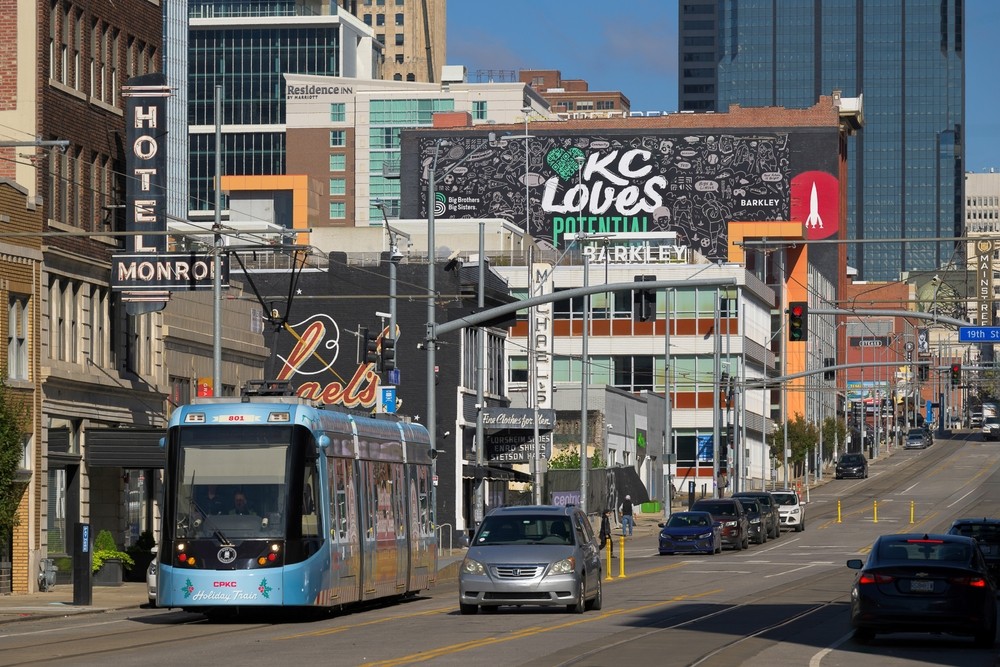
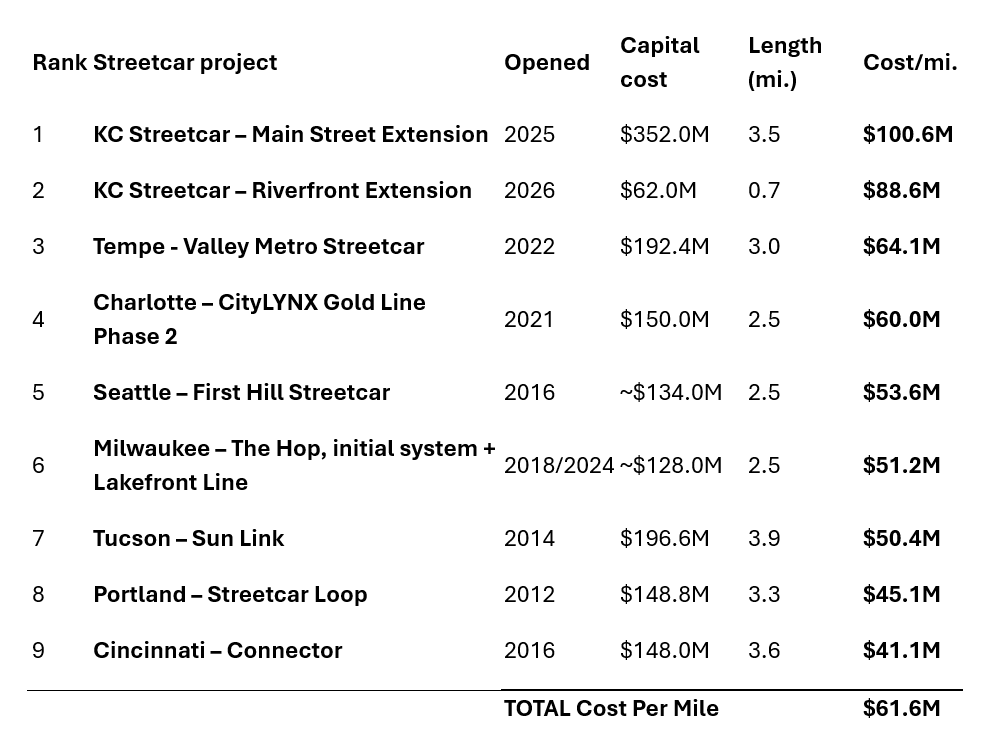
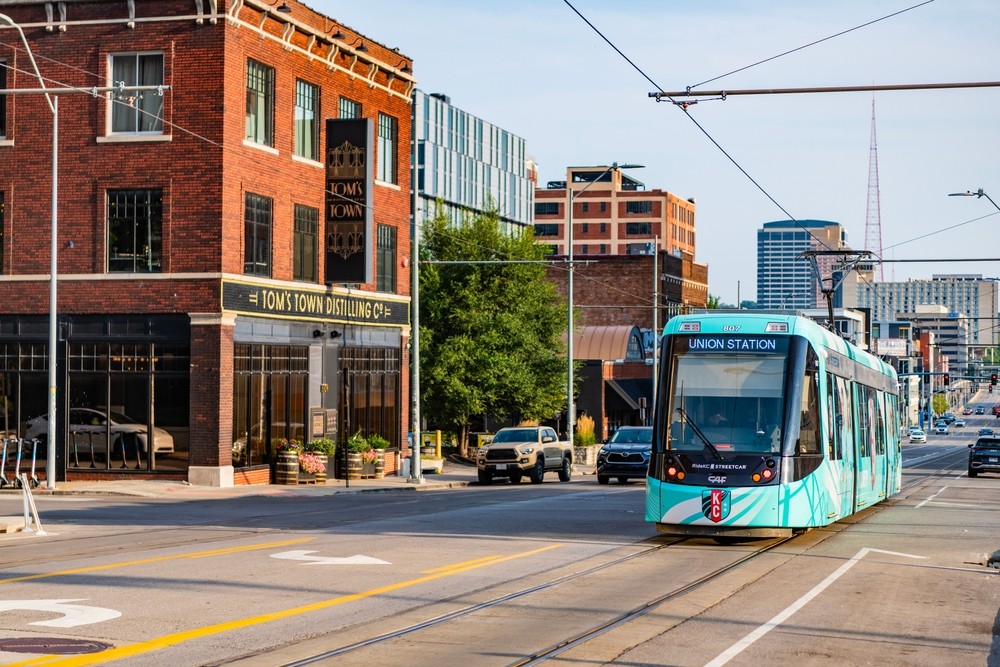
Kansas City just spent over $100 million per mile for its Main Street streetcar extension, making it the most expensive system per mile in the United States. Last year, Randall O’Toole estimated that the average streetcar cost per mile is around $91 million. It’s worth looking at some recent examples to see if that number is accurate.
Looking at recently opened systems (see table below), the cost per mile seems to be lower, at about $61.6 million. Note that I am excluding the yet-to-be opened Orange County line, which may run as much as $156 million per mile, and the Sacramento line (~$47.7 million per mile), which had been paused because of construction costs.
Former Kansas City City Manager Brian Platt told KCUR radio in 2024: “These things cost $150 million per mile.” That’s way off the mark, but important because Kansas City is considering a few other extensions to the streetcar line. If $150 million per mile is the baseline cost, streetcar passengers won’t be the only ones taken for a ride.
In a recent essay for the Missouri Independent, I responded to an op-ed in The Kansas City Star by former Kansas City Mayor Sly James. In the piece, he extolled the streetcar for helping the city grow, and claimed the streetcar is an opportunity to bring the city together.
The mayor’s piece was mostly fluff—and several assertions he made were flatly wrong. One of them involved the success of the streetcar to drive the city’s economic growth, using sales tax receipts as evidence.
I first learned of this claim after I authored a piece in the Star in July 2024. In that column—and here on the Show-Me Institute website—I used property tax assessment data provided by Jackson County. From 2014 through 2023, the total value of the streetcar transportation development district (TDD), which runs along the entire route of the streetcar, grew at the same rate as the county as a whole. If the streetcar were truly a driver of economic development, one would expect to see the values in the TDD rise faster.
The streetcar authority, in a May 6, 2019, press release, does provide evidence of increases in total market value within the TDD, but it doesn’t go the extra—and necessary—step of comparing it to the county. Such growth may seem impressive, until you realize it was happening in places nowhere near the streetcar.
Even if the streetcar TDD property values had risen faster than property values elsewhere, it’s possible that the cause was something other than the streetcar. It could have been due to the number of other development subsidies handed out along the route. But the data show us that there is no growth, regardless of the reason.
After the piece was published, streetcar supporters alluded to the growth in sales tax receipts within the TDD, but did not share any information to back up this claim. James refers to this too in his recent piece, writing: “Sales tax receipts generated within the Transportation Development District surged by more than 65% following the line’s opening — far outpacing citywide growth.”
It appears that the source of these data is a 2019 article in Metro magazine in which the head of the KC Streetcar Authority, Tom Gerend, writes:
Sales taxes within the streetcar’s downtown Transportation Development District, a revenue-generation mechanism, have increased by 65% compared with approximately 16% growth citywide over the same period. Downtown is growing at a faster rate than the city as a whole and proving to be a strong economic engine.
That claim is from a press release dated September 14, 2016, on the streetcar authority’s own website. It reports that sales tax receipts grew by 58% from 2014 through 2016, versus 16% citywide. That May 6, 2019, press release repeats the sales tax increase claim, except at 60%.
Let us assume some version of these numbers is true. The TDD is a small district, and it is entirely plausible that even two or three downtown venues saw a big growth in their sales tax receipts. That may account for such impressive growth in a small district that wouldn’t cause much of a ripple citywide. What it doesn’t tell us is whether that sales tax growth was throughout the TDD, or whether it was due to the streetcar. That’s clearly what streetcar supporters want readers to believe. They may believe it themselves.
It reminds me of what former Show-Me Institute researcher Joe Miller uncovered in June 2016: even the Federal Transit Administration pointed out that “Almost all [civic] representatives interviewed believed that streetcars positively affected the built environment, particularly in attracting new development. . . . Few, if any, streetcar system operators seek information on their impact on economic activity, although most interviewed consider economic-related questions to be vital and desire further research on this topic.”
That’s damning.
Streetcar operators believe it; they just can’t prove it. Apparently they don’t even try.
Kansas City is considering expanding the streetcar system. We will likely hear all these economic benefit claims again. But until we see meaningful data, the claims can’t be taken seriously.
We just released our new report, Missouri’s 21st Century Public School Personnel Boom, at showmeinstitute.org. The report documents how the growth of Missouri’s teaching and administrative staff has greatly outpaced growth in student enrollment since the year 2000. In fact, student enrollment has declined slightly (-4 percent), while Missouri schools have added significantly more teachers (+13 percent) and more administrators (+35 percent).
The growth in administrators is especially pronounced. And a recurring question has come up since we released the report: Is the administrator boom attributable to the rise of diversity, equity, and inclusion (DEI) programs in public schools?
While it is possible that DEI initiatives account for some of the growth in administrators, most of it appears to be unrelated. How do we know? Because the administrator growth trend was well underway before DEI became widespread in public schools. DEI initiatives largely emerged as a distinct institutional framework in the mid- to late 2010s, but administrative staffing in Missouri schools had been increasing fairly consistently since at least 2000. From 2000 to 2015, prior to DEI becoming widespread, administrator positions grew by about 15 percent against flat student enrollment.
Could DEI have contributed to the more recent growth in school administrators? Perhaps. The growth rate has accelerated since 2015, which roughly coincides with the rise of DEI. But we do not have clear evidence establishing a connection between the two, and other factors could be responsible. For example, aside from the short-lived COVID recession, the economy has generally been strong over this period. When the economy booms and tax coffers are flush, we tend to spend more on everything, including schools.
Put differently, it is not obvious that there would be fewer administrators today if DEI had never taken hold in public schools. Schools may simply have found other initiatives or priorities to justify expanding their administrative staff, with the same underlying result.
Our report is meant to be informational. It documents what has happened: Missouri schools have added substantial numbers of teachers and administrators even as student enrollment has declined. But it does not tell us why this has happened. We hope the report spurs further inquiry into the reasons behind Missouri’s public school personnel boom.
The preliminary results for the 2026 Missouri Assessment Program were recently released to the public. Student performance in mathematics was encouraging, as scores have now surpassed their pre-pandemic levels. Of course, it is still concerning that 27 percent of students scored below basic, and that only 44 percent scored proficient or advanced—meaning less than half of students had a firm grasp on grade-level material.
However, results for English language arts (ELA) were not as positive.
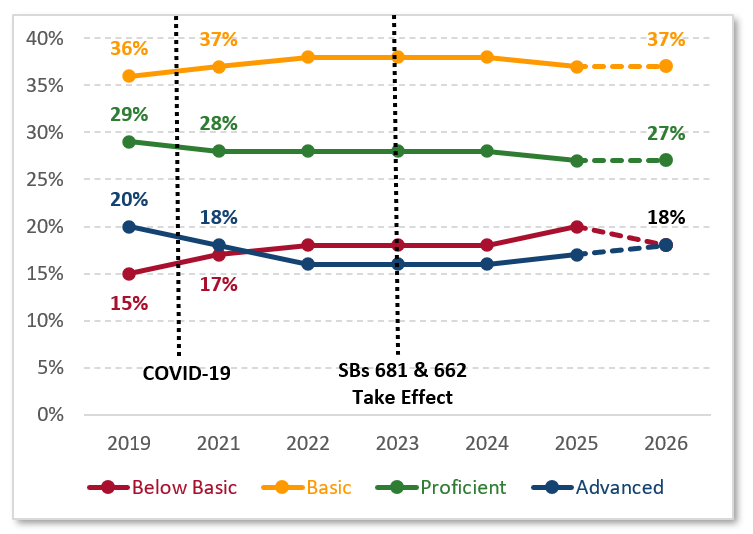
Technically, scores improved. There was a one-percentage-point increase in the number of students who scored advanced, and a two-percentage-point decrease in the number who scored below basic. However, over the last five years, scores have largely remained stagnant.
Not only did ELA scores remain below pre-pandemic levels, they remain below the post-pandemic dip in 2021.
Figure 1: Missouri Assessment Program ELA Scores, 3rd Grade through High School
There was an opportunity to pass proven early literacy reforms in Missouri last year. However, our legislators continued to insist on waiting for past legislation (Senate Bills 681 and 662) to take “full effect.” This raises two key questions:
How long are we going to continue to wait as scores remain stagnant?
Why wait on an unknown when we could pass early literacy reforms that have led to dramatic improvements in other states including Mississippi, Louisiana, Tennessee, Indiana?
One explanation is that Missouri school officials and lawmakers continue to misunderstand how dire the situation is. Missouri should see minor improvements from earlier legislation, but it won’t be enough. We need more substantial reforms, like mandatory third-grade retention and aligning teacher preparation programs with the science of reading. These more serious reforms have been integral to driving huge gains in other states.
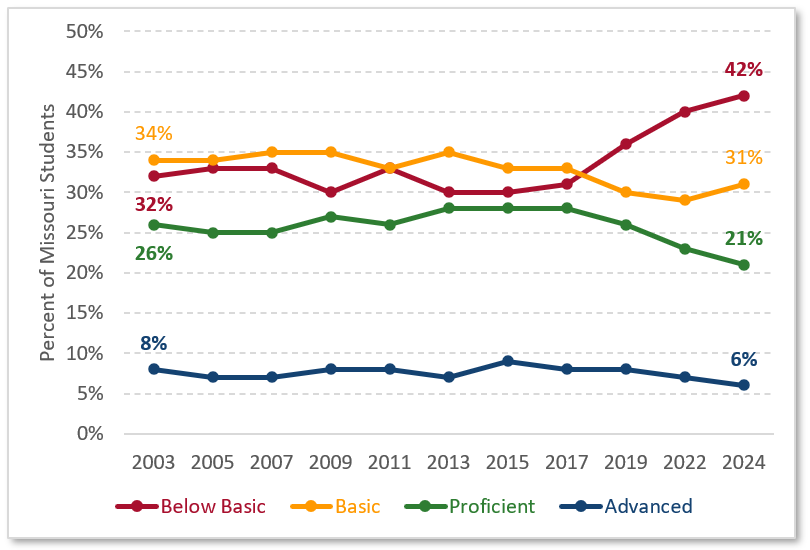
In 2024, 42 percent of Missouri’s fourth graders scored below basic on the National Assessment of Educational Progress (NAEP). In other words, 42 percent of our fourth graders can barely read.
Figure 2: Missouri’s National Assessment of Educational Progress (NAEP) ELA Scores, 4th Grade
We will have another chance to make meaningful reforms during the 2027 legislative session to help more students become confident, capable readers. Given where we are, small reforms with small potential aren’t enough.
I just saw “Meet Me in St. Louis” at the Muny a few weeks ago, so St. Louis at the start of the 20th century has been on my mind. Now MarketWatch has come out with a report saying that the Midwest in general, and St. Louis in particular, has long had the most affordable housing in America. The report goes back to 1890, and over that time period housing prices in St. Louis have only increased 6 percent more than inflation, which is an amazing statistic. Even in 1904, the Smith family spent a lot less money on their beautiful St. Louis home than they would have if they had moved to New York, like their overly ambitious dad wanted to.
There are several key reasons for St. Louis’s affordable housing; some are good, and some are bad. They all basically relate to supply and demand. We have long had plenty of supply in housing. Even when there was more demand to move to St. Louis, the city (and region) allowed enough housing to be built to meet that demand. However, over the past several decades, as Ness Sandoval has documented, demand to move to St. Louis has greatly diminished. The combination of a large existing housing supply, relatively low barriers to building new supply, and a lack of external demand to move here has resulted in the low cost of housing.
This has nothing to do with St. Louis’s status as an independent city. The report covers the region, not just the city. Baltimore is also an independent city not within a county, and just like St. Louis, it also has had a very high crime rate in recent decades. Its housing costs went up 477 percent relative to inflation.
I’ll let the readers debate the myriad reasons why there’s been an undeniable lack of demand to move to St. Louis over the past half-century (or more). Clearly, the region has many problems, and they’ve persisted for some time.
Back in the late 1800s and early 1900s, when there was a great deal of demand to live in St. Louis, the region built a lot of housing units to meet that demand. As demand and growth slowed substantially over time, that large housing supply was there to meet demand (in part). The MarketWatch article focuses a lot on this dynamic.
St. Louis local government is heavily fragmented into many municipalities and other taxing entities. There are downsides to fragmentation, but there are good things that come from it, too. One of the best things about our fragmentation is that it makes it harder for the region to agree on centralized plans that place too many limits on growth and burdens on builders. As a result, St. Louis has the most liberal zoning rules of any region in America. Hence, the region has continued to allow plenty of new housing units to be built in places like St. Charles County. This is, of course, a very good thing, and it is a key point in both Wendell Cox’s paper and my recent report.
It’s great that our housing is cheap, but it’s equally important that people actually want to live in St. Louis. The Smith family decided to remain in St. Louis due to the romantic entanglements of their teenage daughters and the looming opening of the World’s Fair. The World’s Fair strategy may have worked for the city in 1904. I don’t think we can count on it to keep people here again.
Susan Pendergrass speaks with Avery Frank, senior policy analyst at the Show-Me Institute, and Cory Koedel, director of education policy at the Show-Me Institute, about their new report on staffing and enrollment trends in Missouri schools over the past 25 years. They discuss why teacher and administrator hiring has grown steadily even as student enrollment declines, what teachers could be earning if staffing levels had stayed flat, the shift in school spending from instruction to support services, whether pensions play a role in the hiring trend, and more.
Susan Pendergrass (00:02): We are once again gonna be doing a podcast on one of my favorite topics, which is not my favorite topic, actually, demographic changes happening in the state with kids and schools, and I certainly talk about it a lot, but Avery Frank and Cory Koedel are joining me to talk about a paper that you guys will be releasing soon that really puts this into pretty stark relief. Avery, if you could just give a quick summary of what this paper is and what your top line findings are.
Avery Frank (00:32): Well, this paper really was looking at what’s been going on with staffing and enrollment in the past twenty five years in Missouri. Because we know that some people have been saying we have a teacher shortage, and some people are concerned about enrollment. But we wanted to look at, okay, what’s actually the numbers saying about demographics in Missouri school districts. And what we found is generally that there’s a small percentage decrease in enrollment, so we have fewer students than we did 25 years ago. It’s been decreasing. It was a strong decrease after the pandemic. And teachers and administrators, their staffing levels have been steadily growing since 2000. It’s not been like a rapid climb one year. It’s been steadily growing since 2000. So we continue to hire more and more administrators and teachers for fewer students, and especially administrators. Administrators saw very strong growth since 2000.
Susan Pendergrass (01:30): So I wonder, Cory, I’ve been thinking about this because I’ve been talking about it for a few years, and I just got off the radio talking about it, and there’s another article in the Wall Street Journal about it. I feel like this is a major policy conundrum, that ultimately we’re seeing a decline in the number of children, which is going to be one day a decline in the number of people in this country, and the school system should be reacting, but I don’t see a reaction, and I wonder what you think. Is this like, are we in this weird gray area where people are like, great, teacher-student ratios are going down and my son only has eight kids in his math class, this is such a great thing for me. Are we just in this weird in-between time where we’ve decided that this could possibly be a good thing?
Cory Koedel (02:15): Well, that’s a tricky question. I will say, for as long as I can remember, and back before I was born even, every year we just spend more and more on schools. The real dollars just go up and up and up, and that can’t last forever. And an issue that the report points out is that we’re just putting more and more personnel resources in schools, and it’s really just not matching, historically, what the need actually is that schools really have.
The other interesting thing that’s going on is there’s this trade-off between how many people we’re hiring and how much we’re paying them. And the report puts that in stark contrast as well. There’s a lot of talk about teacher shortages, as Avery mentioned, and low teacher pay. Well, there’s no teacher shortage in the sense that we have more teachers per student than ever before. So you can argue about pockets of shortage, and I know Avery has some other work on that, but in terms of the overall workforce, we have more teachers than ever. We seem to be choosing to keep hiring more and more teachers and administrators, as Avery mentioned, rather than pay these people more. And so when there’s polling, people say they want to pay teachers more, but what school districts do instead is they just hire more and more people. So if you think about that pot of money available for salaries as fungible, you can either spend more per teacher or hire more teachers, and we’re consistently choosing the latter.
Susan Pendergrass (03:40): Why do you think that is?
Cory Koedel (03:41): That is a tricky question. I don’t have a good answer for why that is. In the report we talk a little bit about possibilities. The best example I can think of is there’s this perception that students today are much needier than before, and we need more people there to help manage them. The reason I kind of struggle with that explanation is that the data aren’t really consistent with that being a driver of what’s happening, in the sense that when there’s been disruptions of student behavior, so you think about the rise of smartphones, it’s not like a bunch more people were hired right when that happened. We were hiring more people even before smartphones came along.
Common indicators of student disadvantage are related to poverty. Poverty is actually lower today than for most of this century, and there’s been this growth in adult bodies in the schools this whole time. So I don’t know the explanation. I don’t have a good explanation, unfortunately.
Susan Pendergrass (04:42): Yeah, I think about it a lot. And I wonder if twenty years from now we’re not gonna go back to some of the charts you put in this paper and just see this lag, right? So the personnel will just catch up to the number of kids. ‘Cause I just don’t think this current trend can continue indefinitely.
Cory Koedel (04:59): Yeah, I mean, they’ve been going on a long time. I mean, the difference
Susan Pendergrass (05:03): Yeah, mm-hmm.
Cory Koedel (05:05): now is enrollment starting to decline, right? The earlier, like say pre-2000, but we’re really showing the trends from 2000 onward. Pre-2000, this was also happening. So this is really a continuation of a very long-term trend. Before the turn of the century, enrollment was growing, and teachers and administrators were growing faster, but they were both growing. Now we have this weird new dynamic where the student enrollment part is starting to actually fall, and teachers and administrators are still growing. So it’s shifted a little bit, but it’s been going on a really long time. I agree with you, at some point the buck has to stop, but it hasn’t yet.
Susan Pendergrass (05:41): So Avery, I know this is in the paper, and I just want to mention that there’s also a great companion dashboard where you can look at district-level data, but if we had kept student-teacher ratios the same, if they were the same in twenty twenty five as they were in two thousand, how much more could we be paying each teacher?
Avery Frank (06:03): If we fixed it just for the teachers, so if we only did, okay, we’re gonna have the same amount of teachers in two thousand as we do today, which would still be a lower student-teacher ratio because we have fewer students.
Susan Pendergrass (06:14): That’s right. So just the same amount of teachers.
Avery Frank (06:18): If we just kept the same amount of teachers, sorry for the long-winded answer,
Susan Pendergrass (06:21): No, that’s fine.
Avery Frank (06:22): we’d be paid teachers about eight thousand dollars more, and that’s not including if we held administrators the same as well, which is a pretty significant pay
Susan Pendergrass (06:29): So what if we held administrators the same?
Avery Frank (06:31): raise for each teacher. That’d be an average teacher salary increase of eight thousand dollars, so some of course could have more or less.
Susan Pendergrass (06:39): So in other words, the budget wouldn’t go up. The budget would be the same. And at this time we know student growth was going up towards the beginning of the early two thousands, but not so much since then, and now it’s declining. So I understand what you’re saying with teacher-student ratio, but what if we kept administrators the same? How much would we be able to be paying each administrator?
Avery Frank (07:03): If we kept administrators the same, it’d be about a two thousand dollar raise if we kept them the same from two thousand. Now, of course, there would be some pushback on the fact that we’ve had some special education increases which have called for more administrators, or we’ve had some things that do require some administrators. So there is a little bit of reason for there to be growth in administrators, but still, it would still be a significant pay increase. What’s honestly surprising to me in this paper as well is that we don’t even have to go all the way back to 2000, because some people would be like, well, a lot’s changed in twenty-five years.
Susan Pendergrass (07:41): Yeah, yeah.
Avery Frank (07:42): A ton has changed in twenty-five years. But if you go back just to twenty fifteen, if we use the same amount of teachers from twenty fifteen, we would still get a three thousand dollar raise for teachers, which I’m sure a lot of teachers would love, a three thousand dollar raise to their salary. That’s a pretty big raise, and that’s only from ten years ago that we’re seeing these staffing numbers. And we have significantly fewer students now than we did in 2015.
Susan Pendergrass (08:10): Yeah, I’ve heard some folks talking about this idea from the Edunomics Lab at Georgetown. When a district is in declining enrollment, what they can do about their expenses, one recommendation was, ask teachers, if there’s thirty-six third graders and you have three teachers, or you have two teachers and they each get eighteen kids, ask them if they want twelve kids or do they want a five to ten thousand dollar pay raise. And most of the time the teachers will pick the five to ten thousand dollar pay raise to keep the eighteen kids. So I wonder if this isn’t superintendents, administrators, and school boards making these decisions that go against what teachers want, because I suspect that teachers would prefer the higher salary. What do you think?
Cory Koedel (08:57): Well, I certainly think the way they talk, yeah, they would like the higher salary. I think the public wants to give teachers a higher salary. So I think that’s probably quite likely. And these class sizes are very low by historical standards already in most places, certainly in Missouri.
Susan Pendergrass (09:13): And I wonder what will happen, you know, the governor a couple of years ago appointed a task force to look into how we could change the way the state funds schools, the state portion, which is about half of state funding. And if they do what they’re supposed to do and make it more fiscally responsible, then I suspect that what the state’s paying will possibly go down, and certainly for some districts it will go down. And I wonder if that will be the wake-up call, where they realize that in a world that’s based on reality, where money doesn’t just keep going up every year, you have to make trade-offs instead of just assuming that there will always be more money in your account. What do you think, Cory?
Cory Koedel (09:58): Yeah. So my reaction to that is, the flip side of that is, without any constraints on funding, of course they’re just gonna keep over-buying resources, right? There’s no, the school district has no incentive to sit there. What are they supposed to do, just sock money aside and do nothing with it? They’re gonna spend it. So I do think at some point we’re gonna hit a fiscal wall here and have to make some tough choices, and we just haven’t had that happen yet. I will say I’m a little more skeptical than you about the politics of actually reducing spending in some of these districts. At some point, at least the growth in spending has to stop. We just can’t afford it.
Susan Pendergrass (10:31): Right.
Cory Koedel (10:32): But as you know, it’s gonna be a big political fight to do anything to rein in the spending in schools.
Avery Frank (10:39): Our paper talks about how there’s probably some legitimate bureaucratic bloat that is happening in some of these school districts, giving people jobs to be part of the education bureaucracy. But there’s also, I mean, there are some other explanations, as we mentioned earlier, where maybe special education requires hiring more people, or whatever. So I think it would be very interesting. That’s kind of what this paper really wants to do. We want to put the information out there. That’s why we do district-by-district reports
Susan Pendergrass (11:09): Yeah.
Avery Frank (11:10): on how much their growth is, because maybe a teacher from Rockwood could look and see this huge growth in administrators and be like, that’s not right, there’s no reason for administrators to grow X amount of percent. I think that’s one of the strengths of this paper we’ve written, that it gives people information to look at their own individual district and be like, this isn’t right, we don’t need this many administrators, what’s going on here?
Susan Pendergrass (11:35): Yeah, I agree. I wonder though if it isn’t an artifact of the fact that the teaching career path is kind of limited, right? So if you want to advance as a teacher, generally they go to administration, because we don’t have it set up with lead teachers like some other countries do, you’re just on your step and ladder until you join administration, and if you’re sort of a gung-ho teacher, that might be where you have to go. And maybe that’s why we see the increase in administration. I will say that you broke this out by locale, and the suburban school districts kind of surprised me, because they’ve had almost a fifty percent increase in the number of administrators since two thousand. Like fifty percent. We don’t have more suburban districts that I’m aware of, right? So that one kind of surprised me.
Cory Koedel (12:24): Yeah, there’s been really large increases. But Susan, I do want to push back a little bit on what you said about, you know, we lack this career path for teachers, so they want to be administrators. It is quite a jump in economic logic to then say we will just have more administrator jobs. Just because people want certain jobs doesn’t mean they’re gonna exist. Certainly in a well-functioning market, that would never happen, it couldn’t survive competition. But the idea that we’re just sort of creating these extra administrative jobs because people want them is inefficient, and if that were true, that would be a big source of spending inefficiency.
Susan Pendergrass (13:00): So what do you think it is?
Cory Koedel (13:01): Look, I think Avery makes a good point that there are more and more administrative rules and regulations put on schools that they have to respond to, and someone could argue that’s a legitimate reason to need more administrators. I would push back on that as well and say maybe we should just cut back on all of the regulations and red tape we’re putting on all these schools so we have fewer administrators. If the schools could function twenty-five years ago with so many fewer administrators, and a lot of people today, myself included, went to school then and it seemed fine, why do we have to add all of this stuff? Is it really doing any good, or is it just a bunch of make-work that the taxpayers are stuck footing the bill for?
Susan Pendergrass (13:41): Yeah, so you guys are gonna have a dashboard on the Show Me Institute website that allows people to look at each district and see how their enrollment, number of teachers, number of support staff, and number of administrators has changed. But I will also make a plug for MoSchoolRankings and our finance data, because when I look at that at the district level, I’m with you, Cory, where I see a lot of spending categories like marketing, legal, a lot of things that I assume are either growing or new, that districts used to manage without that amount of what looks like red tape to me, and then you need people to manage it and also report on it. But I’m kind of surprised, you’ve looked at this, Avery, how funding has shifted from instruction to support, right?
Avery Frank (14:30): Yes, I think this is off the top of my head, I believe it was like forty-nine percent in twenty thirteen for instruction, and now today it’s about forty-two percent, while support services is just a few percentage points below it, ’cause you have non-instruction and support growing, and our share of instructional expenses continues to go down, and that’s a very interesting trend, to be honest. At the same time that’s happening, our student-to-teacher ratio is about twelve, which is below, the national average is fifteen. So it’s like we have more teachers per student, but we also have more administrators, and we’re also spending a higher percentage share on administrators. So there’s a lot of different interesting trends going on in Missouri schools. And I do think the reevaluation of the funding formula in general will have to make us answer a lot of really hard questions, because there are a lot of abnormalities in our
Yeah.
Susan Pendergrass (15:30): And certainly in the midst of this personnel boom, we haven’t seen any boom in test scores. Right? To say that we needed this many
Cory Koedel (15:38): Yep, that’s right.
Susan Pendergrass (15:39): people, that’s a tough argument to make, because we’ve been flat and declining when it comes to test scores. But I think that this is great insofar as putting the information in front of people so that we can reevaluate what we’re doing, and maybe we can’t reevaluate five hundred and twenty districts, but the fact is that people are making choices. Boards and administrators making choices. And what they’re choosing is to hire more people instead of paying their existing people more. And that is a fundamental trade-off. And I’m not sure that people realize it’s being made, especially the people that are directly impacted by it. And I think it’s worthwhile to put it out there, because I feel like the teachers are the ones kind of getting the short end of the stick. If I remember correctly, on an inflation-adjusted basis, teacher salaries have gone down. Is that right in the state?
Cory Koedel (16:25): Yep, that’s
Susan Pendergrass (16:25): So
Cory Koedel (16:26): correct.
Susan Pendergrass (16:26): So in fact, teachers are taking this pretty negative situation as a trade-off for having more teachers, and I think we should either bring them to the table to participate in that decision-making, or hold school boards and administrators more accountable. Do you think pensions play into this at all, Cory?
Cory Koedel (16:46): So before I get to the pensions question, I
Susan Pendergrass (16:49): Yes.
Cory Koedel (16:49): wanna come back to what you mentioned, teachers bearing the brunt of this with the lower salaries. I also think we’re all bearing the brunt of it. It depends on how you think things work. But my view, I would rather elevate the prestige of the teaching profession, and by paying more, make it a more professional job where teachers can go in and teach and do what they’re supposed to do. I think that benefits everybody and will lead to stronger schools for everybody. It kind of depends on your view of the world and how you think this functions, but just hiring a bunch more people at low pay, it’s not obvious that’s the best way to have strong schools. So it’s not just the teachers, it’s all of us that are potentially being harmed by this trade-off. The pension issue, and I know you’ve talked about this before, Susan, so it shouldn’t be new, but the pension system in Missouri, like a lot of states, is kind of like a Ponzi scheme. It’s not supposed to be. Every cohort is supposed to self-fund their pensions, but the way these plans work is they end up accruing debt, and then newer generations of teachers have to pay down that debt as they’re going through the workforce. And that’s been going on for decades. So you could argue that this is all a big master plan of teacher
Susan Pendergrass (18:01): Ha ha ha.
Cory Koedel (18:02): unions, or someone who understands that they just need more bodies to pay the pension debt. I personally don’t believe this is such a coordinated effort that it really makes sense as a theory for why this is happening. It certainly helps the pension finances that they keep having a broader and broader base to pull from to fund the pension plan. I would also add, for teachers in the pension plan, they shouldn’t care one way or another. They don’t need more teachers to pay their pensions. Their pensions are going to get paid regardless, unless districts in the state go bankrupt. It’s a very guaranteed benefit. They’re gonna get the money one way or another. So it’s kind of a convoluted argument to get there on the pensions, in my opinion.
Susan Pendergrass (18:46): But as we keep hiring more teachers, there’s gonna be more people with guaranteed benefits, right? It’s going to get more
Cory Koedel (18:51): Sure, no, yeah.
Susan Pendergrass (18:52): expensive.
Cory Koedel (18:53): No, we’re accruing more and more debt the more we do this, that’s right.
Susan Pendergrass (18:57): Well, what I appreciate about this paper and the kind of companion piece on the teacher shortage and the teacher pipeline is, I’d never want to be accused of being anti-teacher. I think it’s a very hard job, and certainly I appreciate that people want to do it, and that there are some really great teachers out there. But I think that these papers are so important in shining light on the fact that we could be talking about it in a more nuanced way, which isn’t just to say we either support teachers or we don’t support teachers. We support teachers with good information, like what’s happening to their salaries, and whether there really is a shortage or not, so that we can all better understand the profession. Because I think right now it’s just held up as this weird thing where altruistic people take low salaries for the hardest job in the world, and I just don’t think that’s a good description of what’s going on there.
Cory Koedel (19:52): Yeah, I’m glad you said that. I don’t think depending on altruism is a good model for such a big portion of the workforce, like you said, and there’s this idea that if you raise any issues with how the market’s functioning, you’re anti-teacher. I just don’t think that makes sense. Personally, the first thing I would want to do out of this is pay teachers more. And I’m sitting there looking at a pot of money that could be used to do that, and we’re not. I also recognize the practical reality, there’s not a big money dump coming in the future. And like you mentioned earlier in
Susan Pendergrass (20:21): Yeah.
Cory Koedel (20:21): the podcast, we may have to have spending cuts. So what are we gonna do? So I do think this is not an anti-teacher issue, but it’s about having a thoughtful discussion about how to manage the teacher workforce and get good people in classrooms and keep them there.
Susan Pendergrass (20:35): Yeah, well that’s great. I appreciate you both coming on and talking about it. I’m sure a lot of people look forward to reading the papers, both this one on the Personnel Boom and the one on the teacher pipeline, and the Personnel Boom data dashboard, which will be on the Show Me Institute website. Thanks so much.
This dashboard is a companion to our report, Missouri’s 21st Century Public School Personnel Boom, which examines the growth in Missouri’s teaching and administrative staff relative to student enrollment since 2000.
A few weeks ago, the City of St. Louis issued a proposal that would require new data center developments to use renewable energy for their operations, among many other requirements. There is now a conditional waiver process to sidestep the renewable requirement if the developer can prove they and Ameren can’t meet it, which is a slight improvement.
From a free-market perspective, the flaws of the proposal are clear. The city would be selecting certain types of energy (in this case solar and wind) in the name of “clean air” while excluding from consideration not only energy from coal and natural gas, but even nuclear energy, which also has zero emissions. The St. LouisPost-Dispatch reported that officials said the goal was to push Ameren to build more solar and wind power.
In February of this year I wrote about my concerns with Missouri’s renewable portfolio standard, which also excludes nuclear energy. The same concerns apply to the city’s proposed renewable requirement, which should be rejected.
The Fordham Institute released a new report on charter school funding in St. Louis and Kansas City. The report examines House Bill (HB) 1552, a Missouri law enacted in 2022 to equalize funding between public charter schools and traditional public schools in these cities.
The law addressed a real problem. Traditional public schools were receiving substantially more funding per student than public charter schools, despite charter schools being significantly more effective at educating students. In the year before HB 1552 went into effect, charter schools in these cities received approximately 30 percent less funding per student—a gap of $7,000 to $8,000.
The objective of the policy was noble. We should provide at least as much funding to public charter schools as we provide to traditional public schools. Indeed, if funding followed productivity, charter schools would receive more funding because they generate more student learning per dollar invested. Only in government would we systematically provide the most resources to the least efficient providers.
But while HB 1552 was well-intentioned, it has gone off the rails. The Fordham report provides the gory details; below I provide a short summary of what happened.
Here’s how the law works: Under HB 1552, the state calculates the state and local revenue per pupil received by each host district—Kansas City or St. Louis—and then provides additional state funding to charter schools to make up the difference between their funding and the host district’s funding.
At first glance, this sounds sensible. And the law did substantially increase charter school funding. But it hasn’t closed the funding gap because funding for the traditional public school districts has risen even faster, and the catch-up funds are calculated based on lagged data.
The fundamental flaw is that HB 1552 does not fix the underlying inequity in the distribution of local revenue. Charter and traditional public schools still do not share local revenue equally. Instead, the traditional districts retain nearly all local property tax revenue, and the state is responsible for backfilling the resulting gap for charter schools.
This creates a perverse feedback loop.
Suppose a student leaves a traditional public school to attend a charter school. The traditional district loses the student but retains nearly all of its local property tax revenue. With the same local revenue spread across fewer students, the traditional district’s local revenue per pupil rises. HB 1552 then uses that higher per-pupil figure to determine how much funding charter schools should receive, forcing the state to spend more to keep up.
This mechanism is especially problematic because enrollment in the traditional city school districts has been declining for decades, while local property tax revenues have been increasing lately. As enrollment falls, district revenue per pupil rises. As district revenue per pupil rises, the state owes charter schools more. As the funding gap continues to move, the state keeps chasing it.
The result is a bizarre upward funding spiral with no obvious end. The cost of HB 1552 has already far outstripped the estimate in the original fiscal note. The Fordham authors project expenditures under the law into the future and conclude that it is unlikely to be fiscally sustainable. They identify the primary driver as the “relentless increase in host districts’ local revenues per pupil.”
The lesson here is that policy design matters. HB 1552 started with the right objective: Charter schools, which substantially outperform traditional public schools, should receive at least as many resources. But instead of fixing the underlying inequity in how local revenue is distributed, lawmakers created an open-ended state obligation tied to an ever-moving target.
Now the chickens are coming home to roost.
Missouri’s budget is in dire straits. We cannot afford unforced errors like HB 1552.
Support Us
The work of the Show-Me Institute would not be possible without the generous support of people who are inspired by the vision of liberty and free enterprise. We hope you will join our efforts and become a Show-Me Institute sponsor.