Some Positive Signs on Economic Development Incentives in Kansas City

Writers at the Show-Me Institute have been railing against the subsidy culture of Kansas City for years. A wide range of private developments have received subsidies, including private world headquarters buildings with questionable job creation claims, hotel subsidies despite (indeed because of) a saturated market, luxury apartment high rises, and entertainment districts that merely moved jobs around the city, to name a few. But there may be reasons to think this is all coming to an end.

  • The Tax Increment Financing (TIF) Commission diverted from its usual rubber-stamping to say no to an outrageous request to subsidize a luxury hotel downtown.
  • A vote to approve a proposal to dump a bunch of public money into an office tower has been repeatedly delayed by the city council. Not only is this a speculative risk for the city, the numbers used by proponents are wrong.
  • More recently, and immediately after the Show-Me Institute published a call to do so, the deal to bring the USDA to Kansas City was reworked to cap public investment by reducing the port authority’s windfall.
  • More promising for the long term, Mayor Lucas appointed former councilmember Alissia Canady to head the TIF Commission as well as appointing some current council members to the commission. Putting elected officials on the commission should make the commission more responsive to voter concerns, and Canady herself has been consistent in her willingness to oppose some incentive projects.

There is a great deal more to be done to rein in the incentives culture in Kansas City. Among other things, we need a legitimately independent study of incentives and their impact, the recent city effort having been an absolute debacle. But based on the past few weeks, there is reason to be guardedly optimistic.


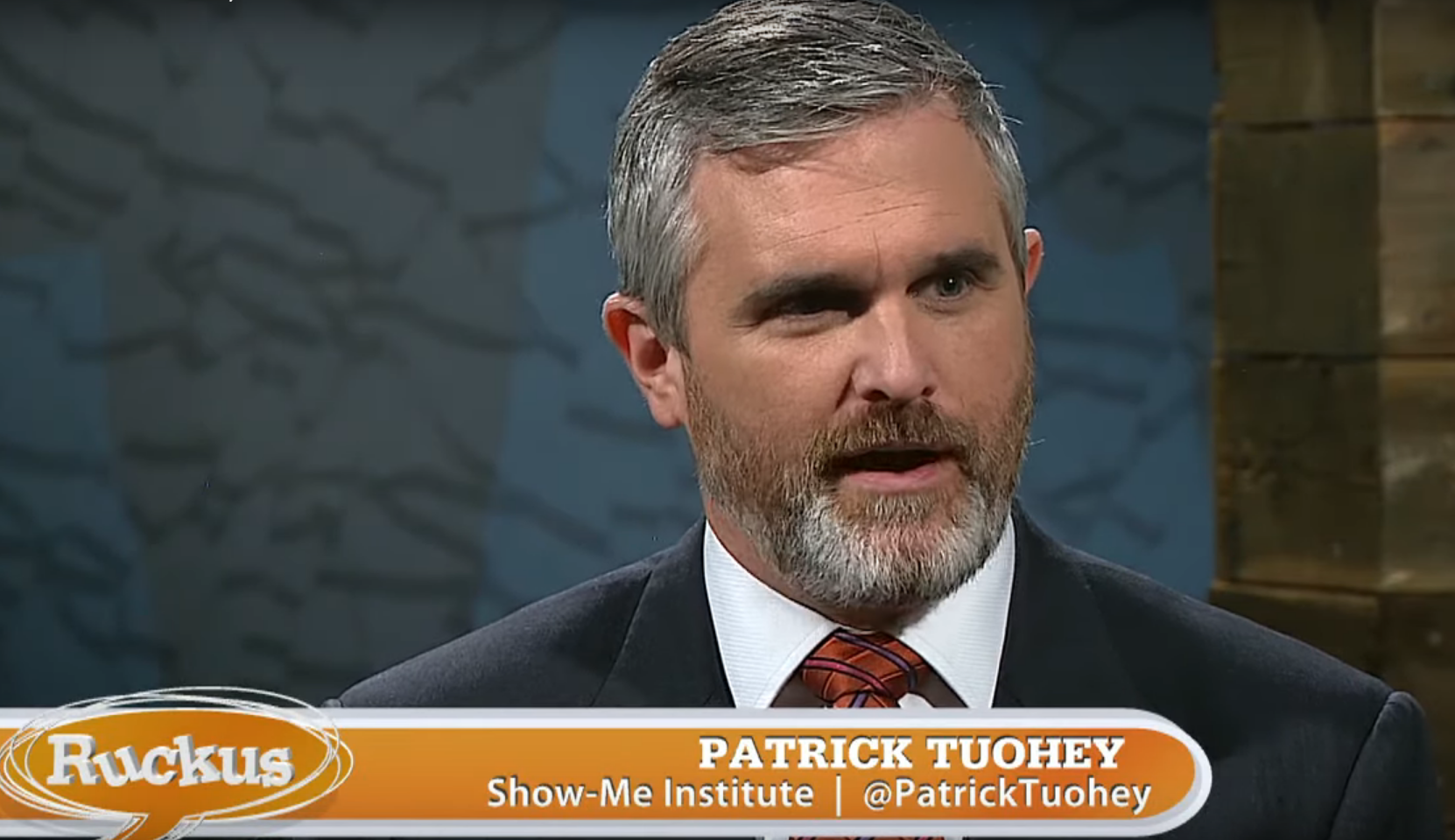
Patrick Tuohey Discusses Local Issues on KCPT’s Ruckus

On November 7, Patrick Tuohey joined the panel on KCPT’s Ruckus to discuss voters overwhelmingly deciding to change the name of Martin Luther King Jr. Boulevard in Kansas City, the recent debate over the tomahawk chop , the USDA move from D.C. to K.C, and a toast to the city’s TIF commission.   

https://www.youtube.com/watch?v=NibOUrzzwho&t=5s


Show-Me Institute v. Office of Administration: A Brief Update

Late this summer, we announced that the Show-Me Institute was going to court to compel the state’s Office of Administration (OA) to provide records to us that it had already provided to the American Federation of State, County and Municipal Employees (AFSCME), a government union. You can find the details of the case in this story by the Jefferson City News-Tribune, or you can listen to our podcast about the litigation featuring attorney, Dave Roland here.

Two months have now passed since our lawsuit was filed, and so far, the case is proceeding relatively slowly, which we expected. Unsurprisingly, the Office of Administration didn’t immediately surrender and decide to just hand over the documents it’s been giving the AFSCME, so we are still anticipating the case will carry on well into next year. In the interest of transparency, I would have hoped that the OA would have simply provided these documents to us without further delay—transparency for AFSCME should also mean transparency for the rest of the public. But unfortunately, it may take a judge to affirm this notion.

A little more surprising is the fact that AFSCME itself has decided to try and intervene in the case, arguing it has a stake in the resolution of this case. That’s surprising because our litigation doesn’t address AFSCME’s actions, but rather the actions of the government. Time will tell what becomes of this intervention, if anything.

We’ll continue to keep you posted on this important case.


St. Louis Ranked in the Middle in Ease-of-Doing-Business Study

The St. Louis Business Journal recently published details of a report that placed St. Louis in the top ten “untapped cities” for startups. This is encouraging, but another study out of Arizona on barriers to business creation was less positive, showing that St. Louis has a lot of work to do in order to ease the way for entrepreneurs.

First, it’s worth recalling that in 2018 the National Bureau of Economic Research (NBER) demonstrated how tax rates affect innovation. Looking at state-level taxation dating back to the early twentieth century, the NBER concluded, “A one percentage point higher tax rate at the individual level decreases the likelihood of having a patent in the next 3 years by 0.63 percentage points.” Specifically, they found that, “higher personal and corporate income taxes negatively affect the quantity, quality, and location of inventive activity at the macro and micro levels.” This should not surprise anyone; resources that might be put toward innovation can’t be used for that purpose if they are spent paying taxes.

The new study from Arizona State University, titled “Doing Business: North America“ looked at 115 cities in the United States, Canada, and Mexico and rated them in six different categories. Those were “starting a business,” “employing workers,” “getting electricity,” “registering property,” “paying taxes,” and “resolving insolvency.” (All U.S. cities tied for first place regarding insolvency.)

While St. Louis ranked 31st overall out of the 115 cities in Canada, the United States, and Mexico (no other Missouri cities were included in the study; Chicago scored 45th overall), the areas where it scored less impressively—starting a business and employing workers—feature significantly in attracting entrepreneurs and innovation.

St. Louis scored 60th on “starting a business” (46th among U.S. cities). This ranking resulted from a “study of laws, regulations, and publicly available information on business entry,” along with consideration of the time and cost of complying with applicable regulations.

Regarding “employing workers,” St. Louis ranked 47th both for the whole sample and among the 66 U.S. cities examined. This ranking was more involved and is described on page 177 of the report, but it reflects the cost of wages and wage regulations such as probationary periods, overtime requirements, and sick leave.

Policymakers can debate the value of local and state mandates and regulations associated with starting a maintaining a business, but all should acknowledge that each one imposes a cost on the employer. Forty-six other U.S. cities have formulated less costly ways to meet their public policy objectives when it comes to employing workers. And St. Louis was outranked by cities in in all three countries examined when it came to ease of starting a business!

All this suggests that when working toward the important goal of taking advantage of St. Louis’ “innovation districts” in the agri-tech, biomedical and technology fields, city government could do a lot more to help entrepreneurs take advantage of what the city may already offer.


A Day Late and $90,000 Short

Despite dire financial trouble and warnings that it may be forced to cease operations this month, it now appears that the St. Louis Loop Trolley will stay open through the end of 2019.

Several weeks ago, Loop Trolley officials asked for $200,000 from St. Louis County to stay open for the rest of the year and another $500,000 to operate for next year. St. Louis County Council members did not oblige the request. Now, the Loop Trolley Transportation Development District (LTTDD)—the entity that owns the trolley—has announced that it will provide $90,000 for the trolley to finish out the year.

This announcement raises so many basic questions that deserve answers, such as:

  • Why did the Loop Trolley ask for $200,000 if $90,000 was enough?
  • Why did the LTTDD just now realize that it did not need to ask someone else for money it could provide on its own?
  • Why do taxpayers in the trolley district have to keep paying for a project that cannot sustain itself?

It has been nearly one year since the trolley began operating. Ridership has been dismal; trolley officials predicted 400,000 riders for the first year of operation, but instead the total barely clears 15,000.

Isn’t it time taxpayers stop rewarding poor behavior and let the trolley stand or fall on its own merit?


St. Louis Officials Recommend “Blight Designation” for . . . A Gated Parking Lot

When is blight not really blight? Apparently, when tax incentives are involved.

According to the St. Louis Post-Dispatch, the St. Louis Land Clearance for Redevelopment Authority (LCRA) has recommended that Balke Brown Transwestern receive 10 years of property “tax assurance” for a proposed housing development in the Central West End. The deal involves the current property being deemed blighted.

The property? A parking lot—a good-looking, useful one at that. The lot is pictured at the top of this post. Does it look blighted to you?

And what exactly is the “tax assurance” Balke Brown is receiving? The resolution by the LCRA explains this a bit (pg. 44):

ten (10) years tax assurance that includes a fixed schedule of payments in lieu of taxes (PILOTs) equaling annual real estate taxes of $850 per unit, and annual real estate tax increases of 2.5%

Translation? It’s a tax break. Instead of paying taxes on the multimillion-dollar apartment complex as most St. Louis property owners would, the developer will pay a lesser, stair-stepped but nonetheless fixed amount each year. We continuously see developers try to bargain their way out of their tax burden and city officials can’t seem to tell them no.

While a new apartment complex in the Central West End may seem great, the tax assurance deal does not. To get the best deal for taxpayers and consumers, what Show-Me Institute analysts have said before bears repeating: If a developer can’t afford a project without assistance, maybe it shouldn’t be doing it. Local officials shouldn’t pick winners and losers, and they shouldn’t feed the appetite for incentives—especially in one of St. Louis’s wealthiest neighborhoods.


Stubbornness on School Choice Comes at a Price

Last week, Missouri got its latest grades on “The Nation’s Report Card,” (an assessment given to public-school 4th- and 8th-graders in each state every two years by the U.S. Department of Education), and the news isn’t good. On one hand, the percentage of Missouri 4th-graders who scored Proficient or above in Reading has increased by six percentage points in the last 20 years. On the more important other hand, our standing among the fifty states has gone from 22nd in 1998 to 34th. In just two decades, twelve states have passed us by. We’ve gone from the top half to the bottom third.

The news isn’t much better in math. Only 19 percent of 4th-graders were Proficient or above in 1996, but we ranked 15th out of the fifty states. Since then, we’ve doubled the percentage scoring on grade level, but we’ve slipped to 34th in state rankings. Nineteen states have leapfrogged us.

What these numbers mean is that while we’re being told that nearly every school district in Missouri is fully accredited (and therefore must be doing pretty well), we’re slowly slipping toward the bottom of the pack. This decline has real consequences. States compete for businesses, workers, and young families, and the quality of a state’s schools is a major factor in how attractive it is to families and business owners. Unfortunately, in Missouri the public education establishment is firmly entrenched, and it appears to have no appetite for changing the status quo.

For some ideas about how Missouri might pull out of its tailspin, we could look at one state that is clearly on the way up. In the late 1990s, Florida’s 4th-graders were 43rd in Reading and 39th in math. Last year, the came in at 6th and 4th, respectively. So what happened? Florida created a choice-rich education environment, and families have responded. Florida families can take advantage of publicly funded scholarships for low-income students, students with disabilities, students in low-performing schools, bullied students, and students reading below grade level. In addition, there are over 650 charter schools in Florida, including one all-charter-school district.

Missouri has charter schools in just two of 518 school districts, and those were authorized only as punishment for the low performance of the existing public schools. Families living anywhere else in the state are stuck with their assigned public school unless they can pay for private school out of pocket or homeschool their children on their own. Just three percent of Missouri families are able to choose a charter school, while nearly half of all Florida families exercise some form of school choice. And the results show the impact that access to choice can have.

Something is backwards when Missouri’s tumble down the national education rankings is quietly accepted, while policies that put parents in the driver’s seat are considered dangerous and controversial. Twelve other states passed Missouri by in the space of a single generation. If we continue to dig in our heels and refuse to create a vibrant marketplace of educational options, we’d better get used to looking at everyone else’s back.

Skepticism Is Warranted on Missouri/Kansas Border War Truce

A lot of people around the country have cheered a recent agreement by the governments of Missouri and Kansas to end their economic development border war, including this recent piece in The Hill. Specifically, the two states agreed to no longer use economic development subsidies to lure employers back and forth across state line—at least in the Kansas City metro area. And while the precedent is welcome, there is less here than meets the eye.

The Kansas City region is unlike many in the United States in that the metropolitan area is divided almost exactly in half by the state line. The older and more urban part of region, Kansas City, sits in Missouri. The newer and more suburban post-war developments rest in Kansas. So the traditional urban-suburban economic wars seen across the country have an additional component: state interests. According to the Hall Family Foundation, the two states spent $335 million in the past decade trading employers only to see Kansas win a slight 1,200 net gain of jobs.

While the state action is welcome, the truce deal does not include all the various localities on either side of the state border. Cities may continue to offer incentives or other financial packages to lure existing businesses into their domain. While Kansas City, Missouri has pledged to honor the agreement, smaller suburban communities on the Kansas side have not. As demonstrated by the USDA’s recent announcement that it has chosen a site on the Missouri side to relocate some of its workforce, the two states will continue to fight an expensive war among themselves to bring jobs from afar. The Kansas City Area Development Council—a private non-profit which seeks to attract jobs to the region—still operates as a double-dealing promoter in the regional jobs Fight Club, collecting dues from both sides of state line and then repeatedly pitting them against each other.

Many of the individuals and organizations who profited handsomely from the years of combat have come out in favor of the deal. Sort of. The CEO of the Greater Kansas City Chamber of Commerce—a chamber whose portfolio includes both sides of the state line—recently told a local radio host, “I think it forms a new way to think about how we’re going to grow Kansas City where we really are looking to grow it in a net new way, not just moving companies from one side of the city to the other.” But moving companies and jobs from one side of the city to the other is exactly the economic development policy the Chamber has championed in the past and will likely champion in the future (e.g. a downtown baseball stadium for the Kansas City Royals).

Part of the problem seems to be that the folks who run such economic development programs are able to use questionable data in order to proclaim job growth and presumably justify their own budgets. For example, Waddell & Reed, a financial services firm originally located in Missouri but that crossed state line years ago in exchange for such incentives, started its incentives negotiations to return to Missouri just before the Border War truce was announced. In exchange for $62 million in Missouri incentives, it will move 1,000 jobs from Kansas. A spokeswoman for the Missouri Department of Economic Development heralded the move as good for the region, apparently unaware the jobs were already well within the region. One can be confident they will claim those jobs and new in their reporting documents.

Perhaps most notable of all is that the truce lacks precise language to describe exactly what it is prohibiting. Kansas Governor Laura Kelly’s executive order seems to restrict incentives to projects that create “net new” jobs. But that term is not defined. Could a growing Missouri firm already planning to make a few new hires take that plan to Kansas and seek incentives — using those “net new jobs” as leverage? How will Kansas assess whether those “net new jobs” were due to the incentives themselves?

Knowing the degree to which job creation or private investment is due to incentives has been a point of contention all along. Policymakers and developers point to all the new property development as proof of efficacy, but the vast majority of the economic research literature indicates that such development likely would have happened anyway, and that the return on investment of public dollars is small if anything at all. Private companies have learned how to game the system through a combination of over-promising, threats of relation, and fanciful accounting.

It is heartening to learn that other regions may be examining the Missouri/Kansas deal to see if it might work for them; the goals are laudable. But if policymakers are serious about ending these types of economic development incentive wars, all levels of government in the region need to be a party to it and the terms must be precisely defined. The allure of ribbon cuttings and claiming to be job creators is too great to leave to vague promises.

Support Us

The work of the Show-Me Institute would not be possible without the generous support of people who are inspired by the vision of liberty and free enterprise. We hope you will join our efforts and become a Show-Me Institute sponsor.

Donate
Man on Horse Charging