Some Possible Good News

Last fall, the MNEA submitted applications for six ballot initiatives to the Missouri Secretary of State. If a ballot initiative is approved, the secretary of state crafts language that summarizes the applicant’s proposal and estimates the cost to taxpayers. Then the applicants have to circulate petitions and gather enough signatures to have the language included on every voter’s ballot. So far, the status of signature collection on the MNEA’s initiatives is . . . TBD? There’s no evidence the MNEA is collecting the signatures, but it hasn’t officially said that it’s not going to.

The MNEA’s ballot initiatives are about protecting the status quo monopoly on public education in Missouri. If passed, the initiatives would dramatically increase the potential budget for K–12  education in the state and remove the education budget from the constitutional protection given to taxpayers—that taxes cannot be raised without a statewide vote of approval.

During the required public comment period for the initiatives, analysts at the Show-Me Institute and concerned groups in the state submitted evidence of the potential disaster that could result from any one of these initiatives being passed. If the petitions passed into law, the annual cost could easily be in the billions and the state would have no choice but to either take money from other programs or raise taxes. Fortunately, the secretary of state drafted ballot language that includes these estimated costs and implications.

Don’t be fooled into thinking that spending more on education while allowing the public education establishment to keep its stranglehold on the delivery of that education will improve outcomes. We’ve been doing that for at least twenty years and our education metrics are only declining in relation to other states. We can be smarter and more innovative in the design and delivery of K–12  education in this state. We just need to be open to ideas that come from sources other than the protectors of the ineffective status quo. Hopefully, the MNEA agrees and will drop its effort.


 

Raise a Toast: Missouri Three-Tier Speech Prohibition Struck Down

While it remains an issue of generally low public awareness, Missouri’s three-tier alcohol regulatory system is one that the average Missourian should care about. Without going into great depth, many states, including Missouri, require alcohol sales to follow a process by which alcohol producers, distributors, and retailers—the “three-tiers”—have discrete and different ownership interests. A relic of post-Prohibition efforts to mitigate the harm and maximize the revenue of the return of widespread alcohol consumption, the modern effect of the system has been to raise the cost of booze by forcing a middleman between alcohol producers and alcohol consumers.

It’s an issue we don’t talk a great deal about, but it’s one that we’ve had a clear and long-standing stance on. Back in 2012, my colleague Michael Rathbone wrote about the problems with a proposal that would have further limited vertical integration of alcohol distribution in the state, and in 2013, my colleague David Stokes testified on the matter before the Missouri Legislature. It was logical, then, that we would have a stance on litigation that the United States Court of Appeals for the Eighth Circuit ruled on yesterday, and for which we submitted an amicus brief in collaboration with the Washington Legal Foundation in 2018.

The case, Missouri Broadcasters Association v. Dorothy Taylor, centered on a very specific aspect of Missouri’s three-tier law that prevents producers and distributors from providing certain advertising materials to retailers. Although there are many policy problems with the three-tier law, the First Amendment issue here is particularly egregious. Even though commercial speech has historically been subject to greater regulation, courts are generally reticent to impose or enforce content restrictions and burdens on commercial speakers. And as our amicus brief notes, these content impositions are substantial:

In § 311.070.1, Missouri prohibits alcohol manufacturers and distributors from “directly or indirectly, loan[ing], giv[ing] away or furnish[ing] equipment, money, credit or property of any kind” to “retail dealers.” Mo. Rev. Stat. § 311.070.1. This blanket ban prohibits manufacturers and distributors from giving any advertising-related support to retailers. In § 311.070.4(10), however, Missouri allows manufacturers and distributors to advertise on behalf of retailers, so long as the advertisement (1) excludes any mention of retail price, (2) lists “two or more unaffiliated retailers,” (3) does so only once, and (4) displays the retailers’ names inconspicuously. Mo. Rev. Stat. 4 § 311.070.4(10). But this “exception” is just an unconstitutional condition on exercising First Amendment rights.

And yesterday, the court of appeals agreed. Readers can find the ruling and our full amicus brief attached at the bottom of this page. We may have more to say on this matter in the future, but for now, suffice it to say that we are pleased with this outcome and hope that policymakers will, separately, consider doing more to dismantle Missouri’s antiquated alcohol regulatory regime in the future.


A Win for Economic Development Sanity

There isn’t enough good news about economic development policy in Missouri. But a recent vote in Maryland Heights, just outside St. Louis, is a reason to cheer. In short, the St. Louis County Tax-Increment Financing (TIF) Commission rejected a proposal to spend millions in taxpayer subsidies developing in a floodplain.

According to the St. Louis Post-Dispatch:

The six members of the Tax Increment Financing Commission appointed by [St. Louis County Executive Sam] Page joined Parkway School District Chief Financial Officer Patty Bedborough in a 7-5 vote Friday evening against creating a TIF in the low-lying area. 

This is good news for taxpayers for more than just financial reasons. As David Stokes of the Great Rivers Habitat Alliance (and formerly of the Show-Me Institute) argued in his testimony before the commission:

As severe flooding has indisputably become more frequent and more dangerous in recent decades, Maryland Heights officials intend to turn thousands of acres of farmland and floodplain into asphalt and concrete. In the next flood, the city will take millions of gallons of water and pump it back into the river to flood someone else. Of course, when they take those thousands of acres that currently can safely hold the water and remove the land from the floodplain, that “someone else” they will flood will be someone whose land previously was not in the floodplain and is not prepared for it.

Too much development in a floodplain does not seem like a good idea for the reasons Stokes outlines above. It therefore is no surprise that developers would not be able to get enough private investment to support the project. Taxpayers should be hesitant to support private endeavors even in the best circumstances. Public dollars should certainly not be used to bail out projects in risky circumstances (pun intended). That the TIF commission rejected this plan is good news.

Listen to our podcast on the topic with David Stokes here: 

https://soundcloud.com/show-me-institute/smi-podcast-stop-building-in-floodplains-david-stokes

Downtown Baseball? Show Us the Research

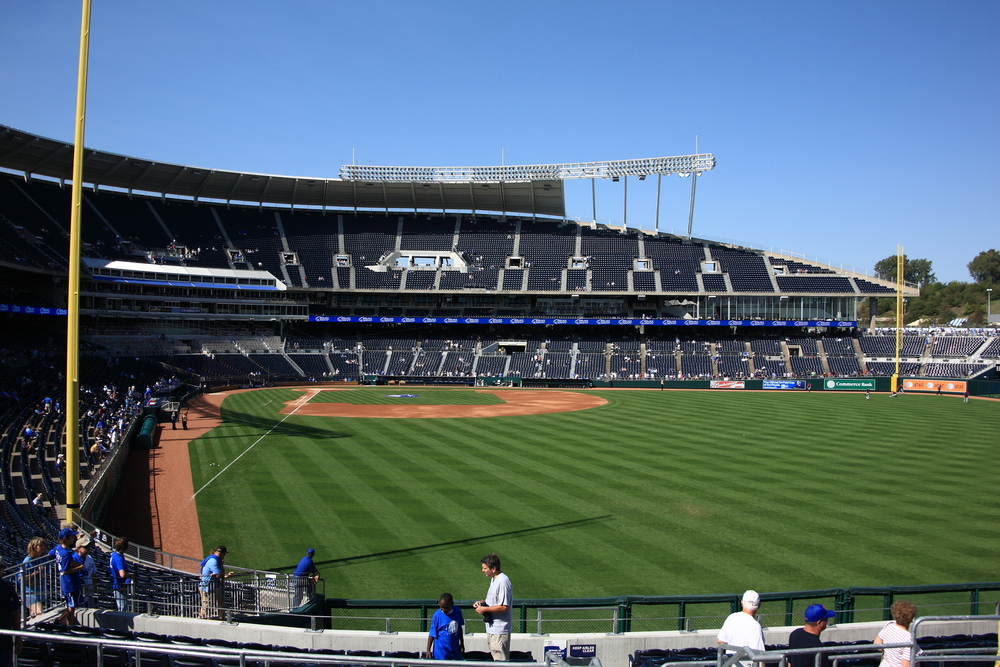
New Royals owner John Sherman is giving interviews extolling the virtues of downtown baseball. In a recent story published on Flatland KC, Sherman said: “Baseball creates more economic opportunity in denser areas versus suburban areas or less dense areas.” Unfortunately, he does not offer any evidence to support the claim.

Mind you, a new baseball stadium funded by taxpayers might be great for the owners of the Royals. But what evidence is there for any benefit to taxpayers?

The St. Louis Federal Reserve pointed out that stadiums fail to drive economic development in a 2017 report, concluding:

Building sports stadiums has an impact on local economies. For that reason, many people support the use of government subsidies to help pay for stadiums. However, economists generally oppose such subsidies. They often stress that estimations of the economic impact of sports stadiums are exaggerated because they fail to recognize opportunity costs. Consumers who spend money on sporting events would likely spend the money on other forms of entertainment, which has a similar economic impact. Rather than subsidizing sports stadiums, governments could finance other projects such as infrastructure or education that have the potential to increase productivity and promote economic growth.

A 2019 piece in The Berkeley Economic Review, a publication of the University of California–Berkeley economic program, also failed to find any economic benefit from sports stadiums:

Over the last thirty years, building sports stadiums has served as a profitable undertaking for large sports teams, at the expense of the general public. While there are some short-term benefits, the inescapable truth is that the economic impact of these projects on their communities is minimal, while they can be an obstacle to real development in local neighborhoods.

The owners of the Royals are welcome to build a stadium wherever they like. But if they want to take tax dollars away from schools, public safety, and infrastructure to help build the stadium, they should share any evidence they have that such a plan presents a good return on investment for taxpayers—not just themselves.


It’s Listicle Time!

The end of the year is the time for top-ten lists, top-story lists, and best-moments-of-the-year lists, to name a few. So it’s only appropriate that the Show-Me Institute have our own list of what’s out and what’s in for Missouri public education. Here are our top five:

  1. What’s out: Annual Performance Report (APR) scores
    What’s in: APR colored bar graphs with words
    It used to be that each school and district received a number between 0 and 100 that indicated what percentage of their possible APR points they received.  Now the APR reports have a couple dozen colored bar graphs with words like “Floor” and “On Track.”  “Floor” means below average and “On Track” means average. Why not just use the words that make sense? Supposedly, the change was intended to make things easier to understand. I beg to differ.
  2. What’s out: Top Ten by 2020
    What’s in: Bottom half by 2020
    Once upon a time (2009), the Missouri Department of Elementary and Secondary Education (DESE) set a goal for themselves. By 2020 Missouri would be a top ten state on the Nation’s Report Card, a test given by the U.S. Department of Education to students in all states every two years. While the goal was certainly admirable, the execution got tripped up somewhere along the way. The 2019 scores were released in October and Missouri 4th-graders were 34th in both reading and math. Our 8th-graders fared somewhat better—23rd in reading and 26th in math—but nowhere near the top ten.
  3. What’s out: Kansas City charter school students receiving state funding based on the legislatively approved formula
    What’s in: Kansas City charter school students, no matter how many there are, sharing a finite and too-small pot of money
    Although the state has a formula that determines how much money each charter school student should receive (spoiler alert – it’s less than traditional public school students), the money is deducted from the public school district’s state funding. Unfortunately, the Kansas City Public School district doesn’t receive enough state funding to cover the amount calculated for the charter school students. So going forward, as the charter school population grows, the amount for each student will get smaller.
  4. What’s out: Only knowing how much each school district is spending
    What’s in: Also knowing how they distribute those funds to their schools
    For the first time (and for the first time that it was legally required) DESE released school-level spending data. This means that we can now compare, for example, elementary schools in the same district in terms of both spending and performance. We can also compare how much is spent on the central office in each district.  These data are new, but analysts and policy wonks are already digging in, and I expect to see some interesting findings.
  5. What‘s out: Students forced to go only to the school assigned to them based on their address
    What’s in: Giving every parent, regardless of background, a variety of high-quality options for each of their children.
    Ha, ha, ha – just kidding. The Show Me state remains firmly planted in the Twentieth Century on this one.  Some states, like Florida, are embracing multiple forms of school choice for families. They acknowledge the desire that every parent has to find a good fit for each child. And while Florida didn’t set a “top ten by 2020” goal, they got there anyway. Their 4th-graders have gone from the bottom 10 to 6th in reading and 4th in math. The one choice that public school districts must, by law, now offer parents—for their student to take courses online at no cost to them – is being strongly resisted by the powers that be. We’re digging in our heels on a status quo that we know isn’t working.

So, here we are, just like so many other Decembers, saying “maybe things will get better next year.” I hope so. Happy Holidays!


Not All Funds and Games

The federal Highway Trust Fund (FHTF) is in jeopardy, and that could mean bad news for Missouri’s roads and bridges.

You may never have heard of the FHTF before, but the Missouri Department of Transportation (MoDOT) relies heavily on it. Forty-two percent of MoDOT’s budget is federal money, the bulk of which comes from the FHTF (page 7).

This pattern of dependency is not a reliable way to maintain our transportation infrastructure.

The FHTF, funded mostly by federal fuel taxes, faces looming solvency problems, especially as the federal gasoline tax is unlikely to budge. Since 2004 Missouri has benefited from the fund, at times receiving $1.45 for every $1 contributed. According to the latest information, Missouri gets $1.14 for every $1 contributed..

MoDOT recognizes this dependency problem (page 14). A solution? User fees like tolling or gas taxes, which are the fairest way to ensure those who use the roads most pay their fair share for upkeep. Most states employ some form of tolling, and many others index their fuel tax rates in some way to ensure the revenue keeps up with the economy.

By relying more on a system that collects revenue based on use, Missouri could mitigate the pitfalls of federal dependency and the need to push costs into the future by issuing bonds.

Federal grants awarded to Missouri this year illustrate how the problems of federal dependency and pushing costs into the future are related. Missouri received $100 million from the federal government to repair bridges, which triggered $300 million in state bonds to supplement those repairs. Those bonds will now need to be paid off down the road.

Federal money certainly helps MoDOT with budget issues in the near term, but it does not address the more serious problem of MoDOT’s long-term solvency. Missouri needs more robust  user fees if it wants to create sustainable funding for our infrastructure maintenance.


Show-Me Gets Results? PortKC to Refund Taxpayers

Back on November 4, I recommended Kansas City City Council members curtail the $6 million administrative fee that PortKC would collect as part of the deal to bring the USDA to Kansas City. Two days later the city council’s Finance, Governance and Public Safety Committee did exactly that, revising the related ordinance to reduce the city’s subsidy from $6 million to $1.6 million.

To review, there were two offerings to get the USDA to relocate to Kansas City, Missouri. The first was a state subsidy that allowed half of the withholdings tax paid to the state to be used to offset the costs of preparing the new site. Under the statutes relevant to the particular incentive package being used, 20 percent, amounting to $6 million, was to be paid to PortKC in administrative fees.

The second subsidy (unrelated to the first) redirected local Kansas City taxes to the project. This amount also happened to total to about $6 million. So rather than have local taxpayers give up all that money, the city council simply directed PortKC to forgo some of its administrative fee so that Kansas City taxpayers didn’t have to cough up as much. The amount given to the USDA is the same, but PortKC’s windfall is dramatically reduced.

Monday, Steve Vockrodt reported in The Kansas City Star that PortKC followed suit, albeit begrudgingly:

Last month the Kansas City Council passed an ordinance that reduced by about $4 million what the city would contribute to the USDA incentive package. In turn, the Port Authority felt compelled to cut the $6 million it had counted on from the AIM Zone by $4 million to make up the difference and keep the USDA interested in relocating to Kansas City.

This is a victory for Kansas City taxpayers and a necessary limitation placed on PortKC. Back in August I called for further restrictions to be placed on PortKC’s authority and jurisdiction. This is a good start, but more should be forthcoming.

If You Build It, Will They Come?

Imagine that today you are put in charge of running MetroLink. In your first day on the job, this is what you learn:

  • Operating revenue is not close to covering expenses—MetroLink’s parent organization, Metro Transit (which also includes MetroBus and Call-A-Ride), covers only about 18 percent of its expenses with fares from riders. The rest of the revenue comes from local, state, and federal subsidies.
  • Ridership is down by over 20 percent since 2014, so the revenue picture isn’t getting better.
  • The primary reason people don’t want to ride MetroLink is that they don’t feel safe. A comprehensive study of MetroLink’s performance released earlier this year found that 71 percent of people surveyed cited security concerns as their biggest criticism of MetroLink (page 4).

So, given that MetroLink is (1) solidly dependent on subsidies for the foreseeable future, because (2) ridership is declining, because (3) riders fear for their safety, what would you prioritize?

Would you decide to build nine more miles of MetroLink for almost $700 million?

Back in the real world, this is what Metro intends to do, apparently missing the point that if people don’t feel safe riding MetroLink, they’re not going to feel safer just because it covers more ground.

Violent crimes on the MetroLink—defined as homicide, shootings, aggravated assault, and rape—numbered 197 during 2017. Proportionally, there were 1.4 violent crimes per 100,000 boardings in 2017. From January to October in 2018, violent MetroLink crimes in St. Louis declined 12 percent according to the head of the city’s MetroLink police unit, although it is unknown if this trend also held system-wide.

Metro justifiably believes that the safety perception spurred the 11 percent drop in ridership between 2017 and 2018, and recently approved a plan that would allow them to hire off-duty sheriff’s deputies for extra security. But should we assume that the recent dip in violent-crime numbers will repair MetroLink’s image and bring riders back? Or would it be smarter to wait and see if the positive trend continues before sinking $700 million into a massive expansion?

Even if people eventually feel safe riding MetroLink, the wisdom of adding another line is open to many questions. This much should be clear, though: MetroLink should not be laying more track when people don’t even want to ride what they already have.

The data are here! The data are here!

For me, Christmas came early this year. On December 12, the Missouri Department of Elementary and Secondary Education (DESE) released, for the first time, detailed data about spending at the school level for all Missouri schools. Before this, spending data were only released for districts as whole. Now we can finally see how districts distribute funds to their schools and how much they keep for the central office. Equally interesting, we can compare spending among schools in the same district with their student demographics and their performance. I know not everyone will be as geeked out by this as I am, but I’ve been anxiously awaiting these numbers and the conversations that I hope they spur.

DESE released tables for each district that show, on the left side, the spending per student in each school building and, on the right side, the district-wide spending per student on the district’s central office. Both sides should raise a number of questions.

For an example on the left (school-building) side, consider Columbia. Two schools—Midway Heights Elementary and John Ridgeway Elementary—look very similar:

  • Midway Heights has 212 students (84 percent White, 24 percent qualifying for free or reduced-price lunch) and John Ridgeway has 234 students (74 percent White, 13 percent qualifying for free or reduced-price lunch).
  •  Each spent about $2 million in 2018–19 at the building level (before central office costs)
  • But at Midway Heights, 72 percent of the students scored at grade level in English/Language Arts (ELA) in 2018-19, compared to 57 percent at John Ridgeway. In math, the numbers were 82 percent for Midway Heights and 59 percent at John Ridgeway.

So what’s going on? I don’t know, but we now have the data to ask the question. One school seems to be getting a higher return on investment, and it’s worthwhile to figure out why.

Now let’s look at the right (district-office) side for two school districts of similar size—Brentwood (755 students) and Marionville R-IX (757 students).

  • Marionville has four schools and Brentwood has three.
  • Brentwood spends $5,100 per student—nearly 30 percent of their total expenditures—for their central office. Marionville, on the other hand, spent just $1,900 per student (about 20 percent of their total) on their central office. For the record, Marionville has more than twice the number of low-income students than Brentwood.
  • Yet, just like their size and unlike their spending, their test results are fairly similar. At both middle schools, 58 percent of students scored on grade level in ELA in 2018-19. Brentwood High School did better than Marionville’s, but Marionville still scored well above the state average.

Why do some schools have much higher test scores for the same investment and similar students? Why do some districts have nearly triple the central office costs of others of similar size? There are so many questions raised by these data. I look forward to digging in more, and I hope that local stakeholders across the state will do so as well.

Support Us

The work of the Show-Me Institute would not be possible without the generous support of people who are inspired by the vision of liberty and free enterprise. We hope you will join our efforts and become a Show-Me Institute sponsor.

Donate
Man on Horse Charging