While the Missouri Legislature continues to debate A–F school report cards, the Show-Me Institute recently released our annual report card update on MOSchoolRankings.org.
Our rankings are built on a model that incorporates 10 academic indicators of student success. All data are sourced from the Department of Elementary and Secondary Education (DESE), and all English/language arts (ELA) and math scores are based on the Missouri Assessment Program (MAP). Each component is weighted equally, and a full explanation of the methodology is available online.
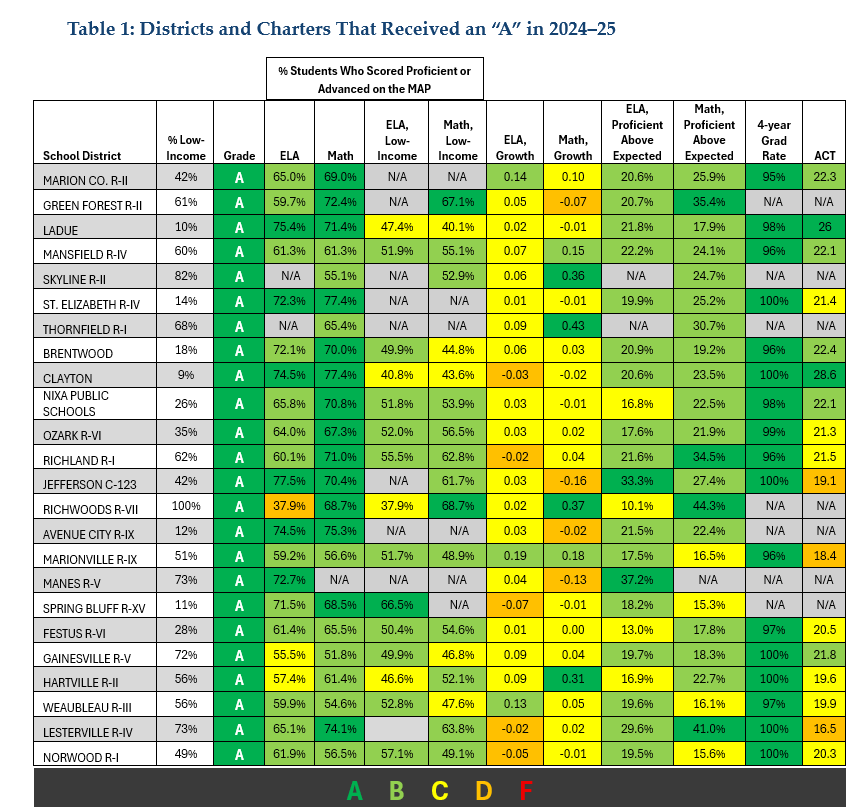
Table 1 shows all 24 public school districts and charter schools that received an “A” in the 2024–2025 school year.
Suburban and rural districts dominate the top rankings, with numerous districts from St. Louis County (Ladue, Brentwood, Clayton). Many of the rural school districts are exceptionally small: Skyline has 81 students and Thornfield has 48. The largest school district on the list is Nixa Public Schools (near Springfield) with 6,518 students.
The suburban districts have relatively low rates of students eligible for free or reduced-price lunch (FRPL)—a common proxy for school poverty rate. Fewer than 10 percent of Ladue and Clayton students were eligible for FRPL, with Brentwood at 18 percent, Nixa at 26 percent, Festus at 28 percent, and Ozark at 35 percent. However, some rural “A” districts have a sizeable number of lower-income students.
Mansfield R-IV, which had 60 percent of its 622 students qualify for FRPL, performed above average in almost every single category (except in ELA growth). Richwoods R-VII, a small rural district about an hour from St. Louis, had 100 percent of its 125 students qualify for FRPL and had particularly impressive scores in math. These examples demonstrate that low-income schools can achieve academic success.
There is a lot more to delve into for academic performance. Table 1 is just one snapshot of what is available on MOSchoolRankings.org. Accountability tools like these can help highlight success stories, identify areas for improvement, and provide a clearer picture of how schools across Missouri are performing.
Every property owner knows there are two costs to any improvement you build. First, there is the cost of construction itself, including any fees you need to pay to the city or county. Then there is the increase in property taxes when your assessment increases. It is, in effect, a disincentive to build and improve property.
But what if that weren’t the case? What if the government only assessed the value of your land—and not any improvements you put on it?
That approach is called a land tax, or land value tax (LVT). By separating land from improvements and taxing them differently, governments can encourage property development. In downtown areas, often dotted with parking lots or undeveloped parcels, owners would be incentivized to build or to sell to someone who will.
This need not be an increased cost to owners. Taxes on improvements and land could be set at different rates (ideally zero for improvements) to ensure there is no net increase.
Show-Me writers have argued in favor of this approach for years:
The legislature in Kentucky, our neighbor to the east, is considering a bill that would, among other things, allow cities to separate property taxes into land and improvements.
In Missouri, such an effort likely would require a change to the Constitution. Currently, Article X, Section 3 states, “Taxes may be levied and collected for public purposes only, and shall be uniform upon the same class or subclass of subjects within the territorial limits of the authority levying the tax.” Later, Article X Section 4 defines real property as a single class with limited subclasses.
This could easily be changed, perhaps by inserting into Section 4, “Land and improvements upon land may be classified as separate subclasses of real property for purposes of taxation.”
Every city wants to spur development. The structure of our taxing system often serves as a disincentive to build. A land tax is a way for cities to encourage building and development without increasing taxes and without offering taxpayer subsidies. And it’s simple to understand and explain.
As Missouri and its cities look to encourage population growth and development, adopting a land value tax is a simple and straightforward way to do so.
Last week in The Kansas City Star, I argued the earnings tax is harmful. The responses suggest the Show-Me Institute is winning the argument, regardless of the vote’s outcome. What’s striking is that even those who acknowledge the tax’s flaws remain unwilling to act on their supposed principles. (St. Louis will also be voting on the earnings tax.)
I argued that the tax is regressive, drives workers and businesses away, and fuels the city’s subsidy culture.
David Hudnall, a reliably left-of-center columnist for the Star, urged a yes vote but largely conceded my points. In a column titled, “Just hold your nose and vote for Kansas City’s earnings tax,“ he agreed the tax is regressive and supports lavish subsidies for wealthy developers.
Weirdly, Hudnall then lamented that the tax requires a public vote in the first place. But he wistfully concluded, “I’d welcome a little more fiscal discipline at City Hall.”
The Star’s Editorial Board also endorsed a yes vote but conceded the tax is regressive and “economically harmful”—a significant admission. The piece further conceded, “The earnings tax is not the best way to fund such a large proportion of our city services.” Another notable concession. The piece closed not with a demand for action, but with little more than meek, wishful thinking:
We hope to see future City Council candidates campaigning on a pledge to reform the system. We also hope to see council members who vow to keep the basics of what makes a city hum fully funded—and ratchet back the incentive handouts.
Back in 2021, the last time Kansas City voted on the earnings tax, the Editorial Board urged a yes vote after admitting the tax was regressive and fed the city’s incentive culture. (They even admitted that the sales tax was too high.) Yet they feared reform would be worse.
In 2015, another reliably left-of-center columnist for the Star, Yael Abouhalkah, lamented that the city has neither explored alternatives nor held a meaningful discussion about the tax. He also observed that the tax is regressive and hits the poor hardest.
The problem, then as now, is that city leaders have no incentive to explore alternatives or discuss a 10-year phaseout of a tax widely acknowledged as harmful. Why? Because rather than demand better, the Star’s opinion class and business leaders reliably fold at the slightest scare tactic.
Hand-wringing about Kansas City’s flawed tax structure is not enough. We need city leaders, including those at the Star, to live up to their principles. Otherwise, what is the point of having a platform?
The Mayor and Council have failed to address these issues. There is no reason to expect that will change until voters demand it.
For some reason, film tax credits remain popular in Jefferson City. They are much less popular with economists.
Missouri lawmakers are once again debating whether to extend the state’s film tax credit program. Earlier this month, I testified against legislation that would continue the subsidy. For those who don’t remember, this is a debate the state has already had.
Missouri operated a film tax credit program before ending it more than a decade ago. In 2010, the state’s Tax Credit Review Commission examined the program and concluded it served too narrow an industry to justify its cost to taxpayers. Lawmakers shut it down soon after. The idea never fully disappeared, though, and in 2023 the subsidy returned, this time with the promise of better results. The current program allows up to $16 million per year in credits for film and television productions.
So far, there is little evidence that anything has changed. Supporters point to production spending as proof that the program works. The Missouri Film Office reports that productions spent more than $40 million in the state in 2025 while receiving roughly $15.7 million in credits. But production spending is not the same as fiscal return. Much of that activity consists of temporary wages, lodging, equipment rentals, and other short-term expenses tied to a shoot. When filming ends, much of that spending leaves with it. What matters for taxpayers is how much tax revenue actually makes its way back to the state.
On that measure, film subsidies perform poorly almost everywhere they have been tried. Research summarized by the Tax Foundation estimates governments recapture between eight and twenty-eight cents in new tax revenue for every dollar of credit issued. Even Georgia, often cited as the model for film incentives, struggles to demonstrate that the program pays for itself. A 2020 performance audit by the Georgia Department of Audits and Accounts found that tax revenue generated by film production activity fell well short of the credits the state awarded.
There is also a basic budget reality lawmakers should keep in mind. Film tax credits are sometimes treated as something different than spending because the state only grants them after a production films in Missouri. But the fiscal effect is the same. Each credit issued is a commitment to collect less revenue in the future.
Meanwhile, the productions most closely associated with Missouri often film somewhere else entirely. A new HBO series set in St. Louis, DTF St. Louis, was filmed in Georgia. The Netflix series Ozark, which was set at Missouri’s Lake of the Ozarks, was also largely filmed in Georgia.
Though it should go without saying, Missouri’s lawmakers should be focused on using state tax dollars as effectively as possible. And there’s no disputing that film tax credits have repeatedly failed that test. Extending the credit today would mean ignoring the state’s past experience and choosing to repeat it.
Missouri’s application for the federal Rural Health Transformation Program (RHTP) reads like a blueprint for major reform. It promises a “bold and comprehensive vision” that will “fundamentally shift the healthcare experience” for rural Missourians. That kind of language suggests that the state is ready to address long-standing structural barriers to care—and to the credit of those who wrote the application, it does identify many of the right problems.
A portion of the federal funding approved in the One Big Beautiful Bill last summer was designed to help states expand access, improve outcomes, and rethink how care is delivered in rural communities that have long struggled with provider shortages and limited infrastructure. As I’ve written many times before, Missouri, with large rural regions and persistent access challenges, is an obvious candidate for that kind of transformation.
But when you get to Appendix 1 (page 56), where Missouri outlines its actual policy commitments, the tone changes.
Take certificate of need (CON) laws. Instead of proposing reforms, the state spends its time disputing outside criticism, arguing that a report from the Cicero Institute “inaccurately claims” Missouri’s CON program is overly restrictive and that critics “overstate Missouri’s regulatory reach and understate its flexibility.” The focus shifts away from change and toward claiming the current framework really isn’t that bad.
The same pattern shows up on scope of practice (which procedures certain healthcare professionals are allowed to perform). Rather than committing to specific changes, the state says it will “reassess our current scope of practice laws” and “identify the optimal legislative and regulatory changes” at some point in the future. The emphasis remains on further review rather than action.
These are only a few of many examples that make the contrast in this application so striking. The front half lays out a vision built on “innovation,” “transformation,” and system-wide change. But the appendix, where commitments actually matter, falls back on the status quo.
It is true that the federal government bought into that vision. Missouri was awarded significant funding through this program, with the expectation that the state would follow through on what it proposed to improve access in rural communities. The application suggests that the state understands the problem. The commitments, however, raise questions about whether state leaders are serious about implementing real solutions.
As Missouri begins spending the RHTP funds it receives over the next five years, taxpayers should pay close attention to how closely the state’s actions align with its stated vision.
Recently, Show-Me Institute analysts have been sounding the alarm on Missouri’s literacy crisis. The data are sobering—42 percent of our state’s fourth graders can barely read, representing some of the worst results we have seen in two decades. When a child reaches the end of third grade without the ability to decode text, they do not just fall behind. They are essentially locked out of the rest of the curriculum.
Some rural Missouri students, fortunately, are beginning to make breakthroughs with help from The New Teacher’s Project (TNTP) and its Rural Schools Early Literacy Collaborative. This program helps educators move away from the discredited balanced literacy models of the past and encourages them to embrace the science of reading. This signals a return to proven, evidence-based instruction that prioritizes how the human brain actually learns to process language.
For too long, Missouri classrooms have relied on the three-cueing system, which is a method that encouraged students to guess words based on pictures or context rather than sounding them out. As Institute analysts have argued repeatedly, reading is not a natural skill like speaking; it must be explicitly taught. Focusing on phonemic awareness helps students identify individual sounds and connect them to written letters, building the accuracy and speed necessary to make sense of the text as a whole.
While it is heartening to see individual districts taking the lead, Missouri’s recovery requires systemic policy changes. We need essential reforms to ensure this new approach becomes the standard rather than the exception. First, we need universal screening to identify struggling readers in the earliest grades so no child slips through the cracks. Second, we must address accountability in teacher preparation. Currently, too many Missouri universities fail to train new teachers in evidence-based methods, and we must ensure our educators enter the classroom equipped with tools that work. Finally, we must make sure that students who are far behind in reading skills are not promoted to fourth grade.
If we fail to get the foundation right in the early years, we are setting our students up for a lifetime of struggle. The TNTP program is just one example of how we can prioritize research over rhetoric and turn the tide on literacy.
Susan Pendergrass speaks with Todd Davidson, Vice President of Programs at the State Policy Network, about how artificial intelligence is reshaping the think tank world. They explore what AI is good at and where it falls short, how organizations like the Show-Me Institute can use it to become more productive without losing their edge, why face-to-face relationships will only become more valuable as AI-generated content floods the internet, how a Hawaii think tank used an AI agent to help fire victims submit legislative testimony, what good policy looks like in an AI-driven energy landscape, and more.
Susan Pendergrass (00:00) Great, well, thanks so much for joining us this morning. Todd Davidson of the State Policy Network, to talk about the topic du jour: artificial intelligence. Thanks so much for coming on to talk about it. I’m afraid to even say anything out loud about AI because by next week it’ll be…
Todd Davidson (00:11) Yeah, happy to be here. Thanks for having me.
Susan Pendergrass (00:18) Nothing really ages — it changes so fast. But I did just read that Mark Zuckerberg has an AI agent who is performing his CEO duties for him. Did you see that? Why not, right?
Todd Davidson (00:28) I saw that, yeah. And then he can just kick back, go down to his Hawaii bunker and just let Facebook run itself.
Susan Pendergrass (00:37) Yeah, I mean, I still haven’t really dabbled in agentic AI, but I know it’s right there and I’m going to want to do it soon. We’re going to talk about AI in the think tank world, but I have to check legislation and hearings and see how those things are going every day. I can well imagine an AI agent doing that for me.
Todd Davidson (01:01) Yeah, if it’s properly trained. So ShowMe Institute, to give the audience broader context, is a member of State Policy Network, and we have sister organizations like ShowMe in states across the country. The Libertas Institute, which is based out of Utah, did exactly what you’re talking about. Connor Boyack, the CEO, built a legislative tracking system that then feeds into their scorecard where they keep track of legislation. He said it took him about eight hours of work to code the agentic AI, but now it does the work automatically. Of course it needs fine-tuning and always has a final human observer that verifies everything, but it’s being used for those purposes right now across the country.
Susan Pendergrass (01:59) So we’re in the think tank world, and it’s probably more of an art than a science at the state level. Tracking the policies — first of all, thinking about the policies that we think would be best for Missouri, then doing a bunch of research on those policies, then creating content on those policies, then trying to talk to legislators and hope that they see our point of view, and that they enact actual laws that reflect those policies. That’s a really labor-intensive job. Which parts of that could you see being picked up by AI?
Todd Davidson (02:33) I’m by no means an expert on AI, but I work with someone who is. What has been explained to me is that AI is very good at synthesizing information. It’s very good at predicting — it essentially predicts the next word. It takes all these inputs and predicts the next set of words, which comes out to us as sentences. So if you are able to give it certain inputs — say, I want you to look at these bills, I want you to look at these things — and give it a sort of walled garden, it can then be prompted to produce any type of analysis that you want. The reason you want that walled garden is because AI can still hallucinate. It can make stuff up. Actually, this just went viral last week: a lawyer down in Georgia went before the Georgia Supreme Court and had AI produce her entire argument. It cited five fictitious cases, and the judges called that out. So you have to give it constraints and say, here are the data inputs, now summarize this for me. And it can get you a pretty solid first draft of that summary. Of course, you’re still going to need a human to go through and edit it and add voice and texture to it. But summarizing that data, saying tell me which of these align with our principles or does not align with our principles — it would be very good at that kind of thing. What it’s not going to be able to do is the creative part. When you think about what is the policy that we want to design for Missouri, what does Missouri need — it’s not at the stage where it could do that. That’s where you would still want Show-Me Institute experts to be crafting those kinds of things. But if something’s already out there and existing, you can summarize it and score it based on criteria pretty easily.
Susan Pendergrass (04:35) So given how quickly firms are moving towards AI — and in fact mandating AI because it’s such a time saver and productivity increase — how does a think tank position itself in that world? There’s so much talk about AI just replacing all of our jobs. Maybe it does replace my job — I don’t know. I’ve heard podcasts generated by AI in my voice, so it could be doing this job right now. I would like to think it wouldn’t be as great, but how does a think tank position itself? What’s our value add in that scenario?
Todd Davidson (05:12) Start by going back to what your mission and objective is. ShowMe Institute — and by the way, I am a resident of Missouri and a big fan of the Show-Me Institute, both from my SPN perspective and from my Missouri resident perspective — we have principles: free markets, a robust civil society, a thriving economy. We want the feds to get out of the way in a lot of cases. We want the government to get out of the way. And then how we execute that mission is through policy change, mostly at the state level, though I know you also work at the local level. So state and local policy change is the objective. How do we go about that? We produce research and then we advocate — in some cases talking directly to policymakers, communicating out to the public through op-eds and things so that the public then talks to lawmakers. And ultimately we get policies passed that lower the income tax, reduce barriers to work, and provide more options for kids in schools. So what AI is going to do is make research and content much easier to produce. By research, again, I mean that summarization kind of research — it’s going to make that kind of stuff extremely easy for folks to produce. Everybody’s going to have a research assistant. What AI cannot do is personal relationships. It will never be able to do that. What it also cannot do is tour the entire state of Missouri, know all of the history and relationships and connections of people throughout the state. So I believe Show-Me Institute and all of the affiliates across the country that are state and local based are going to have an advantage because you’re in your community. You know people, you know policymakers, you know community leaders, you know people that are affected by your policies. And that’s something AI is not going to be able to do. AI can look at the statistics and arguments and academic literature, and it could put together a brief, and that could be useful. It would make your job more efficient — you’d be able to produce those things in a fraction of the time you do right now. But then with that extra time, I would use it to go out and build stronger relationships in the communities, and then use those relationships towards policy change.
Susan Pendergrass (07:51) What about grassroots? More grassroots-type stuff?
Todd Davidson (07:55) Grassroots very much. AI is going to have an interesting relationship with grassroots. In one way, it actually makes it easier for grassroots individuals to engage their legislature. On the other hand, it’s going to create a flood of grassroots engagement digitally. So face-to-face grassroots engagement is going to have more impact. I’ll tell you a story: Hawaii had the terrible fire that destroyed Lahaina a few years back. Hawaii has terrible building codes — it’s incredibly hard to build homes there. That town was completely destroyed, so the state needed to relax its building codes in order for homes to be rebuilt. Well, they weren’t making this change. Show-Me’s sister think tank, called the Grassroots Institute of Hawaii, built an AI platform that allowed individuals to submit testimony to the legislature. Testimony has a higher bar, right? You can email your lawmakers pretty easily, but testimony goes into the legislative record and has to follow a certain format and be structured in a certain way. That’s not something that grassroots individuals were very equipped to provide. So a think tank would typically provide the testimony and then get grassroots supporters to send emails to lawmakers. What Grassroots Institute of Hawaii did was build an AI agent so that an individual could say, “Hey, my house was burnt down, I need these things,” and the AI agent would turn that into testimony and submit it directly to the legislature. It resulted in a skyrocketing number of testimonies being filed. Because of that, the legislature said, “Wow, we’ve heard from 500 constituents — we’ve never heard from that many constituents before.” So they relaxed their regulatory regime, and now homes are being built in Lahaina much faster.
Susan Pendergrass (09:48) Did they know that AI was doing it? Were legislators thinking, okay, this is AI?
Todd Davidson (10:12) That is why they went through testimony. Legislators’ email inboxes — they’re not reading their emails anymore, right? They get thousands of them. But through testimony, the AI was not making up the stories. The people had to fill out the content and explain their story. The AI was just structuring it in a way to make sure that it got submitted as testimony. I do think that is a bit of an arms race. At some point the same thing that has happened with email will happen — there will just be thousands of pieces of testimony and you won’t be able to read all of them. So there was a bit of a first-mover advantage. And once that becomes ubiquitous, I do think what you predicted is going to happen, where legislators just say, well, this is AI-facilitated. And that’s where it’s going to have to go back to face-to-face, bringing those people in.
Susan Pendergrass (11:08) I think you’re absolutely right. As more video content comes out and we all realize it’s AI — I just don’t really believe that any videos are real anymore. I don’t really believe pictures are real. I don’t really believe music is real. And it doesn’t necessarily bother me that much, but I think because of that skepticism and unwillingness to believe in digital content, things happening in real life right in front of us are going to take on higher and higher value, so that we know for sure that if I’m speaking to a legislator, it is me saying it and what’s coming out of my head. That’s about the only way we’re going to know if something is real — or the default is just going to become AI-generated.
Todd Davidson (12:01) 100%, I absolutely agree. And that’s where I think organizations like ShowMe are well positioned. Because you’re in the state of Missouri, you can be in Jefferson City or you can be in St. Louis or Kansas City in those face-to-face relationships. It’s going to make your government affairs personnel far more valuable, your fundraisers who can be face-to-face with donors far more valuable, grassroots activists that are face-to-face. It’s going to put a premium on face-to-face interactions for sure. I agree — there’s going to be so much content out there. You’re still going to need content because that gives you credibility, it gives you what you’re going to talk about. But then you’ve got to pair that with the face-to-face interaction, otherwise it’ll just get ignored.
Susan Pendergrass (12:47) And you can definitely see the gap when people are generating stuff through AI and they don’t know the subject matter enough — like you said about the attorney. But there is definitely a role for humans to say, I mean, I do this all the time with AI: I’ll say give me five of these things, give me five infographics or something like that. But the human has to know which one is the best or which one makes the most compelling argument. AI simply really can’t do that. So while some people would love to believe that AI is going to run the world, I do believe there is an emerging role for human discernment to know which AI products are better than other AI products. Would you agree with that?
Todd Davidson (13:32) Yeah, 100%. I think the sweet spot is utilizing AI to make yourself more efficient or do things that you don’t like doing. But then that raises you up into that discernment phase where you’re the one making the call. I do this all the time — I’m having conversations with AI to increase the outputs. I should not spend any time making infographics. I’m not good at it. But I can have a conversation with AI where it produces that infographic much more effectively than I could. I’ve also found that, if you put the prompting on it, it can help you find those particular sources that you’re looking for. Say you want to write a survey on school choice research — it can help you gather all of those materials much faster. But then you have to make sure that it’s of high quality.
Susan Pendergrass (14:35) What do you think about the current pushback on AI-generated pictures? Do you think that is just a learning phase we all need to get through? Some top artists on Spotify have been determined to be AI-generated.
Todd Davidson (14:57) Really?
Susan Pendergrass (14:59) Yeah. The number two Christian artist is just AI, and across all genres there are artists with millions of subscribers who are just AI-generated music based on what AI knows we all like. So we do like it. Does it matter that there’s no real person writing the music? I don’t know.
Todd Davidson (15:12) It’s kind of sad. Yeah.
Susan Pendergrass (15:21) I know the initial reaction is, that’s sad. But then after a while you’re like, I don’t know.
Todd Davidson (15:26) There is going to be intense pushback to all things AI. AI is very unpopular right now. I saw some polling just last week that showed it is the number one concern of voters. There will be a populist pushback against AI. We’re seeing this pushback against the data centers. There’s even polling that showed a plurality of the population believes it’s immoral to use AI. And I think it gets at the core of some of what you’re talking about here — yes, there’s this very popular, satisfying music, but it loses some human element because there’s not a human behind it. I do think we’re going to see a lot of pushback to AI on multiple dimensions. There’s that cultural dimension. There’s the economic anxiety dimension right now: a fear that AI is driving up energy costs, a fear that AI could take my job. There’s going to be pretty significant pushback. Right now we’re mostly seeing that in anti-data center efforts, trying to stop the building up of data centers across the country. I was looking at some Democratic pollsters today who were pitching that Democrats should advocate for a guaranteed job, guaranteed income, guaranteed healthcare, and a guaranteed home if you lose your job to AI. That kind of populist messaging is going to resonate with a lot of the public. What is the response going to be to that? What are the other solutions that we could advocate for that both allow the continued growth and opportunity and also allow continued innovation around AI, because we’re going to need AI to continue to develop?
Susan Pendergrass (17:30) It’s already here. I mean, we’re doing this in reverse order. And I think my opinion is that massive new technologies always get pushback — like the car. People were on their horses, and then we started designing roads for cars. Calculators got a lot of pushback, the internet got a lot of pushback. But ultimately people decided that they liked it better. I think AI is the same — we just have to figure out how to work with it. And I know that it is threatening to take a lot of jobs, but I see it more as a good thing. It gives us an opportunity to become the expert over AI. AI is not going to be the expert — we still need the human component. Like you said, face-to-face interactions. Legislators are still going to know what Missourians want and how to represent their constituents, and those are real-world issues. The data center pushback is because I don’t want to look out my window and hear a buzz and see a data center — I don’t want all that land going to data centers. That’s a real-world, in-person issue. But I just think we’re going to have to learn to work with it. I don’t think robots are going to — maybe this is where I don’t want to say things out loud — but maybe the robots will take over the world, I don’t know. But personally I feel like it is helpful to get a lot more content out, because you don’t know what’s going to resonate with stakeholders. Whether it’s a video or an infographic or a report or a different type of content, the fact that we can generate these things much more quickly I think is a benefit to us, and it makes the in-person time more meaningful to me.
Todd Davidson (19:11) You’re absolutely right. When a new technology comes out there’s going to be pushback, and organizations like ours have to figure out what’s the policy framework that allows that innovation to thrive without getting in the way. And fortunately we have a lot of those policies already. Like Avery, your colleague at Show-Me Institute, talks a lot about energy. One of the biggest pushbacks on AI is that it’s driving up energy costs. There’s some research that shows that’s not quite what’s happening. What’s happening is a lot of green policies that got passed in the 2010s are coming to roost — the renewable portfolio standards and those things are really what’s driving up energy costs. But even still, what can we do to make energy more affordable and reliable, even with a bunch of data centers added to the grid? And Avery’s got good policy on this: expanding nuclear power, expanding the use of reliable energy sources.
Susan Pendergrass (20:23) It’s separating out consumer electricity from data center electricity. You can carve these things differently.
Todd Davidson (20:29) Yeah, that’s another one — where the data center has its own power source. So there are policies out there that can mitigate it. And on the job question, unfortunately AI is happening at the same time that we’re having a continued cost of living and inflation issue. It’s one more thing that is driving anxiety. It’s not the root cause of what’s going on — we’ve got other factors that we need to address to get inflation under control, particularly on the energy side.
Susan Pendergrass (21:08) Yeah, but I do think it’s great that we have so many opportunities to expand or improve how we do things. In our little corner of the world, which is think tanks, we’ve been doing things kind of the same way for a long time. So I think a new approach to how we do business is a welcome change, and I think we could be a lot more effective.
Todd Davidson (21:38) Yeah, I think we’re going to see far more productive think tanks on the research side. On the litigation side, I was talking to Wisconsin Institute for Law and Liberty. They litigate a lot of cases. With the advent of AI, every lawyer essentially got a legal clerk right away. They went from nine lawyers and a handful of legal clerks to nine lawyers who each now have their own AI legal clerk. It’s dramatically expanded the number of cases they can take on. And the same thing on the research side. On the marketing side, production of content is going to be quite a bit easier and more cost effective as well.
Susan Pendergrass (22:26) Well, I appreciate having a chance to talk to somebody who has a positive perspective on it, because I do hear a lot of doom and gloom when it comes to AI. I was reminded by somebody that many of the scenarios in movies and books about AI are very dystopian, but perhaps it’ll be utopian. We don’t know. It’s all in how we approach it, right?
Todd Davidson (22:48) Yeah, it is. It’s going to be an exciting new world that we live in and we’re right on the frontier.
Susan Pendergrass (22:54) Anyone with little kids, like you — who knows what the world’s going to look like when they’re going to college. So you’ve got to stay flexible, right? Well, thanks so much, Todd. I appreciate you coming and talking to us about it. We’ll have to talk about it again sometime soon when the whole thing has changed.
Todd Davidson (23:02) Yep, stay flexible and always be learning. Yeah, sounds good. Thanks, Susan.
As technology companies try to meet the skyrocketing demand for AI-specialized computing capacity, they are dotting the country with data centers to the dismay of some and the delight of others. As is all too often the case in Missouri, many of these companies are being offered taxpayer-supported subsidies or tax exemptions.
For example, Independence, Missouri, is giving Nebius more than $6 billion in tax breaks over the next 20 years for a “hyper-scale” data center, and Montgomery County has offered Amazon hundreds of millions in tax abatements to build a data center near New Florence. But why would subsidies be needed when it seems like data-center developers have money to burn and are desperate for suitable building locations?
Recent actions of data-center developers suggest that it is not the cost of building and operating those facilities that is the barrier; the main problems appear to be finding pathways to secure reliable energy generation and getting their centers online smoothly and quickly (speed-to-operation).
These two obstacles are so serious that the major technology companies (Amazon, Google, Meta, Microsoft, etc.) recently met with President Trump and signed the “Ratepayer Protection Pledge” to supply and pay for their own power for their AI data centers.
Why would these companies agree to take on this expense? Because their constraint is not cash. For these firms, time is money. The costs of delays in permitting and interconnection outweigh the value of a local tax incentive.
The negative effects of economic development subsidies and tax breaks are well known. When local officials offer these incentives, they diminish positive benefits that could come from a new data-center development: increased property-tax revenue to fill in the gaps for local services or be used to lower the overall tax rate of the community.
With all of this in mind, rather than just doing what most other states do (handing out checks or tax exemptions) Missouri should work on policies that actually deliver what these companies need most: pathways to secure and reliable energy generation, regulatory certainty, and speed-to-operation.
For local communities, this means they should not offer taxpayer dollars. Even with big tech agreeing to pay for their own power, many municipalities will still try to lure projects with incentives. No doubt the companies will take whatever money is offered to them, but subsidies are unlikely to significantly drive their decisions about where to locate.
Instead, local communities should offer a stable, predictable permitting environment and a suitable location to build. That would help address the greater desire for certainty and speed-to-operation.
And at the state level we should think even bigger. Policies like consumer-regulated electricity (CRE) could help make Missouri a true hub for data center development—without using unnecessary subsidies.
CRE would enable private electricity providers to serve large, energy-intensive customers independent of the existing, permission-heavy grid structure by allowing them to build their own power plants. Rather than spreading the costs for this infrastructure, CRE would create a “parallel path to energy abundance” —one financed by the large customers who demand the power.
CRE would allow these data centers to work with a private partner to meet their own energy needs, with less red tape, more certainty, more control, and more freedom to innovate. These benefits are likely to be more appealing than subsidies.
Unfortunately, offering subsidies seems to be a reflexive reaction in Missouri when there is an opportunity to attract a new business. But especially in this case, Missouri would be better off focusing on what the data center sector really needs. Efficient regulatory and permitting policies (like CRE), a predictable and stable environment in which to construct, and abundant energy would be far better suited to attracting and improving data center development than taxpayer dollars.
A bad idea doesn’t get better with age. Bad ideas aren’t wine, jeans, or your high school memories. The tax subsidies for the Post-Dispatch building redevelopment in downtown St. Louis were a bad idea back in 2019 when the development was proposed, and they are a bad idea now.
Using tax subsidies for economic development rarely benefits the public. Instead, it lowers the risk and increases the returns for private investors. Under a capitalist system, the relationship between risk and reward for investors can be a wonderful thing, but in recent decades the government has somehow decided the public should get involved in private business dealings through tax subsidies and incentives. Taxpayers in St. Louis were left holding the bag for the failed St. Louis Marketplace tax increment financing (TIF) plan, the tax subsidy package for the Renaissance Hotel that was literally sold on the courthouse steps, and numerous other failed, subsidized enterprises. Most economic development schemes are like an expensive game of musical chairs in which the taxpayer is always the one with nowhere to sit.
The tax subsidy package for the old Post-Dispatch building at 900 N. Tucker on the northern edge of downtown St. Louis was approved by the Board of Aldermen in 2019. It primarily consisted of a $12 million TIF package. The summary included with the legislation featured the normal jargon required for such bills, and it included a statement that the development “will have approximately 1,250 jobs with an average salary of $76,500.”
How has that jobs promise worked out? Well, OK at first. The most recent annual TIF report (2024) filed by the developers with the state auditor repeated the same number of 1,250 estimated jobs created. It also listed 830 jobs created so far. There are two ways to look at that number, and both are accurate. The first is that, once again, developers exaggerated their job creation in order to get the subsidies they wanted. That often happens, and it may have happened here. The second is that getting to two-thirds of the promised jobs is actually better than many other subsidized developments, and maybe the developers deserve some credit. Not enough credit to justify all the subsidies in the first place, but, you know, some.
Except that recent actions indicate that the development is highly unlikely to ever get to 1,250, and it may quickly move in the other direction. The largest tenant in the redevelopment at 900 N. Tucker is Block, formerly known as Square. As you may have read, Block recently announced that it was laying off 4,000 people companywide, almost half of its total workforce. How many of those layoffs will be in St. Louis in unknown at this time, but the company previously announced much smaller layoffs in Missouri in both 2024 and 2025, so it seems unlikely that its St. Louis office will be unscathed.
I am not judging the company about the layoffs. If artificial intelligence is making some employees obsolete (the company’s stated reason for the move) then those people should be let go so they can do something else with their lives. That’s the creative destruction of capitalism. But this situation is a perfect example of why cities and counties should not give subsidies to private companies based on promises of employment, growth, renewal, or whatever the vibe of the moment is.
Numerous economic studies have disproved the belief that tax subsidies lead to economic growth. If tax subsidies worked, the City of St. Louis would already be awash in riches. Tax incentives have been piled on top of tax subsidies under every acronym under the sun for decades. None of it has worked. The city should focus on keeping tax rates level and low for everyone, not high for most and low (because of special exemptions) for the politically connected. A reliance on subsidies rewards cronyism, over-promising, and political grandstanding, but it doesn’t lead to real economic success. Just ask the Block employees who may be laid off soon.
Support Us
The work of the Show-Me Institute would not be possible without the generous support of people who are inspired by the vision of liberty and free enterprise. We hope you will join our efforts and become a Show-Me Institute sponsor.