Missouri Needs Tax Credit Reform Now More than Ever

As state policymakers scrambled last week to pass a balanced budget, they appeared to miss what was right in front of them. Instead of potentially cutting funds from state priorities such as education, Missouri should stop wasting hundreds of millions of dollars each year on failing tax credit programs.

In 2018, Missouri lost out on nearly $600 million dollars in state revenues due to its numerous tax credit programs. The worst offender was the Low-Income Housing Tax Credit (LIHTC). As I’ve written before, LIHTC has been a historically bad investment for Missouri taxpayers. Not only does less than half of LIHTC spending go toward building affordable housing, Missouri’s program doesn’t even increase the supply of available housing for low-income residents.

Missouri stopped matching federal LIHTCs after 2017, yet developers are still building affordable housing in Missouri. In the two following years, data from the Missouri Housing Development Commission show the number of affordable housing projects has remained largely unchanged. In other words, housing developers have found ways to build the same amount of housing units with half (Missouri previously matched federal LIHTCs on a one to one basis) the government investment. Despite the many claims that Missouri’s portion of the program was necessary to spur investment, our state’s experience is now the perfect example of how one-size-fits-all economic development policy fails to deliver.

Lessons from Missouri’s LIHTC program should also guide our policymaker’s tough budgetary decisions going forward. Scaling back or ending many of Missouri’s tax credit programs won’t necessarily be easy, and it won’t completely fix the state’s ongoing revenue problems, but it’s the right decision for state taxpayers. Many Missourians are currently finding ways to get by with less, and it’s only reasonable to expect their government to do the same. By leaving LIHTC dormant and reforming Missouri’s tax credit programs today, policymakers can improve our state’s financial outlook for years to come.

 

What to Do About Medicaid?

The hole Medicaid has blown in Missouri’s budget is about to get bigger. Medicaid’s costs are expected to grow by more than $500 million over the next year. To make things worse, the state projects it will collect significantly fewer tax revenues over the same period due to the COVID-19 crisis. Taken together, policymakers may soon be forced to reform Medicaid.

The COVID-19 crisis is putting tremendous strain on Missouri’s budget. Beyond the health care costs of treating those infected with the virus, the resulting economic fallout has led to more people being eligible for Medicaid. And with businesses closing their doors and fewer people working, Missouri is collecting less in sales and income taxes, which are relied upon to cover Medicaid’s costs.

Growing Medicaid is not a new problem for Missouri, but for years elected officials have found ways of balancing the budget that don’t require major changes to the program. What we don’t know yet is whether Missouri’s experience with COVID-19 will make this time any different.

The federal government has suggested it will offer some additional support to help with state budget woes, supplementing the funding already sent to states through the CARES Act. But those funds are coming with strings attached and there is no guarantee that they will be enough to plug Missouri’s budgetary hole. In fact, the “strings” attached to the CARES Act funding included a prohibition on state Medicaid agencies checking whether people enrolled in the program are even eligible to receive benefits, which could lead to higher future spending. Are policymakers comfortable sitting idly by and hoping the federal aid will be sufficient?

My colleagues and I have written extensively (here, here, and here) about the many ways to improve Medicaid through programmatic reform. And just over a year ago, the state commissioned its own audit that included a list of suggestions that would help control spending. Policymakers have all the resources they need, and reforming Medicaid has never been more urgent. All that is left to do is to act.


Missouri Delivers on License Reciprocity

For nearly a decade now, my colleagues and I have pushed hard to establish unilateral license reciprocity in health care here in Missouri.

In 2012, we wrote about letting health care professionals provide Missourians free care—and facilitating it by accepting their out-of-state licenses. We were strong backers of the Volunteer Health Services Act in 2013, were national advocates for its wide adoption in 2014, and were apoplectic in 2015 that New York would stop licensed out-of-state doctors from providing their citizens much needed care. (New York has a different opinion on the issue now.) In 2016, our concluding lines in “Demand Supply: Why Licensing Reform Matters to Improving American Health Care” were:

[S]tates do not have to wait for [an interstate compact] to emerge and should be willing to accept, unilaterally, the licenses of qualified medical professionals from other states. Indeed, just as several states have passed Volunteer Health Care Services Acts for the needy, states can pass similar legislation that would allow licensed physicians in good standing to provide care to their own residents—no additional licensing required.

And we continued our advocacy. Last year we cheered Arizona for being the first to achieve this watershed reform, and this year we have been on the leading edge promoting supply-side health care that, among other things, would ensure Missourians have maximal access to health care professionals to meet their needs during the coronavirus crisis.

Six weeks ago, Gov. Mike Parson to his credit issued a waiver that established wide reciprocity for health care professionals. And this week, driven by Rep. Derek Grier’s leadership, the legislature passed a permanent reciprocity law for health care professionals—and many, many more licensed professions.

Suffice it to say, I am ecstatic. Congratulations to all who have worked toward this moment, but especially, congratulations to the people of Missouri. At long last, the state is an unambiguous leader on license reform issues, and the benefits of that commitment will ripple through Missouri for years to come.

More People Working from Home Means Less Earnings Tax Revenue

The earnings tax in Kansas City and St. Louis is a one percent tax on income not just for city residents, but also for those who live outside the respective cities but work within them. Earnings taxes are often defended as a way for cities to raise funds by taxing people who commute in and use city services (this also means that many people paying the tax can’t vote it down). With many people working from home and not entering each city for several weeks (or possibly months) due to COVID-19, those revenues may be reduced significantly.

Certainly, the vast numbers of people simply out of work will hit cities’ earning tax bottom line. But even those who are still working—and doing from homes outside Kansas City and St. Louis—may present a secondary hit to revenue. Chapter 68-383 of the Kansas City Code of Ordinances, “Allocation of earnings of nonresident individuals,” includes this:

Working days. If the amount of such earnings depends primarily upon the amount of time devoted by such individual, then the portion of such earnings subject to tax shall be that portion of such earnings which the total number of days worked within the city bears to the total number of days worked within and outside the city.

St. Louis’s ordinances are similar. The section on non-resident taxation reads:

If the amount of the earnings depends on the volume of business transacted by the individual, then the portion of the earnings subject to tax shall be the portion of the earnings which the volume of business transacted by the individual in the City bears to the volume of business transacted by him within and without the City.

Each city has created forms for non-resident wage earners to claim a refund for days worked outside the city. St. Louis’s is here, Kansas City’s is here.

The hit to these cities’ earnings tax revenues may be severe in 2020, but there may be a long-term impact. The experience of adapting to COVID-19 is demonstrating to many that working from home is a viable option at least a few days a week. If it also offers the opportunity to cut one’s own taxes, it may become much more common.


Michael Moore’s “Planet of the Humans” Highlights Limits of Green Energy

To commemorate Earth Day, filmmaker Michael Moore released a documentary that did a surprisingly good job highlighting the shortcomings of green energy. While indulging in anti-capitalist rhetoric and overpopulation theories, the film nonetheless makes important points about wind and solar energy, and Missourians should take note.

One of the major limitations of green energy such as wind and solar is its reliance on the weather, which causes intermittent droughts in production. To compensate for intermittency, wind and solar plants must be backed up by reliable power plants, typically powered by fossil fuels. Providing green power when the weather does not cooperate requires massive amounts of surplus generation and battery storage. And, as the film notes, existing batteries can currently store just 0.1 percent of worldwide energy usage.

To even attempt such a green energy buildout requires massive amounts of land. The film shows how a football field-sized solar array can only power ten homes per year in a Michigan town, with the developer saying it would take a 15 square mile field just to power that one town.

Further, green energy is not as “green” as it appears. As the film notes, materials for wind turbines and solar panels must be mined, processed, and transported—a process dependent on fossil fuels. And since solar panels last only roughly 10 to 20 years (and wind turbines slightly longer), this process must be repeated frequently.

Wind and solar plants are often dependent on fossil fuels even when up and running. In addition to requiring backup power, the film highlights how the Ivanpah solar thermal power facility in California—the largest in the world of its kind—used enough fossil fuels during construction and operations that it may as well have been a natural gas plant.

The challenges highlighted above call into question the wisdom of relying too heavily on wind and solar power. An initiative petition circulating in Missouri would do just this by constitutionally requiring up to half of Missouri’s electricity come from green energy. Missouri would face additional challenges in reaching that requirement due to our very limited existing green energy infrastructure. Under 4 percent of Missouri’s electricity comes from wind and solar power, and a planned ratepayer-backed $1 billion wind expansion will increase that to only 6 percent.

While there is a place for green energy, Missourians must be cognizant of its limits.


New Report Highlights Excessive Energy Subsidies

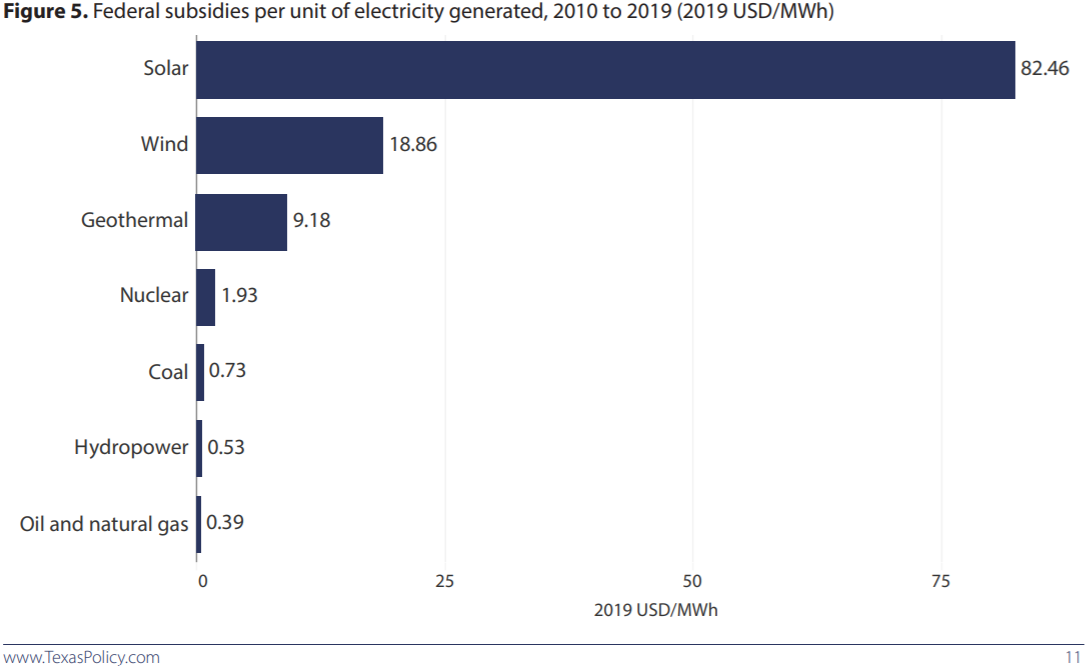
A new report released by the Texas Public Policy Foundation documents federal subsidies received by the energy industry over the last decade. While all sources of energy received federal subsidies of varying amounts, some energy sources benefited much more than others.

Wind and solar power received the most subsidies in absolute terms, receiving $37 and $34 billion, respectively. When broken down by subsidies relative to the amount of electricity produced, the results are staggering.

Subsidies graph

The report concluded that wind and solar producers received nearly as much money from subsidies as they did from selling their electricity on wholesale markets.

The report does not provide state-level data, but Missouri is no stranger to these subsidies. While not having much solar power, Missouri has several wind plants. In addition to the Lost Creek wind farm that received $107 million in subsidies from the 2009 federal stimulus bill, numerous wind plants are recipients of the federal Production Tax Credit (PTC), which is the biggest provider of wind energy subsidies in the nation.

The PTC reimburses wind power producers between $15 and $24 per megawatt hour of electricity generated over a period of ten years. The PTC has been extended several times since its inception in 1992. However, it is being phased out and is set to expire at the end of 2020, although IRS rules effectively stretch this to 2022.

The latest Missouri plans to claim more subsidies is a $1 billion taxpayer-funded wind power expansion by Ameren. Construction will begin in time to claim the last of the PTC, a consideration that Ameren noted helped speed up the construction schedule.

The Energy Information Administration, the data branch of the federal Department of Energy, has repeatedly predicted a near cessation of new wind plant construction once the PTC expires. As Warren Buffett, himself the owner of several wind farms, has said: “without the production tax credit” he wouldn’t build them. “They don’t make sense without the tax credit.”

As the PTC expires, we shouldn’t replace it with a state-level program. Missouri borders tornado alley—the nation’s best region for wind power—and it’s time for the wind industry to compete without subsidies and mandates.

Federal Stimulus Money in Missouri: What We Know So Far

With the federal government handing out trillions of dollars in “stimulus” money (I would call it relief funds), you might wonder how much is coming to Missouri. Over $10 billion has flowed to private and public Missouri entities, with more to come. In addition to money already received, several sums of money have either been awarded to Missouri without notification of delivery yet or are expected based on funding announced via a federal formula for allocation. Some funding is also available for Missouri agencies but not guaranteed, as the relevant agencies must apply for the funding. Here’s what we know based on the information released thus far.

State and local government

Missouri has received roughly $2.096 billion for state and local government relief. $521 million of that must be distributed to counties and cities with populations under 500,000 within ten days of Jefferson City receiving the funds. St. Louis County has also received roughly $173.5 million and Jackson County $122 million. The money is to be used for non-budgeted coronavirus-related expenses.

Community health centers

Twenty-nine community health centers have received a total of $29.8 million for testing, treatment, and continuing primary care.

Education

Missouri’s Department of Elementary and Secondary Education has filed the appropriate paperwork to receive $208.4 million from the Elementary and Secondary School Emergency Relief Fund. Further, the governor has announced that $54.6 million from the Governor’s Emergency Education Relief Fund will also arrive to assist with K-12 and higher education, as well as $117 million from the U.S. Department of Agriculture to help provide school lunches. Senator Roy Blunt has announced that Missouri will receive $206 million for colleges and universities, half of which will be immediately available for institutional and student use, as well as $66.5 million through the Child Care and Development Block Grant for early childhood education needs.

Transportation

The Missouri Department of Transportation has received $61.7 million from the CARES Act to be used for operating expenses and capital assistance for 30 rural agencies. Additionally, Missouri has received $152.4 million to be used for revenue assistance at 75 airports across the state.

Housing

$57.7 million in Community Development Block Grants are reported as being available to a combination of 16 Missouri cities, counties, and state government by the federal Department of Housing and Urban Development. This money is supposed to be used as block grants, emergency solution grants, and housing opportunities for persons with AIDS. The Missouri Department of Economic Development has announced that it will receive $13.6 million of that total.

Unemployment

The Missouri Division of Employment Security has used more than $66 million in federal funds to provide additional unemployment compensation, although more compensation will be distributed once the state determines how to process workers in the “gig” economy.

Emergency management

Missouri can apply for roughly $1.86 million to assist with emergency management procedures ranging from data collection and sharing to response plan development. A 50 percent match in state funding for the program is needed to receive funding.

Public safety

The cities of Joplin and St. Joseph have received funds to assist with public safety expenses for a combined total of $170,000. Overall, $5.5 million is available for 28 Missouri county and city agencies and $11.6 million for state agencies, should they choose to apply for these funds.

Small business loans

Over 46,000 Missouri businesses have received loans from the Paycheck Protection Program, totaling slightly more than $7.5 billion.

Summary

Received: $10.201 billion

Expected: $710.2 million

Available through application: $18.79 million

If you add these sums together you get $10.918 billion. This is what we know so far. More dollars may arrive in the future, boosting the totals for many—if not all—categories.


Don’t Subsidize What’s Already Happening

When the country needed more personal protective equipment (PPE), many PPE-producing companies ramped up production, while other companies started making these products. Now, Missouri lawmakers want to give a tax incentive to PPE-producing companies that expand or relocate to Missouri. Does this raise some red flags? It should.

A tax incentive is meant to lower the tax burden on a business in order to achieve a desired outcome. For example, if the state wanted more boat production, then it could create a tax incentive for boat production, which lowers the cost of producing boats and might increase the supply.

Whether you agree with tax incentives in general or not, the logic here with PPE doesn’t work. The desired outcome—more PPE production—is already happening in the market. The demand for PPE rose drastically due to the pandemic, and suppliers have responded by expanding and shifting production. Firms will continue to respond as long as the demand remains high.

Even if you support tax incentives, the timing here is backward. Why would Missouri subsidize something that is already happening? The market has already incentivized companies to produce PPE; there is no reason to give handouts to try and steer the market when the market is already doing its job.

In this case, there is no reason to give away future tax dollars through government handouts. Additionally, should the state be giving away future tax dollars when the budget will suffer huge hits from the pandemic? Missouri has a rocky history with tax incentives, and this would be an unnecessary addition.


Support Us

The work of the Show-Me Institute would not be possible without the generous support of people who are inspired by the vision of liberty and free enterprise. We hope you will join our efforts and become a Show-Me Institute sponsor.

Donate
Man on Horse Charging