

Federal Relief Funds: A Tale of Two Counties

Neighboring St. Louis and St. Charles Counties are taking different approaches in handling federal coronavirus relief funds, with potential consequences for taxpayer dollars.
St. Louis County councilmembers, in a contested 4-3 vote, forfeited their legislative oversight authority of the federal coronavirus relief funds the county received to the county executive. No spending plan has been released, leading some to question the executive’s spending priorities.
The lack of legislative oversight appears to have contributed to some questionable expenditures. A $1.7 million overflow morgue was constructed which is currently sitting empty and has never held more than 56 coronavirus victims out of a capacity of 1,300. Additionally, a $1 million no-bid contract for a hotel to shelter sick first responders is currently reserving empty rooms. Of the 120 rooms reserved since mid-March, only 52 have been used for an average of $23,000 per person for an eight-day stay. The ten rooms currently in use are housing homeless people rather than emergency responders. As only $9 million of the relief funds have been spent so far, these are not insignificant expenses.
Conversely, St. Charles County councilmembers retained legislative oversight and influence over how the funds will be spent and have released a plan to do so. All money is currently designated for coronavirus-related expenses or reimbursements, as it should be. No spending data has been published yet, so time will tell if additional oversight will aid in more prudent spending.
Having legislative oversight is no guarantee that questionable decisions will not be made, but it can reduce the risk. St. Louis County councilmembers who voted against forfeiting oversight lamented the council’s lack of involvement in the executive’s decisions, noting that other ideas could have resulted in better use of taxpayer money. St. Charles County councilmembers made a point not to take the same route as their neighbors, with the goal of establishing broad transparency over expenditures.
Ultimately, transparency in government spending is for more than just transparency’s sake. Accountability and oversight hold out the promise of more prudent use of taxpayer money, especially as taxpayer dollars will be at a premium for the foreseeable future.
Harsh Trade-offs with Medicaid Expansion

Medicaid is breaking Missouri’s budget, and expanding the program would only make things worse. Every additional dollar Missouri spends on Medicaid is one that can’t be spent elsewhere. Visualizations can help illustrate the scale of the problem.
Assuming Missouri’s spending trajectory doesn’t change (a very conservative estimate given the current pandemic), here is a look at the tough road ahead for Missouri’s budget, with and without Medicaid expansion.
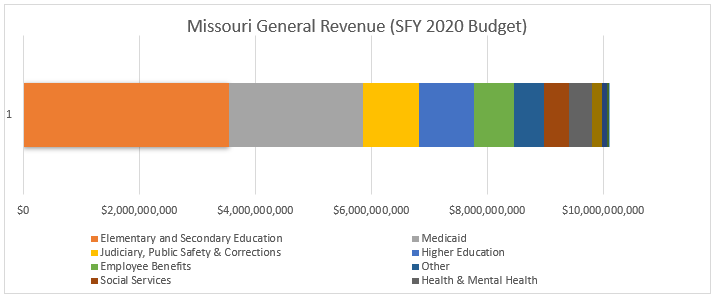
This is where Missouri’s tax dollars are being spent this year:
And here is a simple estimate of Missouri taxpayer spending on Medicaid over the next five years:
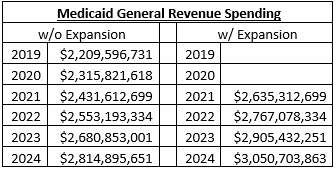
Note: These estimates use a yearly cost inflation factor of 5 percent based off the previous year’s growth. Expansion spending will likely be higher, but for simplicity, the estimate includes new enrollment of 230,000 Missourians with the state picking up 10 percent of their health care costs. The expansion spending also includes a “woodwork effect” of 50,000 new enrollees for which the state would pay the traditional 35 percent.
The table shows that Missouri’s tax revenue collections would have to increase by more than $730 million by 2024 just to cover conservative cost estimates for Medicaid expansion. Simply covering the costs means that no new funds will be available for other state programs over the same period. And any shortfalls will have to be paid for with tax increases or cuts to current programs.
It is important to note that achieving the revenue growth required to avoid these outcomes is certainly not a given. Just last year, state revenue collections increased by $98 million in total, but this year revenue collections are expected to decrease by approximately $600 million.
So, where will the money for Medicaid come from if not from increased taxes or revenue growth? Since nearly 45% percent of all general revenue spending goes toward education, it’s likely the funds will come at the expense of public schools and other state priorities. Here are a few examples illustrating the scale of Medicaid’s cost growth, and how those funds might otherwise be spent.
$730 million translates to:
– $3,500 for each child in poverty receiving a public K-12 education or
– $10,400 for every person in poverty attending a public higher education institution or
– 4,700 miles of interstate highways could be resurfaced or
– More than double the state investment in public safety measures for each of the next four years
Every year that Medicaid’s costs remain unchecked, other funding priorities will suffer. Given the current revenue shortfall, balancing the budget over the next few years is likely going to be a difficult task. Before expanding government programs, voters and policymakers should be aware of the costs and trade-offs expansion would bring.
SCOTUS Delivers Key School Choice Victory

This morning, the U.S. Supreme Court handed down its ruling in the case of Espinoza v. Montana Department of Revenue. The court held that Montana could not restrict participants in a tax-credit scholarship program from using the scholarship funds to attend private religious schools.
The ruling finally puts to rest whether states can discriminate against religious schools in state-funded scholarship programs. Until now, states have relied upon constitutional amendments—born from an idea conceived by Congressman James Blaine nearly 150 years ago—to prevent any public money from going to religious schools. These so-called “Blaine Amendments” were primarily about discriminating against Catholic schools at a time when the Protestant majority was concerned about Catholic immigration. But no more.
And if you don’t think parents want to be able to find the school that’s best for their children, then you haven’t met Kathy Espinoza. Her years-long fight for her children went all the way to the Supreme Court of the United States. Now it’s settled. But just because the legal question is settled doesn’t mean there isn’t still much work to be done. States still need to act, and lawmakers should recognize that parents want and deserve school choice, regardless of school type.
It’s likely that there will be a lot of unhappy parents this fall as districts begin to release their reopening plans. Missouri has over 25,000 available private school seats; some are in religious schools, and some are in secular schools. This ruling means the Missouri Legislature could let parents access these seats by creating scholarship programs that would allow families to choose the best education for them. As of today, lawmakers are out of excuses.
Thomas Sowell, Charter Schools, and Their Enemies

Not long ago, I was having a civil conversation with a colleague with whom I regularly disagree. (I know, this type of thing is rare these days.) We got to the heart of the issue, which was a disagreement on a fundamental principle that led us in slightly different directions. I told him that I put an emphasis on liberty in policy decisions. He said he put an emphasis on justice, and we didn’t go much further than that. If we had, I’d have pressed him and said you cannot have justice when someone’s liberty has been violated. He’d have probably said the reverse: You can’t have liberty if there is no justice. The point here is not which of us was correct (probably me), but that we were talking about principles. Now, as much as ever, it is a good time to think about the principles that guide us.
As we try to work towards a better future, we must understand what we are aiming for. Noted economist Thomas Sowell makes this point in his latest book, released today, Charter Schools and Their Enemies. He’s writing about education, but his observations apply to so many aspects of our public life. He writes, “Trying to micromanage the future has a very poor track record—and so does simply letting things drift. What we can do is consider in advance what kind of general principles and specific institutions seem promising.”
When it comes to education, Sowell suggests, “Perhaps the most important of these general principles is that schools exist for the education of children” [emphasis in the original]. This is a point we too often miss. Sowell’s focus in the book is, of course, charter schools. He describes how pushes to increase accountability and regulation of charter schools rarely focus on efforts to actually increase the quality of the schools, but are instead intended to stifle and limit the spread of charter schools. Issues surrounding charter schools are too often framed in us-versus-them terms, so that people think they must either support public education or side with the privatizers who want to destroy public schools. Sowell reminds us that this binary thinking is not helpful. Instead, when thinking about charter school policies (and other education policies), the public and policymakers should be asking, “what possible benefit to the education of children can we expect from this?”
When we don’t agree on principles or share basic assumptions, as my colleague and I didn’t, it is difficult to agree on solutions to problems. That is why it is important for us to understand and agree that schools exist for the education of children. They are not designed to keep communities together. They are not built to provide jobs. They exist to educate children. When we agree on this, we pursue policies that put the interests of children first.
Today marks Thomas Sowell’s 90th birthday. It also marks the release of his latest book, Charter Schools and Their Enemies. Check it out.
Missouri Needs a Special Legislative Session
Thanks to COVID-19, Missouri policymakers still have legislative work to do before the year is out. From protecting patients to protecting students and entrepreneurs, state leaders should call a special session—and soon—to pass reforms that will ensure Missouri is on firm economic and educational footing heading into the fall.
A list of the most important items to be addressed is available at the link below.
Dear Mr. President: No More State and Local Bailouts

The Show-Me Institute isn’t typically one to join “coalitions” or issue open letters to officials, but the public debate on a proposed second round of coronavirus-related bailouts to state and local governments deserves a plain response.
There should be no further state bailouts. None.
Please do not offer bailouts. Please do not entertain them. The story of American governance over the last half-century has been one of a growing parent-child relationship between the federal and state governments. This relationship is predicated on the expectation of financial support for states in both ordinary and extraordinary times. American states were meant to be sovereigns, not trust fund babies protected from the consequences of their individual actions by the federal government
Now is the time for states to move out of the federal government’s basement and openly reject a new round of bailouts. If they don’t, the federal government needs to kick the deadbeats out by declining to deliver one. The federal government should not prevent states from receiving a needed education on the consequences of their policy decisions.
No. Bailouts.
Further “stimulus” to the private sector, whether it be to businesses or workers directly, should similarly cease. But the increasingly subsidiary federal-state relationship deserves immediate attention, and immediate rejection. Every state, including Missouri, needs to stop its extraordinary reliance on federal money, and the right time to start the detox process is now.
No bailouts. It’s time for the states to grow up.
There Oughta Be A Law: If Walmart is Essential, Small Retailers Are Too

As the coronavirus pandemic accelerated this spring, governments across the country clamped down dramatically on businesses and associations of all kinds. Churches were closed. Restaurants were reduced to carryout, if they were lucky. Other locally owned stores were reduced to even less than “carryout,” often forced to only sell their wares online. Some will make it through the year; others won’t.
But you know who’s doing just fine? Box stores like Walmart and Home Depot and online giants like Amazon. For those massive commercial players, coronavirus evolved into a windfall so great that some of these businesses had to shorten their hours or delay shipping packages.
You know who else is doing just fine? Gun stores, but not because of the goodness of local officials’ hearts. Under Missouri law:
The state, any political subdivision, or any person shall not prohibit or restrict the lawful possession, transfer, sale, transportation, storage, display, or use of firearms or ammunition during an emergency.
Despite attempts to temporarily shut down gun shops around the country, local officials in Missouri largely resigned themselves to applying social distancing guidelines rather uniformly against gun retailers, from Cabela’s to tiny mom and pop gun shops. The purpose of Missouri’s gun law—protecting individuals’ Second Amendment rights—is straightforward. But the effect of the law was to level the playing field between big and small gun retailers, which stands in stark contrast to how local officials treated other small businesses.
Small gun shops could stay open as legally “essential.” But what about small businesses that sold candles, or sporting equipment, or anything else that Walmart and a cadre of other protected operators sold throughout the pandemic? Those small businesses did not get to enjoy the protections of state law, were often deemed “inessential” by local officials and were shut down—in some cases for months.
That’s wrong.
If Walmart can stay open and sell, say, candles, Missouri’s locally owned candle makers should be able to stay open. There is no reason to believe that small businesses can’t undertake rational social distancing and cleaning practices that large retailers have used throughout this pandemic.
How do we know this? Because local gun shops did it. Missouri law should reflect this reality for all small businesses and ensure that Missouri’s entrepreneurs aren’t the victims of disparate treatment by panicked local bureaucrats.
And Missouri should come back into special session and pass a law that makes this clear: If Walmart is essential, all of Walmart’s competitors should legally be, as well. Whether this requires the creation of a brand new statute or can be achieved by expanding the section that already protects gun retailers, it doesn’t matter. What’s important is that legislators act now—before another round of the pandemic hits, and before local businesses can be victimized a second time by inequitable and uneven local public health enforcement.
Missouri Needs Education Leadership Now More Than Ever

The past spring, much of Missouri turned into an education desert of homework packets, learning “opportunities,” and optional enrichment suggestions for children. Soon, very soon, it will be time to turn the education spigot back on. Who will lead us out of this desert? This is going to be a challenge for many of Missouri’s small, rural districts and as much as everyone loves local control, these districts are going to need real leadership from the Missouri Department of Elementary and Secondary Education (DESE).
Unfortunately, that leadership is conspicuously missing. The DESE website has a link to the Show Me Strong Recovery Plan that makes no mention of education. If you dig deeper, you’ll find that DESE and the Department of Health and Social Services hosted an hour-long webinar on reopening that you could watch. The companion pdf has one slide on reopening that mostly focuses on attendance and funding.
What should DESE be doing? Maybe follow the lead of Nebraska. The Launch Nebraska project, has very specific guidance on school governance, operations, and technology targeted to both district leaders or school leaders. Maybe pick up some pointers from the Alaska Smart Start 2020 restart and reentry guidance that has separate suggestions for low-risk, medium-risk, and high-risk districts. Maybe set up a website like Iowa’s Return-to-Learn Support page with deliverables and timelines. Maybe read through Florida’s 143-page pdf titled Reopening Florida’s Schools and the CARES Act regarding closing achievement gaps and creating safe spaces for learning.
Unprecedented challenges in education require more than a webinar video and a slide in a PowerPoint. Having looked at the websites of over 400 Missouri school districts, I can attest that, based on what they were able to do last spring, districts are going to need real guidance and leadership. What type of staffing guidance should they develop? How will they deal with parents who don’t like their plan? How should they deal with teachers who don’t like their plan? How, specifically, should they address the social and emotional needs of students? What should they implement immediately to address learning loss?
There is no reason to make 520 school districts create 520 reopening plans. If the state education agency in Missouri is little more than a clearinghouse of links and information from other sources, then it may be time to rethink its structure and its existence.
