Districts Denied Once Again

Unfortunately, it seems unlikely we’ll get reform for community improvement districts (CIDs) and transportation development districts (TDDs) this year. The governor has vetoed House Bill 1854, which passed the legislature earlier this year. There were a wide variety of measures in the bill (and not all were good), so I won’t speak to the bill in its entirety, but the section relating to CIDs and TDDs would have been a win for taxpayers.

As the process currently works, CIDs and TDDs are approved by a vote of only people within the proposed taxing district. This bill would have subjected CID and TDD approval to a vote of the people in the city in which the district is located. This would have solved one of the biggest problems with these taxing districts: Many are not subject to a broad-based, representative vote for approval. Some districts can even be approved by only a handful of property owners if the district is small enough, yet the costs are externalized to all taxpayers who spend within the district.

As Show-Me Institute researchers have mentioned before, special-taxing districts like these are on the rise. According to financial reports received by the Missouri State Auditor, there are 495 CIDs and 237 TDDs in Missouri. CIDs collected over $56 million and TDDs collected more than $73.5 million in 2018. Hundreds of districts are taking millions away from Missourians, and they may not have had a say in it.

The problems with CIDs and TDDs are clear, and lawmakers should act. There is still an opportunity to give taxpayers increased representation in a special legislative session, but it seems that for now, the problems with CIDs and TDDs will continue.

Call it What it is: Medicaid Expansion

Supporters of Medicaid expansion have long played loose with the facts of the program, and this year is no exception. Earlier this year, my colleague Elias Tsapelas scuttled the notion that Missouri would “save money” by expanding Medicaid. Expansion backers have now pivoted to an oldie-but-goodie talking point: that Missouri would be “bringing home” their tax dollars from Washington.

It was nonsense five years ago when they made the argument to the legislature, and it’s nonsense now.

I won’t republish my entire Forbes piece here, so click the link above if you’re interested in the original editorial. But plainly, the expansion does not operate like the public is now being told it does in TV ads.

  • There is no federal pot of money divvied among participants when other states don’t join the expansion. If only one state expanded Medicaid, that one state wouldn’t then receive the funding of the 49 non-participating states. It’d receive money for its program and no more.
  • Missouri already receives more in federal support than our federal contribution warrants. We rely more on federal money than most other states, and we’re already getting more than our “fair share” in federal cash even without expansion.
  • But perhaps most importantly, there are no “tax dollars” being “sent back” to any state, especially these days. We are in a period of extraordinary deficits, and that means every new dollar spent by the federal government is from debt, not from taxes paid.

Medicaid expansion is debt, plain and simple, and yet it will still require redirecting existing state money currently earmarked for education, public safety, infrastructure, and other priorities to feed the Medicaid program’s insatiable appetite.

It’s Medicaid expansion debt. Supporters should be honest with the public and call it what it is.

Missouri Medicaid Division Confirms Expansion Will Break Budget

Medicaid expansion was never going to be “free” for Missouri, and now we have even more evidence that expansion would be a catastrophe for the state’s budget. Recently, the Missouri House of Representatives Budget Committee met to discuss the fiscal implications of Medicaid expansion. Testimony delivered during the hearing reinforced what’s been obvious for a while now: The promised taxpayer savings from the Medicaid expansion proposal are fictional.

Nearly five months ago, I wrote about my concerns with the widely cited Washington University expansion model. Last week during testimony before the committee, the Missouri Department of Social Services (DSS) confirmed that my concerns were valid. DSS officials explained in no uncertain terms that it would be illegal to enroll disabled Missourians into the Medicaid expansion population. This means that currently disabled Missourians would only be eligible for the current lower matching rate for federal funds, instead of the much more generous matching federal rate for the expansion population. And as I outlined in February, without that assumption, there’s a billion-dollar hole in the Washington University model’s cost estimates.

DSS also released its own estimates for the budgetary impact of Medicaid expansion. The projections are based on Missouri’s current Medicaid costs, its economic conditions, and what is known about the state’s low-income population, and they show that expansion will cost more than $2.7 billion in total each year. The federal government will pay the majority of that $2.7 billion, but state taxpayers still pay federal taxes. In state general revenue spending, DSS estimates it will cost more than $167 million per year, which will amount to more than $870 million in state income and sales tax dollars between 2022 and 2026.

These estimates are a far cry from “savings,” which is especially important because these costs will come on top of the current Medicaid program’s growth. It is also important to understand why the Washington University expansion model varied so significantly from our own state Medicaid agency’s predictions. In the end, it comes down to a series of faulty assumptions.

Not only were the authors of the model wrong about what could be done with Missouri’s disabled population, but they also vastly underestimated the number of Missourians that would enroll in expansion and the associated cost of their care. Instead of roughly 230,000 newly eligible adults enrolling, DSS suggests the total will be closer to 286,000. And the monthly cost of each new enrollee will be more than $730 per month, as opposed to the Washington University assumption of $425.

With updated DSS numbers and corrected assumptions about disabled enrollment, the WashU model’s conclusion of a financial boon for Missouri is unattainable. Based on this new information, and given the severity of our state’s current economic downturn, it’s time to stop pretending Medicaid expansion will not break Missouri’s budget.

It’s Time to Make Net Metering a Net Positive

Net metering is a popular program that allows rooftop solar panel owners to sell extra electricity they generate back to their utility to offset their bill. However, as I wrote recently, net metering customers are routinely overcompensated for their electricity. This makes net metering a costly program for an expensive technology that benefits the wealthy at everyone else’s expense.

So how do we fix this? The key is to level the playing field. This could be achieved by altering net metering customers’ compensation rates and opening retail electricity markets for competition.

For those wanting a closer look, I address this in more detail in a recent op-ed for Real Clear Energy.

Unfairness in Missouri Teacher Pension System

What is fair? It is sometimes a hard concept to grasp. As a first-grade teacher, I constantly heard students say “That’s not fair.” Sometimes the complaints were unfounded, like when the most obnoxious student in the class complained that the students following the rules were rewarded with a piece of candy. At other times the claim had merit, like when I copied a lesson on discrimination out of Jane Elliot’s book. Throughout the day, I favored blue-eyed children over all other children. By lunchtime the class couldn’t take it anymore and a boy burst out, “It’s just not fair, Mr. Shuls!” The truth is, some things are just fundamentally unfair; so much so that even a first-grader can see it.

There are other sorts of inequities, however, that are much stealthier. They are no less unfair, just less noticeable. Take for example the Public School Teacher’s Retirement System of Missouri. Most public school teachers love this retirement plan. It allows many teachers to retire by their mid-fifties and earn a steady income for the rest of their lives. But most teachers don’t know that this system has been built with a structural flaw that favors some individuals over others.

As Andrew Tipping and I demonstrate in our forthcoming peer-reviewed article in Educational Researcher, “Cross-subsidization in Teacher Pension Benefits: Examining Rates of Return Among School Districts,” teachers in some school districts get disproportionately larger returns on their retirement contributions. We calculated the rate of return for a career teacher in 490 school districts. The rate of return is the interest rate that would be needed, based on all contributions, to pay out a specific benefit for a pre-determined period of time. For instance, if I put $100 into a savings account and wanted to take out $110 in a year, I would need to earn a 10 percent return. We simply do the same sort of calculation, but over a 30-year career and a 30-year retirement. We find a tremendous disparity in the rates of return among career teachers in different school districts. The variation of rates of return among school districts is displayed in the histogram below taken from our article:

Pension rate of return

Source: Authors’ calculations on the basis of Missouri School Boards’ Assocation (2015), Public School Retirement SYstem of Missouri (2016), and district salary schedules.

We found that in general, smaller, lower-paying school districts have lower rates of return and larger, higher-paying school districts have higher rates of return. This occurs because of the structure of the system. So why does this happen?

Let me try to explain. Imagine you and I decide to pool our investments, and we each invest $500 for a total of $1,000. Only, we do not invest our money all at once. We do it over a period of five months. You invest $100 every month for five months. I invest $65 the first month and increase my investment each month with a final contribution of $123 in the fifth month. I somehow convince you that we should base the payout on just the fifth period and not our entire investment. We earn a 10 percent return on our $1,000 investment, but distribute the funds based on our final period five contributions, which leads to a 45/55 split, despite both investing the same amount of money in total.

Pension return table

That is essentially what happens in the pension system and no one seems to notice.

Teachers in poorer school districts contribute more in the beginning of their career relative to the end, and because of the way the system works, they end up subsidizing the retirement benefits of teachers in wealthier school districts. This cross-subsidization of pension benefits occurs because benefits are not tied to total lifetime contributions. In fact, only the final three years out of a teacher’s entire career are used to determine benefits. It is this design of the system that allows this unfairness to occur. Yet, unlike my first graders, no one seems to be shouting out “That’s not fair!”

Other States Are Deregulating. Missouri Should Too

The COVID-19 crisis has led to rules and regulations being relaxed or even temporarily eliminated in states across the country. Some lawmakers and government agencies are taking steps to make these changes permanent in order to reduce burdens on businesses and workers. There is no reason Missouri shouldn’t do the same.  

One example is Oregon’s Liquor Control Commission, which is taking steps to make the temporary relaxation of some of its rules permanent. Even better, Idaho’s governor is taking action to make a wide array of the state’s COVID-19 deregulation permanent, saying that “if waiving these regulations was deemed necessary to improve public health and welfare during the declared emergency, there is a rebuttable presumption that the regulations are unnecessary or counterproductive outside of the declared emergency.”

Sound familiar?

Show-Me Institute researchers have made this argument many times when speaking favorably of COVID-19 regulatory waivers and when calling for lawmakers to make the waivers permanent. The issue is critical enough that it was included in the Show-Me Institute list of the top issues that ought to be addressed in a special legislative session.

This call for deregulatory action is not a call from left field, nor is it an extraordinary ask. Other states are taking advantage of this opportunity to stay competitive and lessen the burden on businesses and workers. Missouri should too.


Parma Scandal Affirms: Mandatory Muni Checkbook Transparency Needed Now

The Missouri State Auditor’s Office has started July off with a bang, publishing an audit of Parma, Missouri, which found that “. . . [m]ore than $115,000 was taken fraudulently over a four-year period from the Missouri Bootheel city of Parma (pop. 713) through payroll overpayments and improper payments and purchases.” As the report notes, [Emphasis mine]

Our audit discovered that for almost the entire time the former mayor and former city clerk were in office, there was a pattern of blatant corruption and cover-up that cost the citizens of Parma more than $115,000,” Auditor Galloway said. “This was a betrayal of the public trust that requires accountability, and my office will continue our partnership with law enforcement to pursue justice for local taxpayers. . . .

The audit also estimated more than $7,000 in improperly recorded utility payments and adjustments to utility bills on the accounts of the mayor, water supervisor, the alderman who is the mayor’s father, an alderwoman, and a church. The city’s electronic utility system was destroyed in the city hall fire, but auditors were able to compile information for the audit from paper reports, bank statements and other documents.

The auditor’s full report can be found here.

We are hearing that among the items legislators are considering for a special session is a “Wayfair fix,” which notably would allow local governments to collect sales taxes on internet purchases. As we’ve said before, any such “fix” should be revenue neutral, but it’s become obvious that there should be another precondition: checkbook transparency. Any government wanting to tax the internet purchases of residents should be required, as a condition of such privilege, to regularly publish their transaction data with the state.

Show-Me Institute researchers have called for this transparency before, but Parma’s scandal reaffirms how pressing the initiative is, especially in these difficult economic circumstances where every dollar counts. If government can take your money through force, it should be telling you where it went. And if governments have to do that, well, hopefully we’ll have fewer Parmas in the future.


What Do Parents Want This Fall?

In these uncertain times, few things are certain. But one thing we do know for certain is that parents are anxious about schools reopening this fall. Although very few school districts have released reopening plans, it’s probably safe to say that some will be deemed unsatisfactory by a lot of parents.

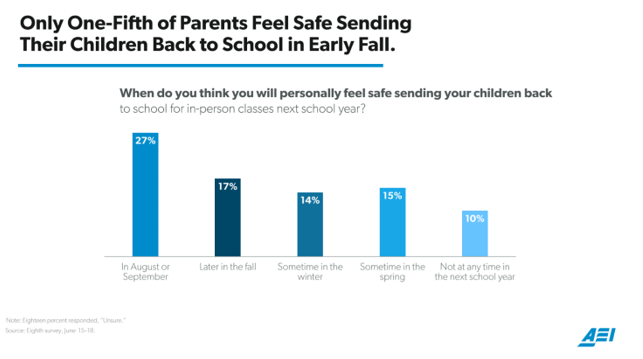
That’s because parents want different things. Some are ready to send their kids back to school right now, and may really want or need a full-time in-person schedule instead of an alternating schedule. Clearly some parents want only virtual education—but for differing amounts of time. One in ten parents wants to wait out the whole year. The graph below, from a recent study by the American Enterprise Institute, reflects how parents are thinking differently about school reopening:

Parents poll

Hopefully, policymakers and education leaders in Missouri are hard at work trying to figure this out. One obvious move is to ensure that parents can easily enroll their children in the existing, approved virtual programs through the Missouri Course Access Program (MOCAP). Requiring district permission to do so is ridiculous at this point.

A second immediate need is to let parents seek out and purchase the education that they’re comfortable with this fall. A Learn Safely Scholarship would give parents funds to spend on education resources, like private school tuition, as they see fit. Putting funds directly in the hands of parents would help fill the void in what districts are providing.

Parents have become front-line workers in public education, and many are exhausted and anxious from the experience. The time to figure out how to educate every Missouri student is now, not after we see the reopening fallout.


Support Us

The work of the Show-Me Institute would not be possible without the generous support of people who are inspired by the vision of liberty and free enterprise. We hope you will join our efforts and become a Show-Me Institute sponsor.

Donate
Man on Horse Charging