What to Expect When You’re Expanding

Earlier this month, Missouri voters decided it was time for the state to expand Medicaid. Our state’s elected officials now have roughly ten months to iron out all the details before expansion goes into effect next July. With so many important decisions on the horizon, here are some questions for policymakers to consider.

What should Missouri’s version of expansion look like? States across the country have been given flexibility in implementing Medicaid expansion, and Missouri should take advantage of this. Seeking the appropriate federal waivers to tailor expansion coverage in such a way that it best meets the needs of Missouri’s recipients, while also protecting state taxpayers, should be a top priority.

What needs to happen prior to July 1, 2021? Expanding Medicaid will likely require significant changes to the current program. First, the state’s Medicaid agency will surely need additional resources to handle the extraordinary influx of new enrollees. At a minimum, this would include computer system upgrades and increased staff. In addition, state laws and regulations will need to be updated to accommodate the new expansion population.

What is the plan for covering the costs? One of the biggest concerns with Medicaid expansion is the cost and corresponding impact on the state’s budget. Policymakers will need to decide how to pay for the already skyrocketing costs of the current Medicaid program, while also figuring out how to budget for the potentially hundreds of thousands of new recipients. In such uncertain budgetary times, how Medicaid is funded could have significant impacts on other state funding priorities.

How will accountability be encouraged? Medicaid expansion will grow Missouri’s budget by billions of dollars over the next few years. It will be more important than ever that state taxpayers know how their money is being spent. Before the expansion proposal is implemented, policymakers should establish accountability metrics to help ensure each tax dollar is being put to good use.

Voters may seem to have the final say on a matter, but the passage of Medicaid expansion means we’re now entering the more complicated process of actually implementing the policy. Over the next ten months, our elected officials should carefully weigh every available option, because the decisions made will surely impact Missourians for years to come.


Is It Just Me?

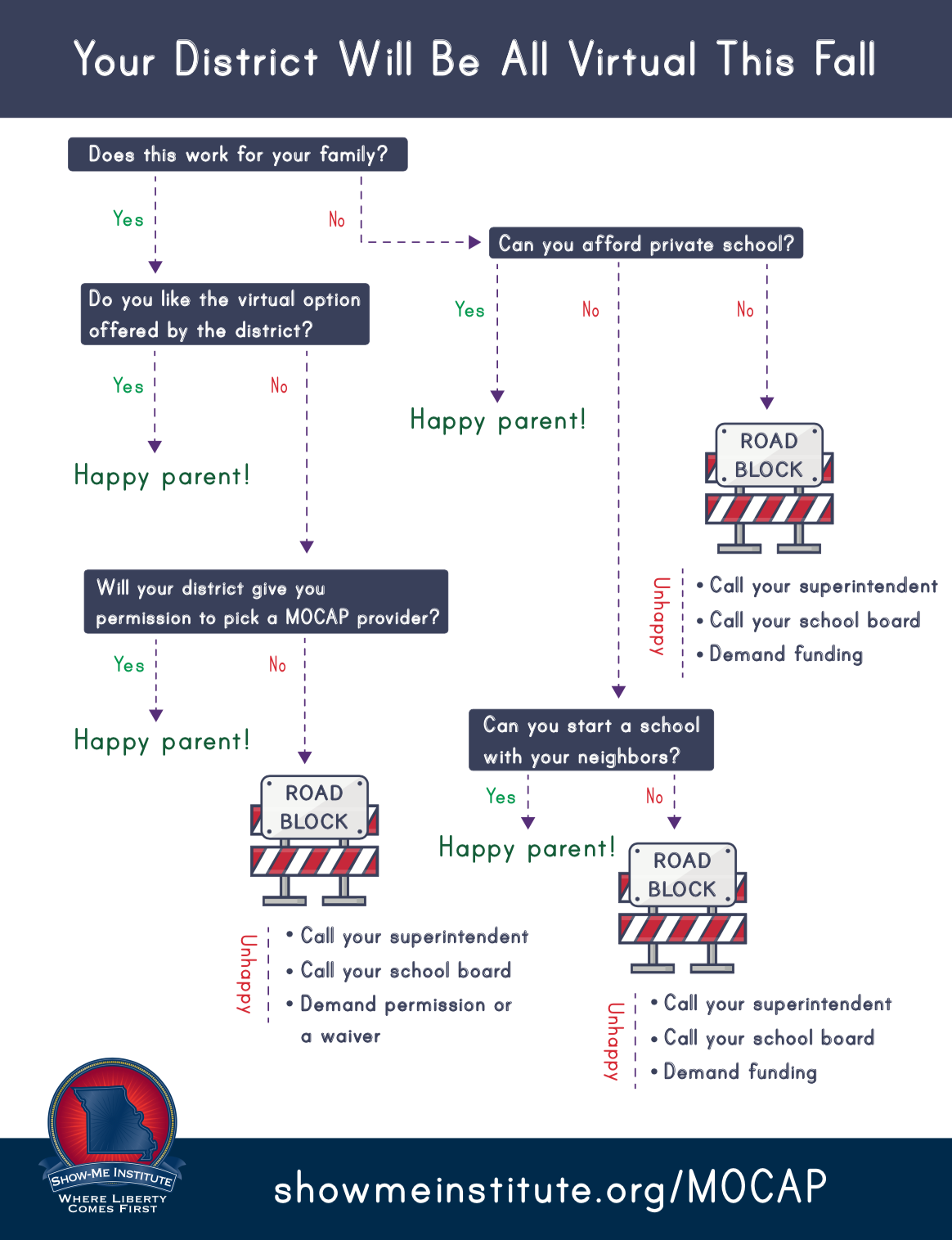
For many Missouri students, the much-anticipated start of the school year has been a bust. Thousands of parents who were expecting to have a safe place to send their children learned very late in the summer that their district is sticking with virtual education for the time being. If these parents can’t afford to pay someone to look after their children and help them with their homework, what are they to do?

In some states—Oklahoma, South Carolina, and New Hampshire, to name a few—governors ve used flexible federal stimulus funding provided through the Governor’s Emergency Education Relief (GEER) to directly help these parents. In South Carolina, Governor McMaster created the Safe Access to Flexible Education (SAFE) grant program for low-income students. Students who apply can receive up to $6,500 to help them pay tuition at a private school. Oklahoma’s Governor Stitt used GEER funds to create the Stay in School Fund, which gives low-income parents $6,500 to keep their children in private schools.

These seem like great ideas that are addressing an immediate need. In a perplexing move, Missouri’s governor has dedicated $15 million of the just over $54 million in GEER funds received to a Transportation Supplement Grant program. This money will eventually go to districts to cover additional COVID-related transportation costs. Other than PPE and cleaning buses more often, I can’t imagine what these costs would be, especially when so many districts are all virtual. But maybe it’s just me. Districts can request reimbursement for any COVID-related transportation costs between now and September of next year and they have until September of 2022 to make the requests.

The Secretary of Education sent a letter to every governor with the following guidance:

This extraordinarily flexible emergency block grant empowers you to decide how best to meet the current needs of students, schools (including charter schools and non-public schools), postsecondary institutions, and other education-related organizations in your State so that faculty continue to teach and students continue to learn. My Department will not micromanage how you spend these funds, but I encourage you, at a time when so many school boards, superintendents, and institutions of higher education have had to close their brick and mortar campuses for the balance of the school year, to focus these resources on ensuring that all students continue to learn most likely through some form of remote learning. They and their families are depending on your leadership to ensure that they don’t fall behind.

We have thousands of desperate families with immediate needs, and yet we’re putting millions of dollars in emergency relief into an account so that two years from now districts can request reimbursement for face masks and bus cleaning? I don’t get it.

This Is School Choice

What is school choice? Many believe it’s a way to get disadvantaged children out of terrible schools. But in 2020, it’s pretty easy to see that it’s much more universal than that.

Parents who work outside the home and just found out their schools will be all virtual this fall know what it feels like to need another option for their own children. Parents who bought expensive homes in top-notch school districts who just found out their district is staying virtual for the fall are quickly getting up to speed on not getting the education they thought they had locked in. Parents who are scraping together funds with their neighbors to hire a teacher for in-person teaching are finding out the meaning of having to pay for school choice. Parents of children who can’t participate in their district’s in-person or hybrid plan are discovering the obstacles of enrolling their children in a virtual program of their choice. Parents of special needs children who haven’t received services for their disability in six months are desperate for school choice.

The term “school choice” has been around for decades. But parents who were able to move to the school district of their choice have tended to struggle with the concept. Letting children from other districts enroll in their district could water down the value of the house they bought. Letting children use public money to attend private schools hurts public education. Charter schools are fine for inner city children, but we don’t need them in our “good” suburban school districts.

School choice isn’t just for other children in the 2020–21 school year. It’s a palpable need for scores of Missouri children across the spectrum of community type and socio-economic status. Any parent who wants “A” for their child but lives in a  district only willing or able to offer “B” this fall needs school choice. It doesn’t matter how good your school is or how expensive your home is.

Parents in our lowest-performing districts have always known this. The “B” that their districts offer is a low-quality and sometimes even dangerous education experience. The “A” that they want and need is a safe space for their children to thrive. I would urge all parents to remember this shared experience. To remember the feeling of finally learning how your district’s hybrid plan was to work, only to have it thrown out the window for all-virtual. Remember the frustration of receiving long emails from your district about their plan, only to read “this is all subject to change” at the end. Remember finding a micro-school option for one of your children, but not the other. Remember hoping your boss will understand.

School choice is simple. It means making sure that no parent is stuck with only one option when that option is unacceptable.

Green Energy’s Environmental Impacts: Out of Sight, Out of Mind

The Missouri Renewable Energy Standard requires that at least 15 percent of Missouri’s electricity from state-regulated electric utilities (such as Ameren and Evergy) come from green energy sources by next year. There has been some movement to increase this, as at least one member of Missouri’s Public Service Commission—the body regulating electricity in Missouri—supports raising the requirement. Further, an initiative petition that circulated earlier this year proposed increasing the requirement to 50 percent by 2040.

While such goals are often introduced as environmental necessities, a new report from the Manhattan Institute calls for a reality check on the environmental impact of such green energy goals. The report highlights “the inescapable reality that every product and service begins with, and is sustained by, extracting minerals from the earth.”

But what does this have to do with green energy? While wind and sunlight are renewable, wind turbines and solar panels are not. Further, energy-storing batteries require large amounts of non-recyclable materials. In fact, all three are quite resource intensive and producing them can have serious environmental consequences.

The report notes that, compared to a natural gas plant, wind and solar power plants require 10–15 times as much steel, concrete, and glass to generate the same amount of energy. Manufacturing a single 1,000-pound electric vehicle battery requires mining, moving, and processing 500,000 pounds of materials.

These machines wear out, too. Wind turbines and solar panels last between 20 and 30 years, and electric vehicle batteries last around seven.

Those concerned about large amounts of unrecyclable waste should be equally concerned about the afterlife of these machines. According to the International Renewable Energy Agency, current solar growth policies will result in roughly 51–67 million tons per year of unrecyclable waste by 2050. While not a perfect comparison, this is nearly twice the current annual level of unrecyclable plastic waste. If wind energy grows as the International Energy Agency predicts, turbines will contribute another 3 million tons per year of unrecyclable plastic waste by 2050. Lastly, the Manhattan Institute report calculates that more than 10 million tons of batteries per year will become unrecyclable waste by 2030 under current projections.

None of green energy’s environmental drawbacks change the fact that fossil fuels negatively impact the environment as well. However, every energy source has environmental impacts, and currently there is no magic bullet for truly “clean” energy production. As Missourians are asked to support green energy programs at the state and federal level, they should recognize the tradeoffs involved. While green energy’s environmental impacts may be out of sight, they should not be out of mind.

Cato’s Michael Cannon Visits the Podcast

Last week, Stuart Butler of the Brookings Institution joined the Show-Me Institute Podcast to talk about his views on health care reform in the United States. Though we disagree on some points, Stuart provided a valuable and interesting perspective on what the future of health care should look like in this country.

This week we have a new batch of health care perspectives. Yesterday we brought the Cato Institute’s Director of Health Policy Studies Michael Cannon onto the podcast and asked him many of the same questions we posed to Stuart, and I think our listeners will be intrigued at how markedly different Michael’s views are. Click here for that podcast, and be sure to subscribe to the channel to be notified of this content every time we add something new.

Subscribing is especially relevant now, because tomorrow we will welcome the Manhattan Institute’s Chris Pope to the program and will release that podcast shortly thereafter. Like Stuart and Michael, we’ll ask Chris many of the same questions so that our listeners can easily compare the different perspectives emanating from the market movement on issues like Medicaid, private insurance, and state-based health care reforms. Stay tuned and smash that subscribe button.

Are Policymakers in a Prisoners’ Dilemma with Economic Development Incentives?

In a recent paper, Michael D. Farren and Matthew D. Mitchell compare economic development incentive decisions by two states to the prisoners’ dilemma in game theory. Examining this interesting comparison may provide insights into the Kansas–Missouri border war and better explain why policymakers continue to give out these harmful incentives.

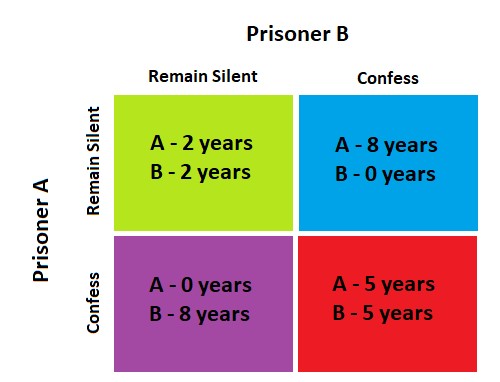
In the classic prisoners’ dilemma situation, two armed robbers have been captured by the police, but there isn’t enough evidence to convict them, so they are questioned separately. Each prisoner can either confess and throw his partner under the bus in exchange for a deal, or remain silent. However, each prisoner knows his sentence is also influenced by the other prisoner’s actions. The police have outlined four scenarios for each prisoner, which are shown in the diagram below. The left side shows the options for Prisoner A, the top shows the options for Prisoner B, and each square shows the results of the corresponding actions.

  • If Prisoner A confesses and Prisoner B remains silent, then Prisoner A will not face jail time while Prisoner B faces the full sentence of 8 years (purple square), and vice versa (blue square).
  • If both Prisoners confess, they will both be partially responsible and serve 5 years (red square).
  • If both remain silent then the police will settle for a lesser weapons charge with a 2-year sentence for both (green box).

Though it would collectively be the best decision for both prisoners to remain silent (only 4 years in prison total, instead of 8 or 10), each has an incentive to confess and betray the other. If Prisoner A confesses, he will either do 0 years instead of 2 if B remains silent or 5 years instead of 8 if B confesses. Prisoner B has the same incentives, so it is also in his best interest to confess.

Because each prisoner cannot know what the other will do, he will act in his own self-interest and confess to avoid more jail time, bringing them to the red square. Here is the prisoners’ dilemma: Each player acting in self-interest actually leads to an outcome that is collectively and individually worse than if both had chosen a different option.

Farren and Mitchell relate the prisoners’ dilemma to policymakers’ decisions to offer economic development incentives. This comparison supplies one possible answer to an important question: Why do we see policymakers offering development incentives when research shows that they rarely have positive (and sometimes negative) effects on economic growth?

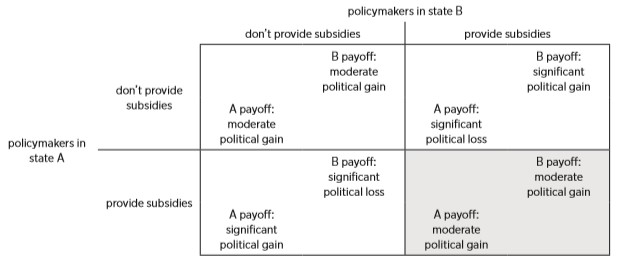
Let’s take a hypothetical scenario where Kansas and Missouri policymakers are deciding whether to provide economic development incentives, without knowing the other’s decision. Ideally, policymakers would consider the research and not give out subsidies, which would result in the most economic growth for both states(outlined on pages 13–14 of the paper).

That is a desirable outcome for both policymakers and citizens; however, the payoffs of this decision would accrue in the long term. When considering the complex decision-making process of policymakers, Farren and Mitchell point out that short-term political support may be an even more compelling motivator. Because of this, we are likely to see decisions that mirror the figure below, with decisions made based on political support instead of economic growth.

Source: Michael D. Farren and Matthew D. Mitchell. “An Interstate Compact to End the Economic Development Subsidy Arms Race. Mercatus Center.

Policymakers feel pressure to provide subsidies because “voters want policymakers to do what they can to outcompete other states for economic development.” (p 15). Policymakers are incentivized to provide subsidies, so we end up in the bottom-right square.

The dilemma is clear: Policymakers act on their short-term self-interest and offer subsidies, which slows economic growth.

So perhaps the prisoners’ dilemma explains why Kansas and Missouri policymakers offer subsidies when the evidence is stacked against their effectiveness. The best solution to a prisoners’ dilemma is for the two parties to somehow come together and agree to pick the communally favorable option. The solution provided by these researchers is an interstate compact. We’ve seen Kansas and Missouri attempt this with their border truce, but the desired results haven’t come to fruition. Finding a way out of the prisoners’ dilemma could be the key to stopping these wasteful incentives and boosting economic growth in Missouri and Kansas.

Not So Fast, Public School Districts

And so it begins. School districts are announcing their plans for how they will reopen, and the protests have begun. Parents in Rockwood, Missouri protested because they want more in-person schooling than the district is offering. Parents in the St. Louis Public School District want more virtual schooling than the district is offering. (And the St. Louis teachers union just declared that the district must start the year completely virtual.) Virginia parents protested because they didn’t like only having a single option of two days in person and three days of virtual instruction per week. Some Washington state parents are unhappy with the lack of details in their district’s plan. Public schooling is currently a mess.

Unhappy parents everywhere are pulling their children out of public schools. In Nebraska, requests to homeschool are up 21 percent. With textbook Toquevillian can-do attitudes, parents across the country are getting together with friends and neighbors and creating micro-schools. Parent unions are forming and some are calling for a “break up” with traditional education.

What could, or should, Missouri be doing during this upheaval? Number one, we need leadership. The Missouri Department of Elementary and Secondary Education (DESE) has only released reopening health guidelines. Should we expect that all 520 school districts simply figure out a great plan on their own? Meanwhile, Nebraska has created a website (Launch Nebraska) with comprehensive planning guides and toolkits.

Number two, we should be making several easily accessed choices available to parents. At least one district, Maplewood-Richmond Heights, is allowing parents who want a virtual education to enroll their students with one of the state-approved virtual providers under the Missouri Course Access Program (MOCAP). Other districts should follow its lead. This is not a year for inventing things from scratch. Parents should also be able to easily choose in-person enrollment at a private school. There are a number of apps, such as Classroom Wallet, that the state could use to provide parents with funds to purchase tuition. This is not a good year to settle the public versus private debate. This is a year to get kids back to learning.

Third, accountability and transparency must not be allowed to fall to the wayside. For the past six months, public school districts have been held harmless from consequences. If this continues much longer, children will be the ones to suffer and achievement gaps will grow.

Parents were put in the driver’s seat last spring whether they liked it or not. And now they’re supposed to give the wheel back to public school districts that seem to not even know how to start the car. It’s not at all surprising that they’re fed up.

Agreeing and Disagreeing on Health Care Reform

This week, my colleague Susan Pendergrass and I had the opportunity to sit down for a podcast with Stuart Butler, Senior Fellow of Economic Studies at the Brookings Institution and a former researcher with the Heritage Foundation. You can find our wide-ranging conversation here. Mr. Butler is highly intelligent and amiable, and I appreciate him taking the time to talk with us.

Our conversation also highlights that even within the market movement there remains a great deal of disagreement about the best way to reform our health care system. Mr. Butler was an early supporter of an “individual mandate” that required the purchase of health insurance, a position he now has largely rejected but does distinguish from the mandate as passed in the Affordable Care Act.

But the main reason we invited Mr. Butler on the program was to talk about his “Medicare Advantage for All” proposal, which he recently published in the Journal of the American Medical Association. Mr. Butler explains what he means by “Medicare Advantage for All” in the podcast, but to be plain (and perhaps unsurprisingly), I disagree with the idea. I don’t think American patients are well served by the government “designing” a health care system that relies more and more on third-party, government-financed and government-controlled coverage for the vast majority of our health services. Proponents of free market-reforms should, I think, focus most of their efforts on expanding supply to meet public demand for health services, and we’ve certainly talked about those options at length and for some time.

In the podcast, we also talk about Medicaid expansion and proposals for changing how Medicaid is administered. As a general matter, I think Mr. Butler is more optimistic about the prospects of the federal government delegating control more definitively to states to control costs and manage the Medicaid program. I’m not so optimistic. In light of the federal government’s Lucyball treatment of state waiver proposals in both Republican and Democratic administrations, I’m not nearly as hopeful as Mr. Butler when it comes to believing states will be allowed to innovate in the program. All of that said, Mr. Butler provides an important perspective that is already part of a larger debate on the future of American health care.

Mr. Butler’s perspective may not be your philosophical cup of tea, but if it isn’t, rest assured that you’ll have plenty of other flavors to digest in the weeks ahead. In the next few days, we’ll be sitting down with Michael Cannon of the Cato Institute and Christopher Pope of the Manhattan Institute to talk about the future of health care in this country, with more guests planned. We hope these podcasts are informative, and we invite your feedback and ideas.


Support Us

The work of the Show-Me Institute would not be possible without the generous support of people who are inspired by the vision of liberty and free enterprise. We hope you will join our efforts and become a Show-Me Institute sponsor.

Donate
Man on Horse Charging