
Susan Pendergrass, David Stokes and Patrick Ishmael join Zach Lawhorn to recap this week’s special election, shed light on a KC City Council meeting that may have happened in the dark, discuss what to do with unspent stimulus money and school mask mandates this fall.
Even Disney Magic Is Swayed by Tax Incentives
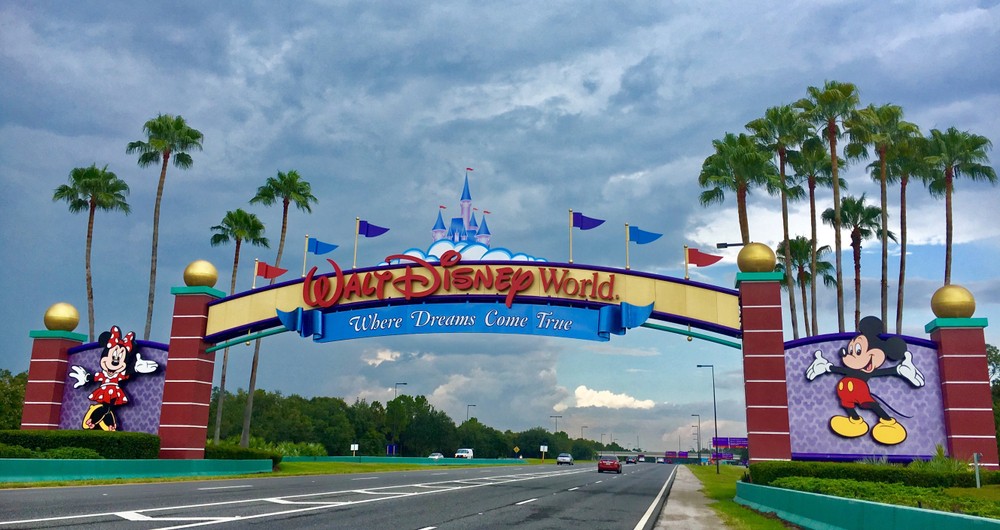
Missouri’s own Walt Disney and his Walt Disney Company may create theme parks that are the most magical places on Earth, but at its core, Disney is a for-profit company. Like other companies, it can be swayed by lawmakers offering tax incentives or tax breaks. Recently, Disney announced to around 2,000 workers that their jobs would be moving from California to Florida. The reason? The company gets tax breaks for moving these jobs to Florida that could save it about half a billion dollars.
Apparently, getting Disney to move a small chunk of its workforce to Lake Nona (a mixed-use development about 20 miles from Walt Disney World) is worth $570 million over 20 years—that’s what Disney is estimated to receive for this move. That’s a lot of money to pass up, so I can’t blame Disney for making the move. However, lawmakers are taking this money away from taxpayers, and they certainly deserve blame for that.
Clearly, Missouri is not the only state that seems to be addicted to handing out money to “help” large companies make decisions. Lawmakers across the country can’t wrap their heads around this important point: Giving away hard-earned tax dollars (or not collecting tax dollars) to manipulate the market and pick winners and losers is a bad idea. The research shows that the broader economy of an area does not benefit from these types of incentives—but the company certainly will.
Missouri and Missouri cities give out and forgo hundreds of millions of tax dollars annually. We’re not the only ones to do this, but we should be the ones to end it. Perhaps we will soon know the “magic” of actually using taxpayer dollars to provide public services to taxpayers.
The Student Shuffle
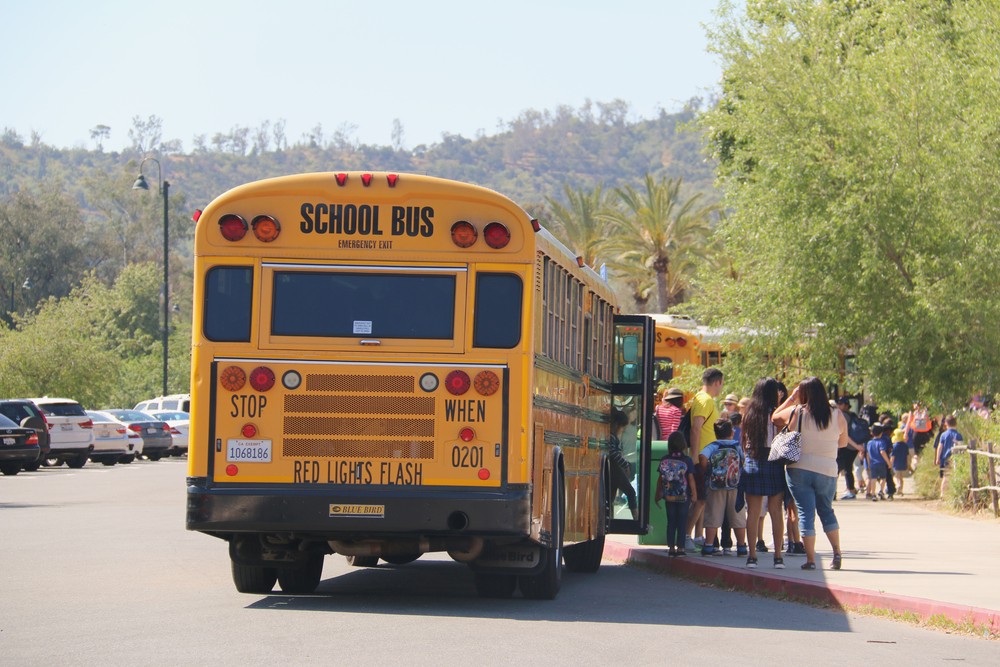
Did you buy a house at least in part because of the neighborhood school? Lots of parents do. What would you do if you suddenly learned that your children must now attend a different school in the name of redrawing school boundaries?
It is common that every five to ten years, school districts will redraw school boundary lines due to growth in the district, attendance changes, and other factors. When these lines are redrawn, students get shuffled around. The Columbia School Board recently redrew boundaries for many of its elementary schools and has announced plans to transfer around 900 students for the 2022–2023 school year.
Leaving aside issues of fit, school culture, student friendships, and other factors, some of these transfers don’t seem to be problematic. For example, some students will be transferred out of New Haven (a school with around 40–44 percent of students meeting proficiency levels in math) to Rock Bridge (a school with around 58 percent of students meeting math proficiency). Other students will be transferred from Shepard Boulevard (math proficiency: 31 percent) to Cedar Ridge (math proficiency: 55–59 percent). These could be positive changes for the students.
But other students will be transferred to schools that perform significantly worse than the schools they currently attend. Some Midway Heights students (math proficiency: 70–74 percent) will be transferred to West Boulevard (math proficiency: 35–39 percent). These kids are transferring from a class where 7 out of 10 students are performing at grade level to a class where 7 out of 10 are not. To think that this will not affect these students’ futures is absurd.
The fact that students can be forcibly shuffled to other schools is an artifact of assigning children to schools based on their addresses. While parents can technically appeal a transfer, slots need to be filled, so the success of an appeal is far from guaranteed. Rather than being able to choose the school where their children can receive the best education, parents watch as their children are assigned to the school that matches their boundary lines—lines that can be erased and redrawn every few years.
The current educational system thwarts parents even when they make intentional decisions and sacrifices to live in areas so their children can attend better schools. This injustice illustrates the importance of school choice. Education Savings Accounts, charter schools, and other school choice programs could help families escape situations like this by giving them the freedom and resources to pursue the education they want for their children instead of being stuck inside school boundary lines drawn by bureaucrats.
In-Person Legislative Update 2021 (Columbia)

Please join us Wednesday, August 25 for a legislative update with Representative David Smith and Senator Caleb Rowden. Enjoy a delicious lunch while Rep. David Smith of the 45th District and Senator Caleb Rowden of the 19th District discuss the most recent legislative sessions in the Missouri House and Senate. Both will be available for questions following their presentations. Do not miss this chance to hear directly from your legislators!
Register Here
Missouri Special Elections, Medicaid Expansion Ruling and A Job Opening In Lake Ozark
David Stokes and Elias Tsapelas join Zach Lawhorn to discuss next week’s special elections, the recent Medicaid expansion ruling and a drama-filled job search for a new Lake Ozark City Administrator.
Listen: How Many Missouri Schools are Teaching CRT?
Patrick Ishmael joined The Mark Reardon Show on 97.1 FM Talk to discuss what he’s learned after sending thousands of records requests to schools across Missouri.
Wait, the Columbia Public School District Said What about Teaching the 1619 Project?
The 1619 Project will be taught in the Columbia Public School District (CPS) and the instruction is supported by a grant issued by the Pulitzer Center. I know this because I have the memorandum of understanding between the district and Pulitzer, which in relevant part includes a commitment from CPS to:
develop standards-aligned units that engage their students in The 1619 Project, and other journalism and historical sources, to strengthen connections to existing curricula, practice media literacy skills, and build empathy. At least two educators from each team will then implement units with at least two classes, evaluate student outcomes, and share their projects publicly through Pulitzer Center’s lesson library and virtual professional development programs. [Emphasis mine]
I talked about this on Gary Nolan’s program last Thursday. I wrote about it two weeks ago. There’s no ambiguity about what CPS is being paid to do and has agreed to do. So I don’t know what exactly to make of this story from the Columbia Daily Tribune published this past Sunday, which suggests the district has represented to parents that The 1619 Project won’t be in classrooms.
Because it will be.
Elements of The 1619 Project will be used by teachers in two elective courses for high school seniors in Columbia as part of the Pulitzer Center’s The 1619 Project Education Network, an official with the center said Friday.
The Columbia Board of Education recently approved an agreement with the Pulitzer Center for two teachers to participate in the network, but in statements since the approval, Columbia Public Schools spokeswoman Michelle Baumstark distanced the district from the agreement, asserting it won’t result in aspects of The 1619 Project being taught.
“We do not have CRT (Critical Race Theory) or 1619 curriculum or lessons in Columbia Public Schools,” Baumstark said Tuesday, while acknowledging that a small group of teachers were looking at the primary source materials for The 1619 Project. [Emphasis mine]
Since I don’t live in Columbia, I wasn’t initially aware of the district’s representations. The only reason I became aware of the story is because a supporter called and recommended the article to me. Suffice it to say, I’m perplexed by the district’s assertion, which may be most charitably described as a word and tense game. Columbia taxpayers and parents deserve transparency and good-faith disclosure about existing or future curriculum plans from the public officials whose salaries they fund.
Update on Missouri’s Special Elections
David Stokes joined The TCT on NewsTalk STL to discuss some of the issues that will be voted on during Missouri’s special election.
Complete the Idea: Diversity, Equity, Inclusion—and Convergence (DEIC)

As I’ve shared before, my immigrant-turned-native-born family enjoyed and endured both the best and worst of America’s story. But my story isn’t unique; in fact, the idea of America as a “melting pot” is centuries old. It’s often said there are more Irish in America than in Ireland, because intermarriage has joined the Irish identity to many others in the United States and made all involved stronger.
But I worry that this key final step—convergence—is being lost in current “diversity, equity, and inclusion” (DEI) trainings, in particular those administered to our teachers.
“DEI” can suggest promoting the American melting pot: a breaking down of division in pursuit of a common, more prosperous, more perfect union through which all of our children can pursue happiness. But it can also imply a sociological Thunderdome where self-segregated interest groups battle it out over insatiable racial and cultural grievance.
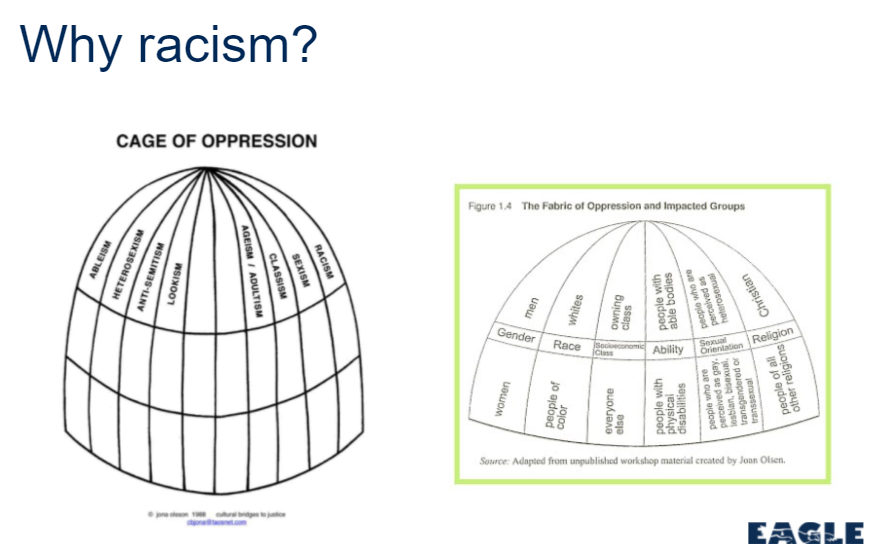
There have already been hints of this grievance-based approach percolating through DEI materials received for the Show-Me Curricula Project. Eagle College Prep’s DEI materials capture the issue. For example, instructional material for teachers that the Institute requested and received contains the following PowerPoint slide, with the second “cage” figure of particular note:
Elsewhere, a PowerPoint on a “cycle of oppression” implies that non-whites are “colluding or surviving” by adopting notions such as:
- “Standards and norms lived by [whites] are the universal standards and norms”
- “Achievements have to do with me, not my membership in a group”
- “Things are earned through work and merit”
- “Uncapped possibility—life potential based on personal choices”
The graphic suggests that the cycle is broken by “going against conditioning” toward “liberation.” In context, this means rejecting notions of work, merit, free choice, and personal achievement.
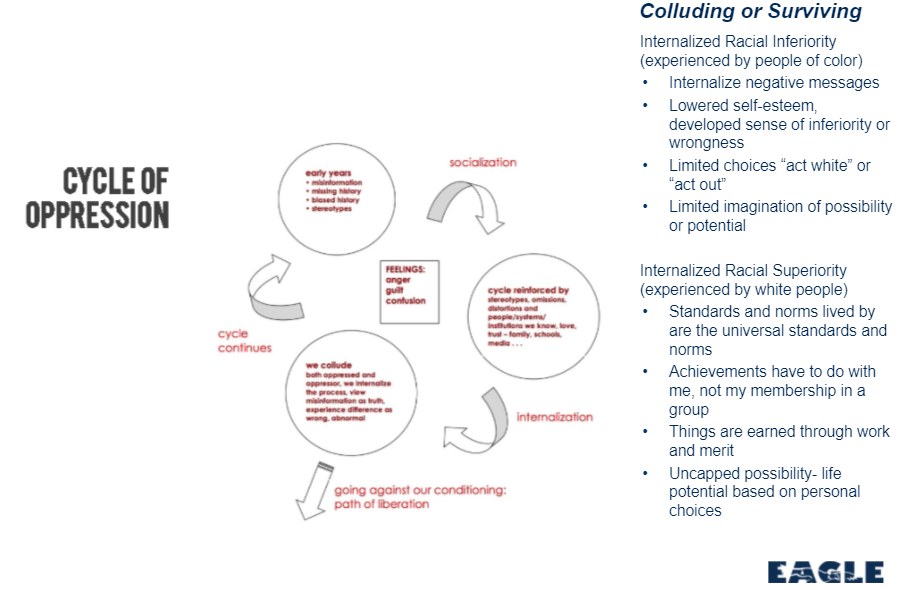
Presumably these slides are discussed by an instructor, so there may be nuance that isn’t captured in the slides. But these materials appear to accentuate divides that work against our convergence as a country.
While the focus so far of my transparency project has been on curricula administered to children, taxpayers should also see the “curricula” and training that schools and school districts are administering to Missouri teachers. No one disputes Americans have differences, but a DEI curriculum that exploits and exacerbates them instead of emphasizing the importance of convergence—of our shared enterprise as a single community and single country—is one that does far more harm than good.
