Introducing the Missouri Parents’ Bill of Rights
Too often, local officials have resisted oversight of Missouri public schools and districts. School bureaucrats from across the state have pushed back against Sunshine requests filed by the public, including many from the Show-Me Curricula Project, and now lawsuits are flying. I’ve heard stories from concerned parents and teachers about their treatment by school officials and their fears of persecution for speaking up about controversial issues.
This is not how parents and taxpayers should be treated by our public education system. Enough is enough.
In an effort to put the power of schooling back in the hands of the public that funds it, today I am introducing the Missouri Parents’ Bill of Rights (MPBR).
The MPBR emphasizes two objectives—transparency and accountability—and sets out reforms that would allow taxpayers and parents to see exactly how their schools and districts are operating and what they are teaching. Titularly highlighting parents’ role in the education of Missouri kids, the MPBR is geared toward promoting good, responsive governance in taxpayer-supported schools and school districts. Certainly, many of these reforms could be just as easily applied to other local governments like cities and counties—and eventually should.
But the taxpaying public should have an unambiguous right to see what’s being taught to their kids, how schools are performing, and how money is being spent. Taxpayers and parents should be able to use every tool available to them to ensure Missouri kids can have a productive educational career and life. For that to happen, taxpayers and parents must have oversight of the educational bodies in our state.
As I’ve written before, the privilege of taxing comes with a duty of forthrightness and responsibility. Denying that forthrightness and responsibility is to entertain the idea that government rules the people and not the other way around. The MPBR seeks to proclaim unequivocally where power in our system resides—with the people—and to emphasize that transparency and accountability are non-negotiable preconditions to accessing tax dollars.
Stay tuned in the days, weeks, and months ahead as we go into greater depth on this initiative.
We’ve only just begun.
Missouri Parents’ Bill of Rights
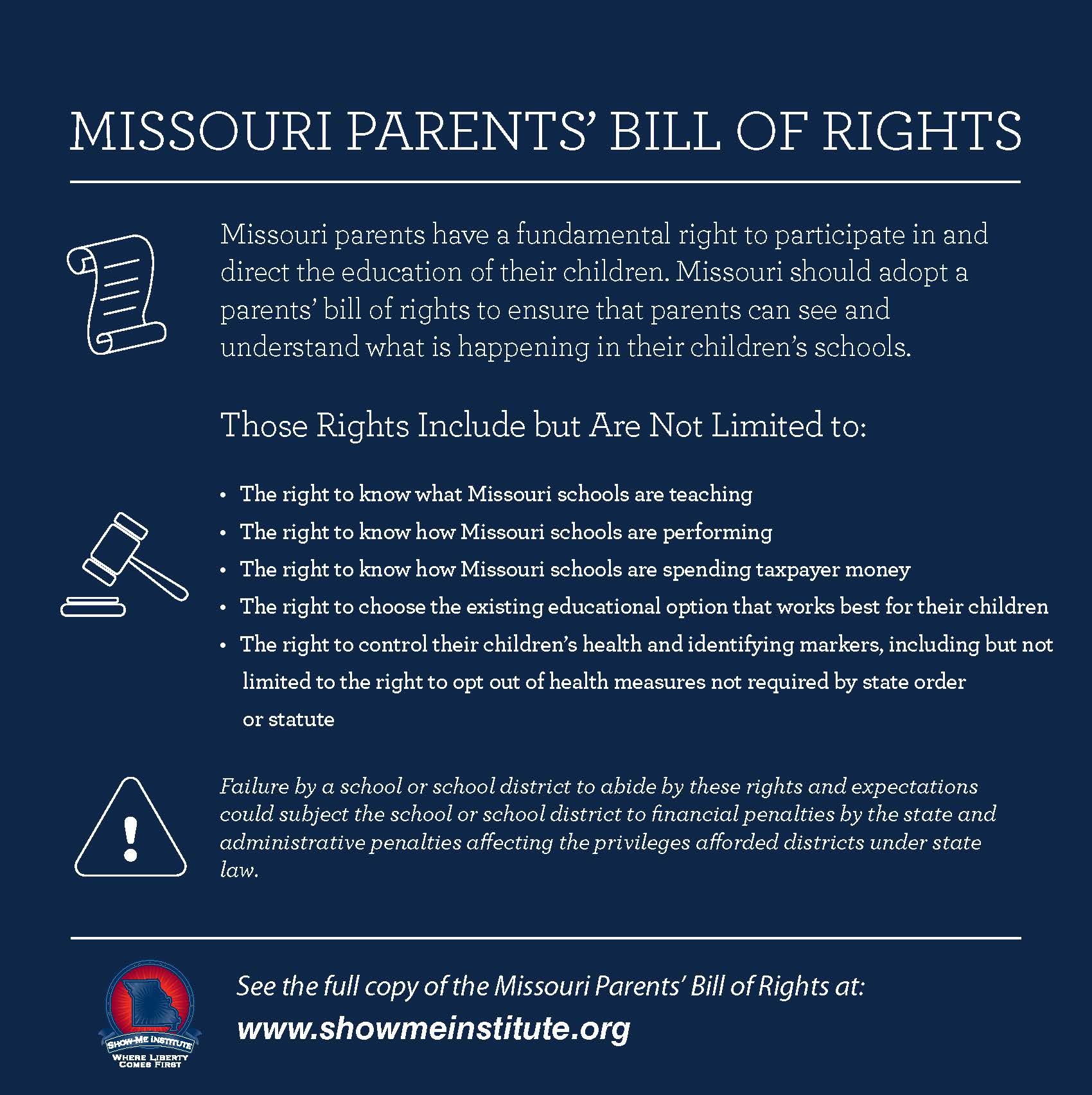
The parents of Missouri’s children have a fundamental right to participate in and direct the education of their children. In order to effectuate and protect those rights, the state hereby adopts an approach that affirms “sunlight is the best disinfectant” to ensure parents can see, understand and trust representations made by state and local education officials about their children’s education and equips parents with the tools to make informed choices to educate their children especially if, in their judgment, the unique needs of their children are not being met.
Those rights include but are not limited to:
- the right to transparent access to school and school district curricula and lesson plans, made available in an electronically searchable format and available at all times online on the homepage of the website hosted by the district (an expansion of RSMo §162.208) and submitted to the state to affirm compliance.
- Curricula shall be available to the public at least 30 days before the beginning of a semester’s classes.
- Because they are often formulated up to the date of instruction, lesson plans shall be available to the public no later than 30 days after the date such course materials were taught. Parents nonetheless have the right to request such materials directly from teachers prior to that time.
- The right to instructional material includes the right to transparent access to school and school district faculty and staff training materials, also made available in an electronically searchable format and available at all times online on a website hosted by the state.
- the right to transparent access to school and school district academic performance information in an easy to understand and electronically searchable format, available at all times online on the homepage of the website hosted by the district (an expansion of RSMo §162.208) and based on data from the Department of Elementary and Secondary Education. That information shall be regularly updated and shall include:
- the percentage of all students scoring at the Proficient level or higher on all assessments administered under the Missouri Assessment Program (MAP)
- the percentage of students in each reportable subgroup, including race/ethnicity, economically disadvantaged, students with disabilities, and English language learners, scoring at the Proficient level or higher on all assessments administered under the Missouri Assessment Program (MAP)
- the Growth score in English/language arts (ELA), measured in National Curve Equivalents (NCE) for grades 3 through 8
- the Growth score in math, measured in National Curve Equivalents (NCE) for grades 3 thru 8
- the right to transparent access to school and school district financial information in an easy to understand and electronically searchable format, available at all times online on the homepage of the website hosted by the district (a new section under RSMo Chapter 162) and submitted to the state to affirm compliance. That information shall be regularly updated and shall include:
- transactional data similar to that produced from an accounts payable report, and if practicable rendered in a manner similar to the existing Show-Me Checkbook website maintained by the Treasurer’s Office.
- the district’s latest financial statements filed with the state.
- the right to transparent access to contract negotiations between the district and labor groups with whom the district is considering entering into labor agreement (a new section under RSMo Chapter 162) including access to all materials used in negotiation and all finalized documents that describe the legal obligations of parties pursuant to an agreement. Such documents shall be available in an electronically searchable format and available at all times online on the homepage of the website hosted by the district (an expansion of RSMo §162.208) and submitted to the state to affirm compliance.
- the right to choose existing educational choice options provided by law that best suit the learning needs of their children.
- the right to request to opt their children out of the classroom for any presentation of content listed in the syllabus with which they disagree.
- the right to control their children’s likeness in district materials, subject to exceptions like court orders.
- the right to control their children’s health and identifying markers, including but not limited to the right to opt out of health measures not required by state order or statute.
Failure by a school or school district to abide by these rights and expectations could subject the school or school district to financial penalties by the state and administrative penalties affecting the privileges afforded districts under state law.