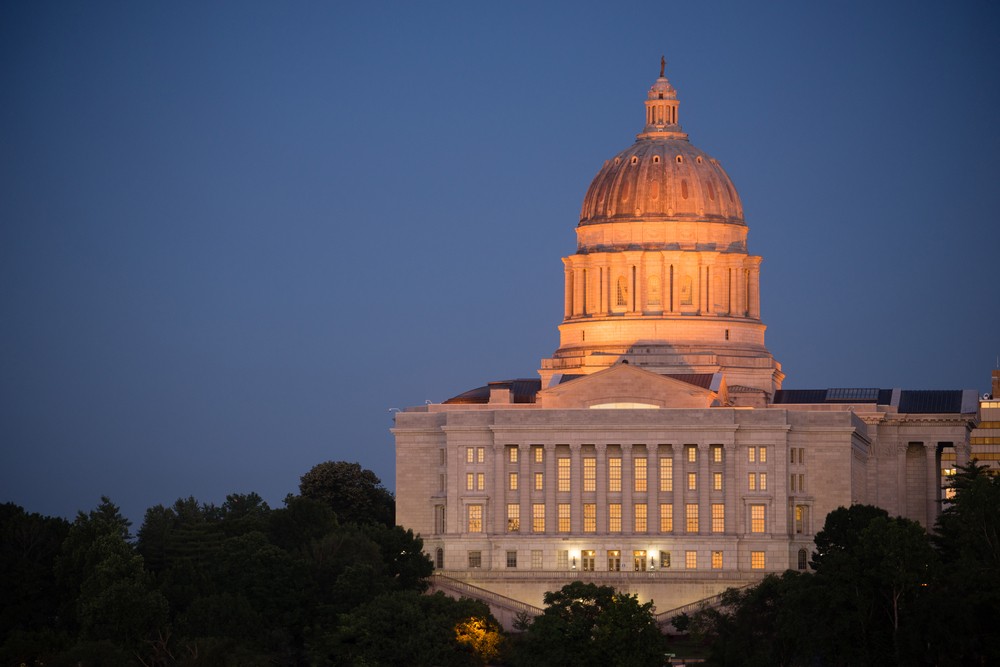
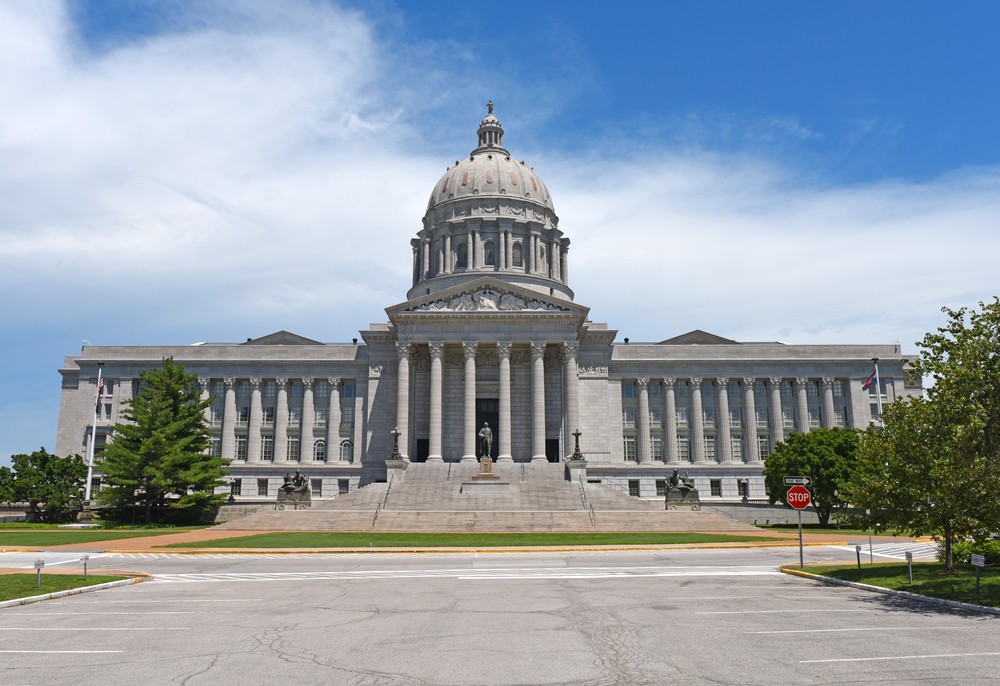
Jakob Puckett, Elias Tsapelas, and David Stokes join Zach Lawhorn to discuss a new plan to spend millions on capital improvements in St. Louis, rumors of a federal gas tax holiday and the latest on Missouri expanding Medicaid.
Like many things, parenting has gotten more difficult in the last couple of years. Families had to adjust to virtual learning and many discovered how little they know about their children’s education. Conversations on the way to the bus stop and looking through backpacks are not the same as being put in charge of the entire school day. One interesting result of having a more informed cohort of parents is that their rights as parents, apparently, need to be clearly delineated.
The Missouri Legislature is currently debating several bills that are each known as a “Parents’ Bill of Rights.” They’re not all exactly the same, but, for the most part, they reiterate that parents have a right to know what their children are being taught—and not by digging through notes or textbooks. Parents should have easy access to what each teacher plans on teaching.
In addition, parents (and taxpayers) should know how much is being spent and what the money is being spent on for public education. Surveys consistently find that parents and taxpayers underestimate how much is spent per student in our public schools. Consider that in the last school year (2020–21), the average spending per student in Missouri was about $16,800. Where is that money going? Parents have a right to know.
One of the most fundamental rights of parents is the right to know whether their children’s school is doing a good job or poor job at educating students. This should be very simple—no jargon, no words like “provisionally accredited,” and no protecting the egos of the adults in the building. Parents understand the difference between an “A” and an “F” on their children’s report cards, and they should be given the same opportunity on a report card for their children’s school and district.
One version of a Parents’ Bill of Rights (HJR 110), sponsored by Representative Christofanelli, requires the Department of Elementary and Secondary Education (DESE) to report on a list of indicators for each school and district and to score them with a letter grade of A through F. Unfortunately, the bill gives DESE too much wiggle room in how to assign points that determine the calculation of grades. It also includes some non-academic measurements, such as attendance, and some gameable measurements, such as graduation rates.
To be useful, school report cards should be based on objective learning outcome measures of both performance and progress. They should be timely and use clear and transparent descriptions of what’s an A and what’s an F. They should be as rigorous as possible and have automatic increases in rigor (e.g., the bar for what constitutes an A keeps going up over time) to encourage continuous improvement.
It’s great that legislators are ready to stand up for parents, but we need to make sure that they get this legislation right.
The Bi-State Development Agency is meeting on Friday to consider getting the Loop Trolley up and running again.
Under the proposed plan, Bi-State would operate the trolley while the Loop Trolley Transportation Development District (LTTDD) would still be liable for it financially. Bi-State would enter into a managerial and logistical support contract with the LTTDD without transferring ownership of the trolley. Leaders of the LTTDD are also asking Bi-State to reconsider the $1.26 million of federal traffic congestion and air quality improvement grants it denied to the trolley late last year.
The catch with restarting the trolley after years of broken promises and operational failures is that the federal government is threatening to claw back $37 million of grants that were used to build the trolley. At this point, the most sensible decision would be to do whatever would cost taxpayers less. This would mean doing some hard math, which I described here previously. The agenda for the Friday meeting does not indicate that a cost–benefit analysis has been undertaken.
And just as a reminder: $51 million of taxpayer’s money has already been spent on the trolley with little to nothing to show for it. As an example of things that can actually be done with that amount of money, India sent a satellite into orbit around Mars on a slightly larger budget of $74 million. I am neither advocating spending another $23 million on the trolley nor sending the trolley to Mars. But I do wish that the Loop Trolley developers had been as resourceful with our money.
But now that I think about it, sending the Loop Trolley to Mars might not be such a bad idea . . .
David Stokes, Elias Tsapelas and Susan Pendergrass join Zach Lawhorn to discuss the first month of the legislative session.
Rail advocates are arguing for an increase in Missouri’s Amtrak funding. They want the taxpayer subsidy for the little-used route across central Missouri increased to allow for two trains per day in each direction (up until this year, Amtrak ran two trips a day, but recent budget cuts reduced that to one trip). They sound like Loop Trolley supporters who actually argued that nobody rode it when it had partial service, but lots of people would ride if it had full service. (Spoiler: people didn’t.)
My brain tells me that the entire Amtrak subsidy should be eliminated. If Amtrak can’t stand on its own, then why should taxpayers subsidize it to such a large extent? There are numerous ways to get across Missouri, including cheap flights and busses for those who don’t drive.
My heart tells me that there is nothing wrong with compromise in politics, and I think the current compromise to fund Amtrak enough to guarantee one trip per day is a good one. In the past, I have argued in support of a limited subsidy for passenger rail service across Missouri. I do believe it is important to have that alternative provided. We subsidize all types of transportation, including cars. There is a public good aspect to having a variety of transportation options available to people.
MODOT released a study several months ago purportedly in support of the service:
The lawmakers set the figure in May, about the time an executive summary of a state-commissioned Cambridge Systematics economic impact study revealed that the four trains each day provide $208 million in annual economic activity, and more than $22 million in tax revenue Missouri would not see if the Runners didn’t run.
I have to be honest here. I don’t believe those numbers; not in the slightest. Like similar studies, this one makes use of exceedingly generous statistics. From the summary of it available online (emphasis added):
Amtrak’s . . . spending in Missouri yields the following direct, indirect and induced economic benefits….
The key words are “indirect” and “induced.” The authors of the study are likely using a robust and flawed multiplier to make assumptions about the tax revenue and economic activity that don’t withstand scrutiny.
Beyond those issues, some of the arguments in favor of a larger subsidy and two trips a day are simply weak (from the St. Louis Post Dispatch article linked at the top of this piece):
Tammy Bruckerhoff, the tourism and economic development director for Hermann, said the line is vitally important to draw tourism to the smaller towns along the route.
There are hundreds of small towns in Missouri. I fail to see why a half dozen of them along the Amtrak route deserve a subsidy for their tourism efforts, which mostly revolve around bacchanalian celebrations of excess (which are awesome, I admit). Do we subsidize Party Cove in Lake of Ozarks? I sure hope not (also, we don’t).
$10 million a year is a generous subsidy to keep Amtrak running in Missouri, and a compromise that I can live with in this debate. A larger subsidy is not warranted. There is no evidence that two trains per day in each direction will accomplish anything more than spending another $2.5 million (at least) in taxpayer money. You can’t wish market demand out of thin air, whether it’s for a trolley, a streetcar, high-speed rail, or Amtrak.
Elected officials who want to put more electric vehicles (EVs) on the road face a Catch-22. Drivers won’t buy more EVs unless there are charging stations available, but businesses won’t install more chargers unless enough people drive EVs. Several Saint Louis area governments are trying to make the first move by mandating the installation of EV chargers.
Saint Louis County, Saint Louis City, and Brentwood have decided to mandate that new construction and major renovations for several types of properties (residential and/or commercial, depending on the jurisdiction) must be accompanied by EV charging stations. None of these mandates consider the $5,000-per-charger cost businesses will face, and some of these regulations impose a substantial fine for being a day late and an EV charger short.
Some places—like apartments and office buildings where people park for hours at a time—are a good fit for EV chargers. But for other places, a charging station could actually be a liability. Think of places like diners or convenience stores, whose business models rely on getting people in and out quickly. The last thing the owner of a small diner needs is someone who comes in and occupies a table for an hour or longer, nursing a coffee while his car charges. That’s why decisions about where the chargers should be installed are best left to businesses rather than being determined by a one-size-fits-all government mandate.
If local officials want more EV charging stations, perhaps they should first clarify where they can be built rather than dictating where they must be built. Ironically, the municipal codes for the Saint Louis jurisdictions mandating chargers are mum about where chargers can be built outside of the areas where they are mandatory. This lack of clarity results in several weeks of permitting and site plan reviews, which often vary by jurisdiction. This is backwards. Dozens of municipalities nationwide have amended their codes to allow EV chargers to be built wherever property owners see fit and have fast-tracked the permitting process to finish, in some cases within a day. For example, Kane County, Illinois, and Bellevue, Washington, allow EV chargers to be built in all zoning districts. Several states, such as New Jersey, New York, and Oregon, have classified the installation of EV chargers as “minor work,” which helps speed up installation times and cut down on permitting costs. Chicago grants EV charger installation permits within a day and even provides a guide for the installation process. These are all simple ways to speed up the proliferation of EV chargers without twisting anyone’s arm.
Local officials are right to recognize that fueling an EV is different than fueling a traditional car. Due to the time it takes to charge, EV drivers won’t be waiting in lines at centralized “electron stations.” Rather, they’ll incorporate charging into their everyday life. As more Missourians buy EVs, it will make good business sense for more businesses and property owners to install EV charging stations, either to retain current customers or attract new ones. What EV driver wouldn’t the option of charging his or her car while at the grocery store or while typing away at work? Likewise, charging stations at apartment complex could become an appreciated—or even expected—amenity for prospective tenants.
Policymakers could also make it easier for Missourians to buy EVs. Currently some uncertainty exists about the validity in Missouri of the direct sales model that many EV companies use to sell their cars. Several years ago, Tesla was taken to court over the legality of selling its cars to customers without using a franchised dealership. While Tesla eventually won, it’s not clear if other EV companies would be granted the same freedom to sell. With many more EV companies using direct sales entering the market, ensuring they can operate in Missouri can bring EVs to thousands more residents.
EVs come with many benefits. They help improve local air quality and reduce the transportation sector’s overall environmental impact. For Saint Louis EV drivers, charging their EV at home can lead to hundreds of dollars of fuel cost savings each year compared to a gasoline-powered car. EVs have lower lifetime maintenance costs than gasoline-powered cars. EVs can succeed on their own merits; forcing the hand of property owners is the wrong way to speed up the EV adoption process.
The Show-Me Institute recently released a guide for spending Missouri’s stimulus money that emphasizes growing the economy, not the government. One idea mentioned is replenishing the Unemployment Insurance (UI) Trust Fund. However, there is a deadline that policymakers ought to be aware of.
The state pays unemployment benefits from this fund, and the COVID-19-induced recession meant that the state was dipping into this fund more than normal. When the balance of the UI Trust Fund is too low, an increase in tax contribution rates on business owners is triggered.
As stated in the spending guide:
States can replenish their UI Trust Funds up to the difference between the balance on January 27, 2020 ($1.054 billion) and May 17, 2021 ($637 million). Thus, Missouri lawmakers should make a one-time contribution to the state UI Trust Fund of $417 million to prevent small businesses from facing hikes in their UI taxes and to keep the fund balance healthy in case of heavy future use.
A tax increase for businesses is the last thing anyone needs right now. Businesses pass on higher taxes to customers, which in turn means higher prices and costs for everyone.
With the finalization of the rules governing State and Local Fiscal Recovery Funds, there is now a tighter timeline for spending stimulus funds on replenishing the UI Trust Fund. If states use funds to replenish their UI trust funds after April 1, 2022, they will be subject to a maintenance of effort requirement for UI benefits through 2024. This means that if states use stimulus funds to supplement UI funds after April 1, they would not be allowed to take any action to reduce weekly unemployment benefits or the number of weeks of benefits available until after 2024.
As Jared Walczak of the Tax Foundation wrote in a great summation piece:
Many states may have no desire to do this. Others may anticipate the need for an adjustment. Regardless, state lawmakers may be wary of having their hands tied by the federal government. But there is a grace period, which could be a motivation for states to act fast.
The bottom line is that if Missouri lawmakers want to replenish the UI Trust Fund without strings attached, they need to act quickly.
A few months ago, I foolishly expressed optimism that Missouri’s low-income housing tax credit (LIHTC) program would perform better for state taxpayers in 2021. (You can read more about how LIHTC works here.) Unfortunately, new data from the Missouri Housing Development Commission (MHDC) confirm yet another year of utter disappointment.
In late December, the MHDC met to dole out the state’s LIHTCs for 2021, and there was reason to believe some measurable improvements were on the way. As I’ve written multiple times, when Missouri’s program returned from its brief hiatus in 2020, we were told this time it’d be different. The tax credit with a history of dismal performance was receiving reforms that would add accountability and allow each state tax dollar spent to go a little further. A pilot program that increases payout rates was being expanded because of its apparent popularity and supposed success.
Recently, Missouri State Treasurer Scott Fitzpatrick released a statement showing that the average sale price for state LIHTCs increased by nearly $0.10 in 2021. But this increase did not translate to more affordable housing being built. According to the MHDC’s newest project approval data, the number of projects and the number of units in projects approved for LIHTCs in 2021 decreased compared to 2020.
In fact, even the number of applications for LIHTCs declined in 2021. This means that while the recipients of these credits received more money than ever, those gains failed to translate into any improvement for state taxpayers. This new year of data also serves as a cruel reminder of the lessons Missouri should have learned during the program’s recent suspension. For two consecutive years, Missouri saved millions by forgoing the state’s investment in the LIHTC program. The federal program continued in its absence, and the same amount of affordable housing was built each year, but at a lower cost. Now the program’s back and we’re told that the way to improve it is to make it more lucrative for developers. In return, the amount of new housing being built remains the same.
Year after year, Missouri is reminded why the LIHTC program is such a bad deal for state taxpayers. How much more money must be lost before our elected officials start seeing the program for what it is and end it for good?