Trump Executive Order Targets Some Housing Regulation

Listen to this article

Show-Me Institute analysts have written often about housing in these pages. Missouri doesn’t face the same affordability crisis as coastal markets, but that doesn’t mean policymakers are powerless to further reduce costs.

A recent executive order from President Trump aims to lower housing costs by reducing federal regulatory barriers. The order directs federal agencies to review environmental rules, permitting processes, and other regulations that can delay projects or raise costs.

This isn’t a new insight. A 2016 report from the Obama administration warned that regulatory barriers—especially zoning and land-use restrictions—have made it harder for housing markets to respond to growing demand.

The Trump order addresses part of that problem. But the most consequential barriers to new housing are found at the municipal level. Zoning determines where housing can be built—and how much. Minimum lot sizes, parking mandates, height limits, and single-family zoning can sharply restrict supply. When zoning allows only a small number of homes on large parcels of land, the cost of each unit inevitably rises.

Federal action also played a role in shaping these systems. Throughout the twentieth century, federal housing programs promoted local zoning and land-use regulation as tools for stabilizing property values and guiding development. Those policies encouraged the spread of zoning frameworks that remain common today.

The administration’s order stops short of addressing local land-use restrictions directly. Addressing federal rules may help at the margins, but without local reforms, many communities will continue to limit the amount of housing that can be built.

Supporters of strict zoning sometimes argue that land-use decisions should remain entirely local. Local authority is important, but it does not eliminate the broader consequences of housing shortages, and it should not be used in a way that violates individual property rights. When cities restrict construction, as Kansas City did with rigid energy code standards, the effects ripple across regions through higher rents, longer commutes, and constrained labor markets.

If policymakers in Kansas City, St. Louis, or anywhere else want to make housing more affordable, they should start with the rules that determine whether housing can be built at all.

Legislation on A–F Report Cards for Schools and Districts Has Gone Sideways

Listen to this article

The Missouri House of Representatives recently passed a bill requiring that the Department of Elementary and Secondary Education (DESE) assign A–F letter grades to schools and districts statewide. The bill now heads to the Senate, which is also considering its own version.

The legislation is meant to build on and improve Governor Kehoe’s executive order from January. Unfortunately, it does not improve on the executive order; in fact, the version that emerged from the House is much worse.

The main problem with the House bill is that it has veered off topic. Governor Kehoe’s short and simple executive order mandates letter grades based on academic performance. This is what we need. The House bill adds language that would create new school climate ratings based on surveys of teachers, parents, and students, which would also go on the report card.

This is problematic for three reasons:

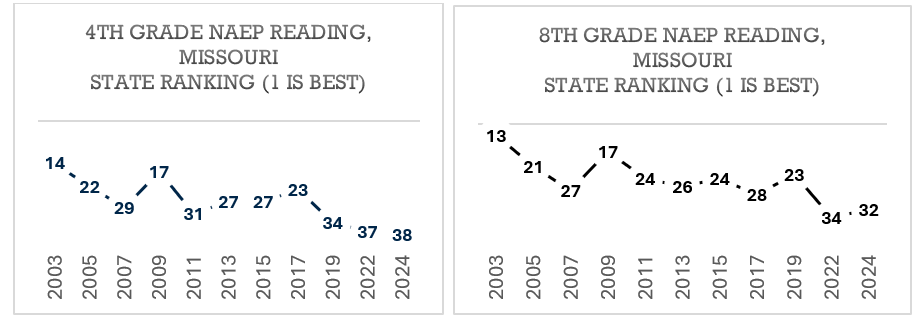
Most importantly, it will distract us from academic outcomes. Academics are where our schools are struggling, and until we focus on them, the situation is not going to improve. This is illustrated most easily with data from the National Assessment of Educational Progress, or NAEP, which is widely viewed as providing the most credible test data in the country. Here are charts showing changes over time in Missouri’s national rank on NAEP, in 4th- and 8th-grade reading, since about the turn of the century:

Our 4th-grade reading results are especially bleak—we rank 38th out of the 50 states as of 2024, whereas two decades earlier we ranked in the low twenties. Today, an alarming 42 percent of our 4th graders score Below Basic on NAEP.

Making matters worse, our ranking decline since about 2015 is in the context of generally declining test scores nationwide. Our scores are declining faster than the rest of a declining nation.

Governor Kehoe was correct to focus on academic outcomes, and the focus should stay that way.

Unlike data on academic achievement, which we already collect, survey data for this new school-climate requirement do not exist. It is difficult to develop and implement a high-quality survey with a high response rate. Have our lawmakers considered how we would get these surveys done?

As one of several concrete technical issues, consider the survey response rate. We cannot make parents fill out surveys. So, what if they don’t? What if we end up with schools and districts where fewer than 10 percent of parents fill out a survey (which is very possible)? Are we going to hold a school with a 10-percent parent response rate accountable for negative survey results? If the results look good, are we going to give the school a high rating?

Even if we ignore the first two issues, do we really want to compel DESE to undertake this work? We hear a lot of grumbling around the capitol about how DESE has gotten too big. This is how that happens. Developing and administering surveys to Missouri’s more than 800,000 students and their parents, and 70,000 teachers, across thousands of schools and hundreds of districts would require more administrative expansion. That is far outside the low-cost, straightforward scope of the original report card plan.

Governor Kehoe issued a clear and simple executive order on school and district report cards in January, which properly emphasizes academic performance. The order is fundamentally sound. There’s always room for improvement, but the legislation that came out of the House has moved this effort in the wrong direction. We hope our lawmakers can get it back on track.


Missouri’s April 7 Ballot Breakdown with David Stokes and Patrick Tuohey

Patrick Tuohey and David Stokes join Zach Lawhorn to break down the key issues Missouri voters will decide on April 7th. They discuss whether local elections should stay in April or move to November, property tax limit votes happening in more than 90 counties, new fire district sales tax authority and what it means for taxpayers, the 1% earnings tax renewals in Kansas City and St. Louis, and Springfield’s convention center lodging tax returning to the ballot after voters already rejected it. They also discuss use taxes, senior property tax freezes, the economic development sales tax on the ballot in O’Fallon, and more.

Listen on Spotify

Listen on Apple Podcasts 

Listen on SoundCloud

Produced by Show-Me Opportunity

Economically, Feeling Better Isn’t the Same as Being Better

Listen to this article

In a series of sketches for Saturday Night Live, Billy Crystal played a fictionalized version of actor and director Fernando Lamas as host of the talk show “Fernando’s Hideaway.” Crystal’s character would often say that it is better to look good than to feel good.

This was on my mind as I reviewed recent evaluations of St. Louis’s guaranteed basic income pilot by Washington University’s Center for Social Development. The review’s claims will sound familiar to anyone who has followed these pilot programs around the country. Participants reported feeling more financially secure. They were better able to pay bills and cover everyday expenses like rent, utilities, and groceries.

In many ways, the findings are exactly what one would expect. St. Louis distributed $500 per month for 18 months to several hundred households using federal pandemic relief funds. If someone suddenly receives an additional $500 each month, it should not surprise anyone that paying bills becomes easier in the short run.

The St. Louis program is also not unique. Over the past several years, cities across the country have launched similar guaranteed income pilot programs. Their evaluations tend to report the same kinds of outcomes: reduced financial stress, improved food security, and higher levels of self-reported well-being.

But as economists Hilary Hoynes and Jesse Rothstein of the University of California, Berkeley note in a review of the universal basic income literature, the new wave of guaranteed-income pilots is “not well suited” to answer the most important questions about the policy. (My colleague David Stokes wrote about this same study in 2024.) The pilot program evaluations tend to measure short-run responses that economists have already examined for decades in earlier experiments.

These evaluations often measure something quite narrow—how recipients say they feel about their financial situation. But feeling good about one’s finances is not the same thing as actually being better off.

More comprehensive research on guaranteed income programs paints a more complicated picture. A recent randomized study published by the National Bureau of Economic Research examined the effects of unconditional cash transfers using a large experimental design. In that study, 1,000 individuals were randomly selected to receive $1,000 per month for three years, while a control group received only a nominal payment.

The researchers tracked employment, income, and time use using administrative data and detailed surveys. Their findings suggest that while the payments increased consumption and temporarily improved subjective well-being, participants also worked fewer hours and saw declines in income earned from work. The transfers reduced labor-force participation and led participants to shift some of their time away from paid work and toward leisure.

In other words, the transfers made recipients feel more financially secure—but they also changed work behavior in ways that reduced earned income.

This should not come as a surprise. Economists have been studying guaranteed income–style policies for decades. Earlier negative income tax experiments and other research on income transfers have consistently found that unconditional income tends to reduce work effort modestly. Those effects may be small, but they are real and have important implications for the long-term economic impact of such policies.

None of this is to say that guaranteed income programs provide no benefit to recipients, or that the research from Washington University is flawed. Reducing financial stress and helping families weather unexpected expenses is not nothing. But policymakers should be careful not to confuse the short-term financial relief detailed in the St. Louis pilot program evaluation with long-term economic improvement.

There are also broader societal concerns that pilot evaluations like this one cannot address. One of the Show-Me Institute’s objectives is to build a state where “all Missourians are free from dependence on government.” Large unconditional cash-transfer programs, such as the program tested in St. Louis, could expand long-term dependency on government support and weaken incentives for work and self-sufficiency. That risk remains a significant policy concern.

Feeling better about your finances is not the same thing as improving the underlying economics—regardless of what Billy Crystal might advise.

Local leaders must be careful not to confuse the two, lest we commit to an expensive program that does more harm than good.

It’s Time to Phase Out the Earnings Tax. Honestly, Nothing Else Has Worked . . .

A version of the following commentary appeared in the St. Louis Post-Dispatch.

They say that the best time to plant a tree was 20 years ago, and the second-best time is now. That about sums up my opinion on the City of St. Louis’s one-percent earnings tax, the continuation of which is before St. Louis voters on the April ballot. The best time to start phasing out the earnings tax really was 20 years ago, and the second-best time is still now.

The 20 years in the saying is particularly appropriate in this case, as the Show-Me Institute released its first study on the earnings tax almost exactly 20 years ago. Professor Joseph Haslag, then at the University of Missouri, documented how the earnings tax reduces overall income and employment in the city by encouraging businesses and individuals to locate outside of the city. Additional studies conducted by Show-Me Institute analysts and others have found similar results regarding the harms of local income taxes generally.

Haslag didn’t just demonstrate the harm of the earnings tax; he also recommended a strategy to replace it in order to maintain necessary city services. Haslag suggested changing state laws to allow St. Louis to institute a land tax, which is simply a property tax on the value of the land only. Pittsburgh is one city that had beneficial results from implementing land taxation in the 1980s. Alas, while land taxes are popular with economists and fiscally beneficial, they are politically unpopular to say the least. Needless to say, land taxes have never been adopted in St. Louis (nor has state law been amended to allow them). But the harms of the earnings tax have continued to help drive St. Louis’s population and economy lower, and those fiscal harms were exacerbated during the pandemic.

An easier change (legally, if not politically) than a land tax would have been to start phasing out the earnings tax 20 years ago while increasing a combination of property and sales taxes over time to replace the lost revenues (while cutting spending where possible as well). Poor decision-making over the past two decades has made that already-difficult change almost impossible. Damaging special sales taxes such as community improvement district (CID) taxes are now ubiquitous throughout shopping areas in the city. Primarily used as a smokescreen for harmful corporate welfare, CIDs and other special sales taxes have driven sales tax rates sky high. While the sales taxes have gone up, commercial property values have plummeted. According to the St. Louis Business-Journal, downtown St. Louis office buildings have lost 19 percent of their assessed value since 2019, and even more if you go back further. The largest office building downtown, the AT&T building at 909 Chestnut, paid $5.5 million in property taxes in 2009. It paid just $200,000 in 2024. While that is the most extreme example, similar examples can be found throughout downtown.

The economic situation in the city was already bad, and the tornado that hit in May made it even worse. It was the type of disaster that could make people consider radical changes, and perhaps the land tax is the type of radical change the city needs. (For the record, the Show-Me Institute’s offices were destroyed in the tornado, and while we’re a nonprofit, our office building is subject to property taxes.)

As large parts of the Central West End and the Northside are still recovering from the tornado, St. Louis city government has commendably allowed homeowners with damaged homes to reduce their tax payments, but the long-term impacts on city tax revenues may be significant. The population of New Orleans still hasn’t recovered from Hurricane Katrina and, while the damage to St. Louis was not that severe, the risk is the same.

I suggest it is time to change state law to allow for a land tax, including on land owned by larger “nonprofits” like Barnes Hospital. The land tax could be imposed on the value of the land throughout St. Louis at a level that would gradually increase to make up for revenue lost as the earnings tax is phased out over a period of 10 years (or more). (Other changes would be necessary, including ending the tax subsidies the city gives out.) What makes land taxation so beneficial is that as homeowners and businesses rebuild their damaged property, they aren’t hit with higher taxes for the home or building. The tax is set to the land, which can’t be altered, rather than the building. So, return to the city, rebuild your home or business, make it even larger—do whatever you want—and you won’t be punished with higher taxes.

Pittsburgh in the 1970s was experiencing economic difficulties just as St. Louis is now. Land taxation helped spur investment in Pittsburgh, and it could have the same effect on St. Louis. The city has been hemorrhaging population, jobs, and wealth for decades. Honestly, at this point in its history, what does St. Louis have to lose?


Kansas Sports Authority Lets Chiefs Play as Home Team, Referee and Rulebook

Listen to this article

The package of subsidies offered to the Kansas City Chiefs by the Missouri Legislature during last year’s special session was bad.

But that bill was not nearly as bad for taxpayers as what is being offered to the team by our neighbors in Kansas. House Bill 2793—the Kansas Sports Authority Act—offers the team, well, it seems, everything.

The bill sets up a Sports Authority to administer the site of a new stadium. That in and of itself is not unique. The Truman Sports Complex, in which the Chiefs and Royals currently play, is administered by the Jackson County Sports Complex Authority. But the power and portfolio of what is being considered in Kansas is breathtaking. Consider the following:

  • The authority board includes “a representative of the professional sports team” using the facility as a voting member. This means the Chiefs would have a vote on such things as negotiating its lease, financing, and operations. Having the team oversee itself is a crazy conflict of interest and uncommon in other similar authorities if not absolutely unique, for obvious reasons.
  • But the Chiefs aren’t merely one of several votes on the authority. The bill allows additional sports facilities to be placed under the authority if the governing body requests it and the Chiefs also recommend it—giving them an unusual role in expanding the authority’s jurisdiction. This provision may exist because team ownership wants to make sure nobody else can siphon away public funds.
  • The authority’s powers “shall not be exercised in a way that conflicts with the terms and conditions set forth in the STAR bond agreement dated December 22, 2025.” This means the authority is locked into the already-negotiated agreement with the team, limiting its ability to adjust terms later.

The three items hand the Chiefs an incredible amount of power. The bill gives the Chiefs a voting seat on the governing authority, binds that authority to the STAR bond agreement the Chiefs negotiated, and gives the team an effective veto over whether additional sports facilities are added to the authority.

But wait, there’s more!

  • Contractors must use competition only “to the extent reasonable and practicable in the authority’s sole discretion.” This is a significant weakening of competitive bidding requirements, increasing the risk of opaque contracting and favoritism.
  • The authority is exempt from multiple statutes including the Kansas Civil Service Act and the Kansas Administrative Procedure Act, removing the standard hiring, rulemaking and administrative oversight safeguards that normally apply to public entities spending public funds.
  • The authority must submit annual reports and testify if legislative committees request it. But this so-called oversight is largely after-the-fact reporting, with no routine legislative approval required for major contracts, bonds or development agreements.
  • You read that correctly: the authority may issue special-obligation bonds for stadium construction and infrastructure. Although not legally state debt, political pressure often arises if revenues underperform, creating potential taxpayer exposure. If you doubt this, read up on the fiasco over Platte County and the Zona Rosa shopping center.
  • In addition to capturing the increase in sales taxes in the approximately 300-square mile STAR bond district, the authority will be exempt from paying state and local sales and use taxes on purchases of materials, machinery, and services used to construct or equip the facility.
  • “Insofar as the provisions of this act are inconsistent with the provisions of any other law, whether general, specific or local, the provisions of this act shall be controlling.” Yeah, that’s in the bill. The authority’s statute is designed to override conflicting state or local laws, potentially weakening local regulatory control.
  • And what happens when the stadium is completed and paid for? Nothing. The statute does not include a sunset provision or dissolution trigger. That means the authority could become a permanent quasi-government entity in perpetuity.
  • But at least the authority’s power is limited to the stadium, right? Nope. The authority’s purpose includes not just sports facilities and infrastructure used for it, but any “civic, community, athletic, educational, cultural and commercial activities.” “Commercial activities” seems like something that could cover, well, anything.

Kansas State Senator Mike Thompson claims that this measure will set up an unaccountable  “shadow government.” That seems like an over-the-top claim, but the provisions of this bill suggest he is at least directionally correct.

If Food Truck Reform Is Good for One County, It’s Good for All

Listen to this article

With Kansas City preparing to host matches during the 2026 FIFA World Cup, Missouri lawmakers are considering a bill to simplify food truck licensing in Jackson County. The proposal would allow vendors licensed by the county to operate in any municipality without additional city permits.

The change would remove a common barrier: multiple permits just to cross a city boundary.

The idea makes sense. But if it will help entrepreneurs and visitors during the World Cup, why should the same principle not apply across Missouri? As the Squirrel Nut Zippers sang, “If it’s good enough for Grandad, its good enough for me.”

Food truck regulations vary widely by city. Vendors operating across a metro area may face requirements for multiple permits, fees, and regulatory approvals.

Show-Me Institute writers have written about these barriers for years. In 2019, we noted that St. Louis food trucks still faced significant regulatory constraints despite growing demand. Food trucks offer a flexible and relatively low-cost entry into the restaurant business, but local regulations can make that opportunity harder to pursue.

In some places, additional rules beyond health and sanitation standards function as a de facto ban on mobile vendors.

Health and safety regulations would remain under the proposal being considered in Jefferson City. Missouri already regulates food safety through inspections and sanitation standards administered by local health departments.

The real issue is duplication. Requiring vendors who already meet health standards to obtain a license in every municipality adds cost and delay without improving safety.

Every occupational license carries costs: higher prices for consumers, barriers to entry for workers, fewer providers, and lost time and money for licensees. The central policy question is whether those costs are justified by clear benefits to public safety or product quality.

Several Missouri communities have taken steps to loosen food truck restrictions in recent years. Clayton, for example, expanded opportunities for food trucks to operate at events and public gatherings while maintaining basic safety requirements.

Such changes recognize that mobile vendors are part of the broader restaurant ecosystem and often serve as a first step toward larger businesses.

Starting a small business often requires navigating numerous regulatory steps and fees. Reducing unnecessary barriers can make it easier for entrepreneurs to test new ideas and serve customers.

That flexibility helps explain the popularity of food trucks: vendors can move where demand is strongest, serve events, and test new concepts without the overhead of a traditional restaurant.

Major events like the World Cup highlight that advantage. When large numbers of visitors arrive, mobile vendors can help meet the temporary surge in demand for food and entertainment.

But the benefits of reducing unnecessary regulation should not depend on an international sporting event. If getting government out of the way helps vendors serve World Cup visitors in Kansas City, it should also help them serve customers across the rest of Missouri.

Are Opportunity Zones Just Federal-Level TIF?

Listen to this article

When Congress created Opportunity Zones in 2017, the goal was simple: use tax incentives to steer private investment into distressed communities. Investors could defer or eliminate capital-gains taxes if they reinvested those gains in designated census tracts.

The hope was that these incentives would spur development and expand opportunity in struggling neighborhoods. But new research suggests the program may suffer from the same problems as Tax-Increment Financing (TIF).

In a recent paper from the National Bureau of Economics, “Understanding the Employment Effects of Opportunity Zones,” the authors examine employment outcomes through 2023. They find that jobs located within Opportunity Zones did increase modestly. But most of those gains appear to come from nearby communities rather than representing new economic activity. Sound familiar?

The authors estimate that job growth inside Opportunity Zones is largely offset by job losses in adjacent low-income tracts. Their overall conclusion is that the program mainly results in a “spatial reallocation of jobs and households” rather than broad economic gains.

The distribution of those jobs also matters. Most of the new positions in Opportunity Zones are filled by workers who live outside the zones—often in more affluent neighborhoods. Meanwhile, the economic circumstances of existing residents show little improvement. Employment among residents rises slightly, but median earnings and poverty rates do not change significantly.

These results should sound familiar to longtime readers of the Show-Me Institute. I’ve argued that programs like TIF often fail to generate new economic growth. Instead, they tend to shift development across neighborhoods or municipalities. Projects still get built, but just in a different place.

The evidence on Opportunity Zones suggests something similar may be happening at the federal level.

Investment incentives can influence where development occurs. But that does not necessarily mean they create new economic opportunities for the people policymakers mean to help.

TIF is TIF is TIF, even at the federal level.

Support Us

The work of the Show-Me Institute would not be possible without the generous support of people who are inspired by the vision of liberty and free enterprise. We hope you will join our efforts and become a Show-Me Institute sponsor.

Donate
Man on Horse Charging