Birth rates have been declining in the United States for decades, and there is little indication that the trend will reverse anytime soon. This poses challenges for many of our institutions that were built on the implicit assumption of continued population growth. Social Security is the most prominent example. Because the program relies on taxes paid by current workers to fund benefits for retirees, it depends on a steady influx of younger workers. Social Security is in trouble, and its day of reckoning is not far off.
More quietly, schools across the United States are struggling with declining enrollment. After decades of needing more—more buildings, more teachers, more staff—we’re entering an era where we will need less of all these things.
In Missouri, public school enrollment has declined about 4 percent since the turn of the century. The decline has been even steeper in many urban areas.
The enrollment decline is not a temporary phenomenon. Demographic projections indicate the trend is likely to continue and, in many places, accelerate. And unlike forecasts of the weather or stock market, demographic projections are highly reliable. We know what is coming.
Yet many districts continue to operate as if enrollment will rebound. This is understandable. School closures and staff reductions are politically difficult and often deeply unpopular. However, delaying these decisions does not change the underlying demographic reality.
Preparing for continued enrollment decline means consolidating and, in some cases, closing schools. It also means aligning staffing levels with student enrollment. With limited resources available for public education, maintaining excess capacity spreads those resources too thinly, undermining educational quality.
The demographic writing is on the wall. One way or another, our school system will need to respond. Districts that plan proactively for declining enrollment are likely to navigate the transition more successfully than those that postpone difficult decisions until circumstances leave them no choice.
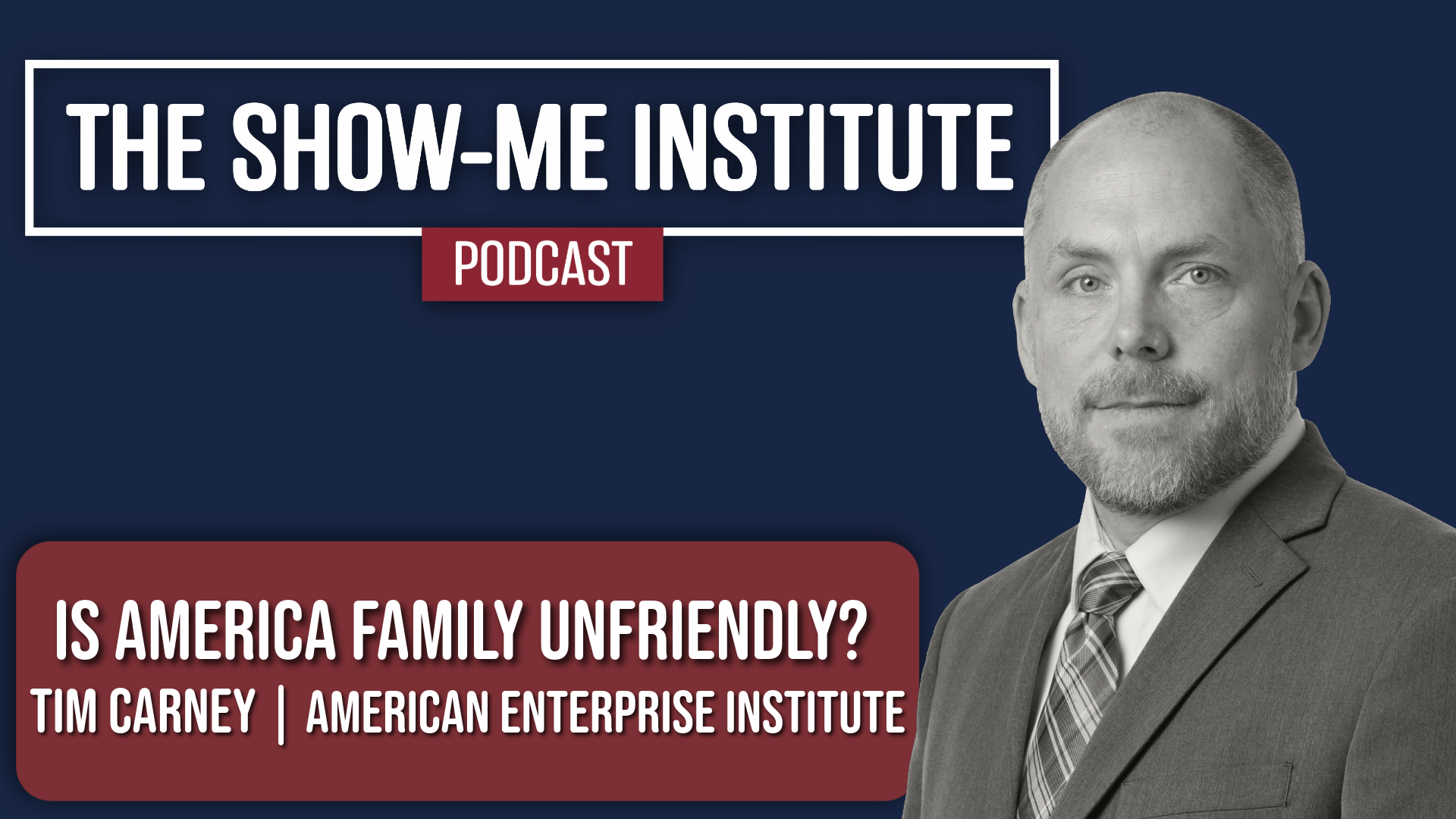
Susan Pendergrass speaks with Tim Carney, senior fellow at the American Enterprise Institute, about why American culture may be making it harder to have and raise children. They discuss the long-term consequences of the declining U.S. birth rate, how intensive parenting culture may be driving childhood anxiety, the “travel team trap” and the arms race of youth sports, what cities and communities can do to become more family-friendly, and more.
Susan Pendergrass (00:00): I’m really looking forward to this conversation with Tim Carney. Thank you for joining us. You’re a senior fellow at AEI? I listened to a podcast the other day with a demographer from the University of Pennsylvania, and it was really good. I think they have a pretty strong department. He said that the United States reached peak child in 2012 or 2013, and basically
Tim Carney (00:06): That’s about right.
Susan Pendergrass (00:24): numbers have been going down on babies ever since. We definitely see that in Missouri. That was our biggest kindergarten cohort, and numbers are going down. I have five grandchildren under the age of five, and it seems to me this is going to be the policy conundrum of their generation. What do you think?
Tim Carney (00:44): It is certainly the biggest story of the next thirty years, policy, cultural, economic, everything. Another way of putting it: the number of births in the US peaked in 2007. Those kids born in 2007 either graduated last year or are graduating this week. Colleges know this very well. They’re all bracing for it. What about ten years from now when the workforce starts significantly shrinking?
Susan Pendergrass (01:03): Yeah.
Tim Carney (01:11): What about the towns that are built around a public school, elementary school, middle school, high school, and those start shrinking? Particularly in rural places, they’re seeing consolidation, two different public schools or two different Catholic schools consolidating. Can schools adjust to being small? How much is this a self-reinforcing spiral? When there are fewer kids, people aren’t used to seeing kids around. Yes, absolutely. It’s the biggest story of the next thirty years.
Susan Pendergrass (01:37): In your new book, Family Unfriendly, I think it’s interesting to juxtapose these two things. At the same time, we’re making it so much harder to raise kids in our culture, and we’ve raised the expectations for each and every one of them so high that people who are considering having kids find it daunting. It used to be, when I was young, people had six or seven kids and just hoped for the best. Everyone did okay. But now every child has these insane expectations, and I sympathize. If your child doesn’t roll over by six months old, they need occupational therapy now. That did not used to be the case. Doesn’t that work against it?
Tim Carney (02:12): Yes. A lot of economists have been praising quality over quantity parenting for years. Isabel Sawhill is an economist I’ve worked with for years, but I think she’s dead wrong when she says this is good, that people are choosing fewer kids so they can invest more in each one. That sounds right, but then you realize
Susan Pendergrass (02:33): Okay.
Tim Carney (02:53): the American Pediatrics journal says the number one cause of the epidemic of childhood anxiety we’re facing right now is lack of unsupervised play. So parents who are giving their kids the best of everything, making sure they’re not just wandering around the neighborhood, making sure they’re safe and busy with violin lessons and enrichment activities and a special private pitching coach for softball, that’s supposedly high-quality parenting. But it comes with low-quality results, which is very anxious kids, as well as stressed-out parents. People ask how my wife and I do it with six kids. I like giving answers about the special cool systems I have, but the real answer is a lot of times we just don’t.
Susan Pendergrass (03:41): Yeah. I feel like I’m probably going to say a lot of unpopular opinions on this. I never liked elite sports or travel sports, but I see travel sports going nationwide now. People from Texas are going to Florida, going to California for travel sports, which I always thought was kind of insane because it didn’t work for my family. We would normally have tournaments at Fourth of July and Thanksgiving. I also see kids being absorbed into the adult world more. Craft breweries have children trying to find something to do there, which is not a very normal environment for them. High-end restaurants have little kids in them, and I just feel like that takes away from the time when they’re supposed to just be kids.
Tim Carney (04:28): I actually think mixed-age mingling is something we need more of. Sometimes when I need to get work done, I’ll go to the local craft brewery to get away from my kids, and then somebody else has all their kids there. But those kids aren’t asking me any favors, so I’m fine with it. I think it’s good that we’re building places for parents to bring kids. The way I put it, though, and again
Susan Pendergrass (04:35): Okay. Yeah. That’s right.
Tim Carney (04:58): my local brewpub allows for this, but we need places where parents can bring kids and ignore them. I brought my kids to the brewery on a cold winter day when they couldn’t be outside because it was ten degrees and forty-mile-an-hour winds. I start the book with a story, in contrast to
Susan Pendergrass (05:05): Yeah. Yeah.
Tim Carney (05:27): high-intensity travel sports, of a program that we saw and then emulated in the Catholic parishes when we lived in Maryland, which was called Friday Night on the Field. There was T-ball and coach-pitch baseball, so this was kindergarten, first grade, second graders. Maybe 10 percent of the dads were coaching. The rest of them, if they were there, were hanging out with other dads. And the kids who were older
Susan Pendergrass (05:53): Yeah.
Tim Carney (05:56): were running around or playing wall ball. The kids who were younger were on a playground. When my wife found out what was going on there, she said, you are bringing all six of the kids to this while I stay home and rest. So I brought the kids there. I maybe had a baby in my carrier, ignoring the other four while one of them played T-ball. And that was exactly what suburban parents needed. Not this high-intensity mom and
Susan Pendergrass (06:08): Yeah, sure.
Tim Carney (06:22): child attached at the hip, but the whole family is there, it’s mixed age, and the children have freedom. This is a really important part of it in so many ways. One, that childhood is expansive and not just intensive. Two, that raising kids isn’t this hyper-intensive, constant thing. There was a commercial I cite in the book about Mother’s Day and how we need to honor mothers more. But it goes way overboard. It says they pretend they’re hiring for a job, and the requirements include you’re never allowed to sit down and you don’t get to eat meals until all of your colleagues are out for the evening. Being a mom is exhausting, and there are days where you don’t sit down, but come on. This is just not true.
Susan Pendergrass (07:00): The hardest job in the world. Yeah. I have three kids that are pretty close together. It was rocky there for a while, but I wouldn’t trade it for anything. As a practical matter, how do you change culture? If the prescription is to back off on intensive parenting, it feels more like an arms race where people say, maybe I don’t even agree with it, but if every other kid is going to Kumon Math, my kid has to go to Kumon Math. What do you do?
Tim Carney (07:36): It’s a tragedy of the commons sort of thing. I discuss it particularly in sports. In chapter one I call it the travel team trap. The reason it’s a trap is you get stuck without wanting to. I know lots of people whose kid just wants to play JV baseball, but the coach says they have to play fall baseball too. But I’m a football player. If you’re saying I’ll miss some reps and the other guys might get ahead of me, well
Susan Pendergrass (07:57): Yeah.
Tim Carney (08:05): that’s one thing. But then the coach says you’re shirking if you’re not playing year round. We have sought out schools and programs that explicitly do not do that, but we had to seek them out. It’s harder to be a backup point guard on a varsity basketball team if you’re going to play three sports, so you might get cut from the team. To some extent the parent is just saying, I really just want them to make the team, and that’s why I’m doing this.
With the academics, there’s a similar dynamic. We put our daughter, who was struggling in math, in a remedial program, something like Kumon. When we showed up, we realized, this was in Northern Virginia, specifically McLean, which is a wealthy area. Nobody else there was remedial. Everyone else there was an A student whose parents wanted their third grader
Susan Pendergrass (08:52): I see. Okay.
Tim Carney (09:03): to be at the sixth-grade level so they could get into Thomas Jefferson, the special super-magnet high school.
Susan Pendergrass (09:08): Yeah. If kindergarten is the new second grade and preschool is the new kindergarten, where does it end? I just feel like we’re overwhelming parents. You said it’s raising anxiety in kids. It’s definitely raising anxiety in parents too. It’s making people not want to be parents. It feels very stressful right now. There are books and apps, and there’s even a book on how to be a more free-range parent, which is strange to me. Does somebody need to be told how to do this? You just let them go outside.
Tim Carney (09:46): No, it does take work. And another thing is, to quote what a wise woman once said, it takes a village to raise a child. Being free-range is easier when other people are doing it. We used to back up to a big playground, and nine times out of ten my kids were the only ones there unsupervised. I actually got an email from a neighboring parent. It wasn’t criticism. It was saying your kids are great and it’s great that you let them run free, and asking if I could talk to them about letting their own kids run free. If you’re in a neighborhood where there are kids but they don’t come out, you might have to build organized activities. We didn’t do that growing up. We just played stickball. My mom wouldn’t organize it. We did it on our own. But now parents might have to be more involved. It’s a little bit of labor, but you connect the families, connect the kids, build the trust.
Susan Pendergrass (10:19): Yeah. Yeah.
Tim Carney (10:44): The community, and we talked about policy. I’m in DC. Everybody wants it to be a federal bill, this or that. The fact is it’s a cultural thing, as I said, and the community is going to have to have these organic, or sometimes deliberate and intentional, structures to help parents raise kids. The more parents who are walking around the neighborhood, the safer the neighborhood is. The more parents making it clear that their kids are going out and should come home when the streetlights turn on, the more that’s known, the safer it is. Remember when you and I were young, other people’s parents would correct us when we were wrong? Now, I have close friends I know I can do that with, but a lot of parents say they’re terrified of correcting someone else’s kid because they’ve been screamed at by the other parents. Your kid was
Susan Pendergrass (11:25): Mad at us. Yes.
Tim Carney (11:41): about to shove gravel down the throat of her two-year-old sister at the playground. And that’s my job too, if I’m right there. That social trust and community takes work. There are people who say it takes a village, and they can’t find their village. You have to build your village. I’m one of those conservatives who really believes that.
Susan Pendergrass (11:54): Are we willing to do the work? Do you see people doing it?
Tim Carney (12:09): We’re too individualistic, and that’s part of all of this. But I’m also one who believes the burden is really on you. You can’t wait for somebody else to do it. You build the community, and then you can sit back and bear the fruits of your labor as a neighbor yells at your kid so you don’t have to.
Susan Pendergrass (12:25): You’ve also talked about building family-friendly communities. There’s a conundrum we face in Missouri: no one wants to live in downtown St. Louis. A lot of cities face that, and St. Louis is probably at the forefront. We’re in the top five for cities in decline, and St. Louis and Pittsburgh are going to serve as examples, because
Tim Carney (12:28): Yes. Mm-hmm.
Susan Pendergrass (12:53): we hit that death spiral with more deaths than births a while ago, and all of our demographic trends are going to be out ahead of everyone else. People are going to look to us. But parents don’t want to raise their kids in the city of St. Louis. And if you don’t have children, you just keep getting older. Tell me a little bit about what has happened to make cities unfriendly to families and what they could do to change it.
Tim Carney (13:19): I’m a believer that we need all of the above. I’m very pro-suburbs. That’s where I raised my kids, that’s where I went to high school. But before high school I grew up in Manhattan, and I’m very pro raising kids in cities if you can do it. The number one thing is crime, or crime and disorder. You saw this a lot during the 2020s when people would say, who cares if people are hopping over the turnstile, so what if people are smoking pot, that homeless guy sleeping on the corner isn’t going to do anything. All those little things that adults can, maybe they shouldn’t but can, turn a blind eye to are disturbing to kids and disturbing to parents. Crime and disorder needs to be put in its proper place.
But then also, this is something where liberals tend to be better than conservatives: walkability and public amenities. I don’t mean my ability to walk to work or to my favorite cocktail bar. What I really mean is my ability to walk my baby in a stroller somewhere nice, and my eight-year-old and ten-year-old’s ability to walk together to a cool park, and more importantly to walk together to their friend’s house. Cities can actually do that better than suburbs to some extent, because they can put in those amenities, which are playgrounds, parks, and other things. That means traffic. Cars have to slow down. This is something I’m really studying now at AEI. The federal government has a walkability index, and it’s laughably bad. It’s published by the EPA, so it doesn’t actually show you
Susan Pendergrass (14:45): It’s about car exhaust.
Tim Carney (15:10): whether your kids can walk somewhere without getting run over by a car. We’re trying to see if there’s a way to improve this. That’s part of the built environment. That’s explicitly a government duty. Are the roads too wide? Are the cars too fast? Are there crosswalks? Are there trails? Because once you can let your kids walk around without getting run over by cars and without running into meth heads, their childhood is so much better. And your family life is so much simpler.
Susan Pendergrass (15:41): What about safety? I think it was you mentioning something like setting up safety zones within which families could have some reasonable degree of comfort that police respond and that crime is being attended to.
Tim Carney (15:58): A big part of raising kids, in my view, is you want to give them a sort of walled garden and let them be free in that garden. Every year that garden gets bigger, and at some point you realize the walls are gone and they’re out in the world. For me, this was a back campus at St. Bernadette’s and St. Andrew’s, the parishes where we had these programs. The kids were running free, but unless there was a kid who was going to run into traffic, and there are those kids, and probably some of your viewers and listeners have one who they know is a flight risk, in general they were going to be safe. When I would leave my kids alone in a museum, I tell the story of my son Sean, who three times I’ve totally lost him, but it was always in a botanical garden or a museum or someplace similar,
Susan Pendergrass (16:33): Yeah.
Tim Carney (16:55): where someone would say, hey, who are you with, four-year-old? And then slowly expanding that realm of freedom. You can walk around the neighborhood but can’t cross over Route 50, and then slowly it gets bigger and bigger. Community norms are really what make that possible. That two-year-old shouldn’t be walking down the street alone. That six-year-old is fine.
Susan Pendergrass (16:57): Yeah. Who are you with? But haven’t we kind of ruined that with the twenty-four-hour news cycle where everybody believes their children are at risk of being abducted by a stranger at every moment?
Tim Carney (17:35): Yes, and this is part of the problem I run into. When I say we need to let kids be free to run around like we Gen Xers were, people say it’s so much more dangerous now. It’s not. Statistically, almost the whole country has gotten over the violent crime wave that came with the George Floyd unrest and COVID lockdowns. That caused a spike in all the cities, and every place in the country right now is much, much safer than it was in 1984 when I was six. By a long shot. Every parent’s worst nightmare is their child getting abducted by a stranger. These cases happen, they end up in the news, and so we all think they’re happening all the time and all around us. Evolutionarily, we don’t have a brain that can understand a country of 340 million people.
Susan Pendergrass (18:08): Yeah. Yeah.
Tim Carney (18:32): So if there are three major cases a year and people talk about it for a few weeks, it seems like there’s some kid who got kidnapped half the year. It happens fewer than a hundred times a year. If you see numbers saying children are abducted ten thousand or a hundred thousand times, those are bad situations, but they’re not stranger abductions. In almost every case, the boyfriend goes off with the kid without the mom’s permission, or the grandparents have custody and then the mom comes and takes the kid. These are not good situations, but they’re not a kid who was left alone at a playground and then shoved in the back of a white van.
Susan Pendergrass (19:20): To the extent that we could bring any of that back, and this is where I’m a little pessimistic, I think kids learn decision-making in a way that isn’t being taught now, so that we end up working with people who never made an independent decision in their life. I certainly was out and got hurt and had to figure out: am I hurt enough to go home? Am I hurt enough to keep going?
Tim Carney (19:37): Ask a boss who has hired somebody right out of college recently. Yes.
Susan Pendergrass (19:45): Got a flat tire or whatever, we had to make decisions on the fly. I just don’t think we’re building that type of independence and resilience into our kids, and it’s a loss at the global level.
Tim Carney (19:58): Absolutely. Employers should all really be getting behind what you and I are saying right now, because if they want to hire a kid out of high school or college who can make a decision. I always remember the time I used to mow lawns in high school. Once I showed up at a lawn across town, used his mower, and it just didn’t start.
Susan Pendergrass (20:05): Yes.
Tim Carney (20:21): He was not home. He had a number on the fridge. I called and said, Mr. Zellinger, your mower’s not starting. And he said, good news is I don’t come home until Monday. So you have between now and then to get the lawn mowed, and I’m confident you’ll figure out a way to do it. It wasn’t an assignment. It was a responsibility. The best way to give your kids a responsibility that’s not an assignment they can just beg out of is to let them be free. And all of a sudden they’re like, wait a second.
Susan Pendergrass (20:40): Yes. Right.
Tim Carney (20:51): I need to be there in twenty minutes. How do I make that happen? Or I’m lost, how do I get unlost? And again, the children suffer. It’s not just that they go through life happy and dumb. They end up more anxious because life will inevitably bring them these problems. There is an epidemic of childhood and adolescent anxiety, according to
Susan Pendergrass (20:56): Yeah.
Tim Carney (21:19): HHS, and it’s caused by the fact that kids don’t have enough freedom in childhood.
Susan Pendergrass (21:29): I want to circle back to actionable items. What can we do about it, realistically?
Tim Carney (21:33): On the parental freedom side, there’s not that much the government can do except build better sidewalks, crosswalks, and pathways. Housing reform is interesting here. I’m a big believer in suburbs, but that doesn’t mean they can’t be more dense. One thing that’s really freeing is when you can buy a house in the neighborhood you want to live in,
Susan Pendergrass (22:01): Yeah.
Tim Carney (22:01): because your mom lives there and you have grandma to babysit. That’s a huge predictor. So many people in Washington think everybody needs universal daycare paid for by the government. Most people want mom to work a little less and grandma and grandpa to chip in, with neighbors to fill the gaps. More housing is what enables that to happen. But for the most part, we need more robust community institutions and more robust community connections. And every parent out there has to think: maybe I’m going to be the one who does this. There’s a field across the street from your house. Start a soccer league, bring food, run a grill. This is exactly what we did with T-ball. Throw in some money to pay for it. Buy the burgers at Sam’s Club or Costco and feed everyone. Bring your six-year-old to play soccer. This is not his or her path to a college scholarship. It’s a fun thing for the families to do. But you have to start it. We started it because we saw somebody else had started it. A lot of this is going to be on an individual level. On the policy side of supporting families, there’s a lot of debate about a child tax credit, a baby bonus, universal child care, and requiring employers to give parents parental leave.
Susan Pendergrass (22:58): Yeah. A lot. Leave.
Tim Carney (23:22): I write about that a lot at AEI. AEI scholars disagree about it. In the book, what I argue is we need a child tax credit, and it needs to be a little bigger. A family of eight making a hundred thousand dollars should not be paying the same taxes as a family of two or three making a hundred thousand dollars. That should be reflected in the tax code, because this isn’t just some consumer thing. It’s not like saying, I bought a Tesla, I deserve a tax credit. It’s saying, we’re eight people, we need to eat eight people’s worth of food, and the tax code should reflect that. But on the other programs, forcing employers to offer certain benefits or creating government-run childcare, I don’t think any of that works.
Susan Pendergrass (24:02): I mean, the Nordic countries do all of it and they have population decline.
Tim Carney (24:05): They have worse population decline than we did. There was a slight uptick, and one of the arguments I make is that subsidized childcare is not really a family subsidy, it’s a work subsidy. Notice who’s lobbying for it as these things bubble up. It’s going to be the Chamber of Commerce. I’m fundamentally a family guy. I think we need work. Part of fulfilling our human dignity is doing work. But that doesn’t always have to be paid work. In the book I defend stay-at-home moms and dads. I really think our society should be oriented around families. Now that’s a little heretical these days because, well, what if you choose not to have a family? Fine. There have always been people who chose not to have families. But that doesn’t mean families can’t be the central organizing principle of our culture.
Susan Pendergrass (25:04): More people now are choosing not to have families. And a lot of cities are pursuing those people, the childless professionals with Top Golfs and loft apartments.
Tim Carney (25:10): I quote a local official in Family Unfriendly saying families are a cost and businesses are an asset. Families come in, they pay income taxes and property taxes, but then they require sewage, they require schools, they complain that the playgrounds and the sidewalks are in bad shape. Businesses are mostly revenue. Washington, DC has explicitly said they don’t just want anyone to move in. They want the college-educated 22-to-28-year-old, meaning a person who gets to spend every dime of disposable income in the restaurants and bars and shops in DC. And if you look at the housing being built in Falls Church, right near me, it’s all studio and one bedroom, because that’s what the local government wants: more singletons who go out and spend their money. Sometimes we do things that are really bad for the economy. My wife makes homemade dinner. We almost never go out. A lot of our activity doesn’t involve paying anyone. The kids are just playing wiffle ball. All of that is horrible for the economy.
Susan Pendergrass (26:19): Yeah. Falls Church used to be such a big attraction for young families because of the schools. I’ve seen the shiny buildings going up recently, and I’m shocked by it. That’s interesting to me.
Tim Carney (26:44): I think it’s good to build more housing. But if it helps boomers sell their single-family homes to move into apartments, then it frees up family housing. This is a really complicated thing. We need more housing, but so many of the YIMBYs just want massive apartment buildings with as many apartments as possible, and that’s family unfriendly. What we really need, in my opinion, is slightly more dense suburbs,
Susan Pendergrass (26:54): Yeah. Yeah. Yeah.
Tim Carney (27:14): a starter home that somebody can buy. That’s basically impossible to build, especially in a high-cost area like this, or in the nicer suburbs around St. Louis and Kansas City. You’re not going to build them because of the regulatory overhead. If I build a single-family house and sell it for two hundred thousand dollars, that’s not worth it. I’m either going to build a McMansion or an apartment building.
Susan Pendergrass (27:26): They’re not building them. No. They’re doing the six hundreds. Yeah.
Tim Carney (27:41): Getting rid of a lot of the regulations that make it impossible to build a starter home is one of the best things that states and counties can do.
Susan Pendergrass (27:49): I really appreciate you coming on to talk about it. It’s a thorny issue. Countries that have really tried their best to encourage people to have more children haven’t been successful. This is going to be one of the biggest policy conundrums of the next few decades. The earlier we start talking about it, the better. I’ve been talking about it for at least five years in Missouri. We just had our smallest high school graduating class two years ago. People ask, where did the people go? They didn’t go anywhere. The babies haven’t been born, and we need to get used to it so that we can start thinking about how to solve it. I love a lot of your ideas. We have to think about solutions to this because if it feels overwhelming to have children, then people won’t have them.
Tim Carney (28:41): That’s exactly right.
Susan Pendergrass (28:42): Family Unfriendly. And your other book was Alienated America.
Tim Carney (28:44): Family Unfriendly. And Alienated America, which is about the collapse of community, which is upstream from this problem.
Susan Pendergrass (28:53): Lack of social capital and all of that. I think these are going to be some of the most important issues we can think about going forward. I really appreciate you coming on to talk about it.
Life comes at you in waves. You graduate high school, watch friends start careers, get married, and have kids. Then social media shows you their children repeating the cycle. As a member of the Pacific High School Class of 1999, I didn’t expect to reach the retirement wave so soon.
Yet a recent post stopped me: a high school classmate, still in his mid-40s, announced his retirement after 25 years in Missouri public schools. Most recently a principal earning roughly $130,000 per year, he is now eligible for approximately $71,500 in annual (with cost-of-living adjustments) pension benefits for the rest of his life. He can also continue working and earning additional income.
He is retiring at exactly the age when most professionals hit their career peak—when experience, leadership, and judgment are most valuable. And that’s the problem.
Missouri’s Public School Retirement System (PSRS) is pushing talented educators out of the classroom at the very moment students and schools need them most. This isn’t just a fiscal issue. It’s a direct loss to Missouri’s school children.
My classmate is doing exactly what the system incentivizes him to do. The “25-and-Out” provision hands him a guaranteed lifetime annuity worth over $3 million in today’s dollars. He’d be foolish not to take it. But Missouri schools are left without a proven leader right when his institutional knowledge and expertise could have the greatest impact.
This is the perverse reality of the current defined-benefit system. It encourages strong teachers and administrators to leave mid-career, creating turnover, knowledge gaps, and disruption for students. Districts then spend time and money searching for replacements, often settling for less experienced candidates.
Reform is long overdue. What could Missouri do?
Raise the minimum age or service requirements for unreduced early retirement.
Adjust benefit formulas for new hires to match longer careers and lifespans.
Offer new employees a hybrid or defined-contribution plan with portability and shared risk.
Current retirees and vested members should be protected. But going forward, incentives should align with what’s best for students. Competitive benefits matter, but not at the expense of keeping great educators in our schools during their most productive years.
While guest hosting Mundo in the Morning on KCMO Talk Radio, Patrick Tuohey is joined by Dimitrios Mastoras, co-founder and executive vice president of Safe Night LLC, a global consulting firm specializing in public safety and policing strategies. With Kansas City set to host World Cup matches, they discuss how cities can prepare for large international crowds, why prevention beats enforcement, and how Safe Night’s evidence-based model helped Fort Worth cut aggravated assault by 76% in just six months.
While guest-hosting Mundo in the Morning on KCMO Talk Radio, Patrick Tuohey is joined by Elias Tsapelas to discuss the Missouri legislature’s effort to begin eliminating the income tax. They break down why Missouri’s tax climate is holding back economic and population growth, how a gradual phase-out could work, and why concerns about sales tax rates may be overblown.
On June 5, Patrick Tuohey, senior fellow at the Show-Me Institute, guest-hosted Mundo in the Morning on KCMO Talk Radio, where Terrence Wise of the Missouri Workers Center announced the organization had collected over 4,500 signatures, more than double the roughly 2,000 required, to force a public vote on any taxpayer subsidy of the proposed downtown Royals ballpark. The city clerk has 10 days to validate the signatures, after which the city council has 60 days to act, with a public vote expected in November.
The 2026 Missouri legislative session delivered significant progress on some of the state’s most pressing economic and regulatory challenges. Lawmakers took notable steps forward on tax reform, health care access, and occupational licensing, though important work remains. The following overview highlights some of the legislation enacted this session and several major policy issues that remain unresolved.
FORWARD MOVEMENT
INCOME TAX REFORM: HJRs 173 AND 174
Lawmakers approved a constitutional amendment for voter consideration that would authorize the eventual elimination of Missouri’s individual income tax. The measure represents the most significant advancement of income-tax reform in Missouri in years and ensures that the future of the state’s tax system will ultimately be decided by voters.
Asks Missouri voters to decide whether the state should pursue eventual elimination of the individual income tax
Allows lawmakers to modernize Missouri’s sales tax system as part of future income tax reductions
Requires local governments receiving additional sales tax revenue to reduce other local taxes
OCCUPATIONAL LICENSING: SB 1233
Expanded opportunities for experienced professionals moving to Missouri by creating a pathway to temporary licensure for individuals with at least three years of work experience in a profession from a state that does not require a license for that occupation.
HEALTH CARE: HB 2372, HB 2974, SB 878, AND SB 1233
Removed outdated barriers, allowing more patients to establish provider relationships remotely
Eased restrictions on prescribing medications through telehealth
Expanded access by allowing providers licensed through reciprocity to serve Missouri patients statewide
Expanded pharmacist authority to test and treat for common illnesses and prescribe certain medical devices
MORE WORK TO BE DONE
Despite extensive discussion, several major policy proposals were left unresolved at the close of the 2026 legislative session.
EDUCATION REFORM
Legislation intended to address Missouri’s reading crisis passed in the House but died in the Senate. Meanwhile, 42 percent of the state’s fourth graders can barely read—the worst results in 20 years.
Literacy reform
A–F school accountability grades
TAX AND BUDGET REFORM
Property tax reform
Spending restraint
The debate over Missouri’s future did not end with the adjournment of the legislative session. Voters will soon weigh in on income tax reform, and lawmakers will return next year facing unresolved questions about education, taxation, and government spending. The most difficult reforms still lie ahead.
KSHB recently reported that Kansas City homicides are down 22% compared with the five-year average, nearly two years after the launch of a coalition of city agencies and non-profits called SAVE KC. That is good news. It is not proof that SAVE KC caused the decline.
One of the most common mistakes in public policy is assuming that because one event follows another, the first event must have caused the second. Crime declines after a new program is launched, so the program gets credit. Crime rises after a policy change, so the policy gets blamed. Often, the evidence for either conclusion amounts to little more than timing.
The KSHB story quotes Jackson County Prosecutor Melesa Johnson, who said she believes SAVE KC is playing “a real role in the success that we are seeing.” Perhaps it is. The problem is that belief is not evidence.
Violence rises and falls for many reasons: gang conflicts, police deployment, prosecution decisions, demographics, economic conditions, and the churn of individual offenders. A before-and-after comparison cannot isolate any one cause.
That is why researchers do not determine whether a program works by simply comparing crime rates before and after implementation. They look for evidence that the intervention itself produced measurable changes that would not otherwise have occurred. Jackson County’s COMBAT program has long suffered from this same problem: public claims of success without rigorous evaluation.
To its credit, SAVE KC has been careful to acknowledge on its website that multiple factors influence violence trends; it does not claim sole responsibility for recent declines. That’s a welcome departure from what we’ve seen before. But public officials are already drawing connections between the program and declining violence. That may ultimately prove justified. But Kansas City has heard similar claims before.
The Kansas City No Violence Alliance (KC NoVA) offers a warning. KC NoVA was once praised as an innovative violent-crime strategy. But a U.S. Department of Justice review found no statistically significant effect on homicides, group-member homicides, or aggravated assaults after two years.
In 2014, city leaders were celebrating the lowest number of homicides since 1972. Public officials were quick to claim credit. “We’re making progress,” proclaimed then-Mayor Sly James, citing targeted police work, community engagement, and anti-crime initiatives for the decline. But after homicides continued to rise in subsequent years, Mayor James’s confidence disappeared.
The lesson is not that violence-reduction initiatives never work. The lesson is that confidence should follow evidence, not precede it.
Rather than asking whether a new program coincides with lower crime, reporters should ask what evidence exists that the program caused the decline. Has an independent evaluation been conducted? Are outcomes being measured against comparable groups? What metrics are being tracked? How will success be defined? What would constitute failure?
Lower homicide numbers are worth celebrating. But celebration is not evaluation. Before officials claim victory, and before reporters repeat the claim, Kansas City deserves evidence that the program worked.
There is a saying in areas prone to significant flooding that “floods bring their own rain.” Like many legends and old wives’ tales, it isn’t scientifically true, but it has a hint of truth to it. In the days after a massive flood—the kind that Missouri is prone to experience—the enormous amount of water sitting in areas it normally doesn’t can generate so much evaporation so quickly that it seems to rain more frequently. Again, I’m not saying it’s true, but it offers an interesting comparison for data centers in Missouri.
When data centers go into smaller cities or rural areas, the assessed valuation they add is so large that it should generate substantial property tax cuts for all involved. How large a difference are we talking? Google just announced plans to build a $15 billion data center in Montgomery County, in east–central Missouri. It remains to be seen how much of that investment will be reflected in property tax totals, but since the largest expense is going to be for the very expensive equipment in the data center itself—and that equipment is taxable—we can safely assume the assessed valuation of the final project will be enormous and almost certainly measured in the billions.
This for a county that had an entire assessed valuation in 2025 of $315 million. Again, that’s every farm, house, car, tractor, building, boat, and cow in the county. Google intends to build the county’s second enormous data center, with an assessed valuation in the billions. Data centers don’t have kids who need teachers. They don’t require much in the realm of public services. What do you think happens when you add huge assessed valuations from businesses that don’t add much to the public service requirements? The answer should be tax cuts, which is exactly what happened in Loudoun County, Virginia. The only way these data centers won’t generate large tax cuts is if the local elected officials make a big mistake and approve massive tax subsidies for them.
Which, of course, is exactly what they will do. Montgomery County officials gave Amazon a huge tax subsidy, just as Festus and Independence city officials did with their data centers. So instead of widespread tax cuts for an entire community, you get, at least in the short and medium term, huge tax cuts for the developers, which might result in slightly reduced taxes for everyone else. Local officials have it all backward. We should use the resources that make Missouri attractive to data centers and promise tax cuts for all instead of special subsidies for a few.
Support Us
The work of the Show-Me Institute would not be possible without the generous support of people who are inspired by the vision of liberty and free enterprise. We hope you will join our efforts and become a Show-Me Institute sponsor.