The Problem
The school choice landscape in Missouri is improving, but most students are still limited to narrow district offerings.
The Solution
Fully commit to a modern school-choice landscape by requiring all school districts to participate in statewide interdistrict open enrollment, increase funding for the MOScholars program, and remove barriers to charter schools in any school district where demand exists.
Key Facts
- Because Missouri does not offer interdistrict school choice, students here are required to attend a school assigned to them based on their address, even if that school chronically underperforms academically or is persistently dangerous.
- As it is currently funded, the MOScholars program can provide scholarships for only about 20,000 of Missouri’s 880,000 public school students.
- Students have access to charter schools in just three of Missouri’s more than 500 school districts.
Interdistrict Choice
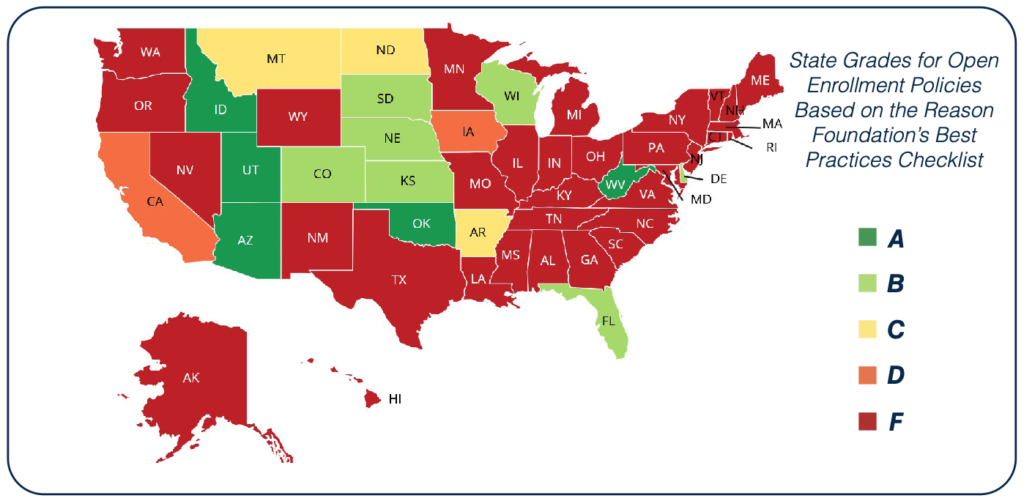
Under Kansas’s new interdistrict open enrollment law, every K-12 student can attend any public school in the state, regardless of where they live, as long as there are available seats in the desired school. School districts must participate in the program, and the Kansas Department of Education audits each district’s capacity annually to ensure compliance. Missouri students are largely denied this level of educational choice. In most cases, they are required to attend the school assigned to them based on their home address. In 2024, the Reason Foundation graded all states’ public school transfer and open enrollment laws, and Missouri received an “F.” There are many reasons why a family might want an alternative to their assigned school. The school could be too big or too small, a child may face bullying, or the school might not be able to meet the terms of an Individualized Education Program (IEP). Another issue that has come into focus of late is school safety—new federal guidance emphasizes that students who attend persistently dangerous schools must be provided with an opportunity to attend a safe public school.
Missouri students should be permitted to cross district lines to access any public school, and Missouri school districts should be required both to allow students to transfer out and to receive students from other districts when they have space. Information on available capacity should be posted on school and district web pages and monitored by the Department of Elementary and Secondary Education (DESE).
Expanding the MOScholars Empowerment Scholarship Account (ESA) Program
MOScholars, Missouri’s private school choice program, provides scholarships for students with disabilities and for low- and middle-income families to attend private schools. These scholarships are distributed through education assistance organizations (EAOs), which receive funding from two sources: (1) $50 million in public funding appropriated during the 2025 legislative session, and (2) private donations, for which donors receive full state tax credits subject to certain limitations. The total value of tax credits is capped at $75 million annually.
The 2025 appropriation of public funding for MOScholars was a step in the right direction, but there is more to be done. If all available tax credits are used, the combined public and private funding would total $125 million— enough to provide scholarships for approximately 20,000 Missouri students. While this is great news for the students who receive funding, it accounts for only a small share of Missouri’s nearly 880,000 public school students.
Voter and parent support for school choice programs is widespread. In a survey of parents taken in June 2021, approximately 75% of parents responded that they somewhat or strongly support ESA programs like MOScholars. If the legislature is serious about supporting this program, it should continue to expand funding to reach more students.
Charter School Expansion
Flexibility, freedom from bureaucracy, and the opportunity to innovate make charter schools a valuable addition to any school district—including those in remote, rural areas. Research shows that on average, charter schools outperform traditional public schools in raising academic achievement and some charter schools deliver results that are substantially better.
In nearly every state, charter schools are available to families in every type of community. In 2022–23, there were 984 rural charter schools enrolling 394,400 public school students nationwide, including 119 schools in communities designated by the Census Bureau as “remote rural.” However, of the 43 states with charter schools, Missouri is the only one with none located in rural areas.
As of 2025, charter schools are currently available to Missouri families in just three out of more than 500 school districts (Kansas City, the City of St. Louis, and Normandy). The reason is simple: In Missouri, charter schools in accredited districts can only open with the approval of the local school board. This is effectively a ban on opening charter schools in most locales. Legislation passed in 2024 allows charter schools to open in Boone County without the sponsorship of a local school board. No charter schools are operating in Boone County yet—it takes a while to open a new school—but they should be soon.
This legislation is a step in the right direction, but the real solution is to eliminate the requirement for local board sponsorship and let the market decide where charters belong. Every Missouri family should have access to this form of school choice.
Policy Recommendations
- Allow students to choose schools outside their residentially zoned districts in order to access broader education options.
- Continue to increase public funding for the MOScholars ESA program.
- Remove restrictions on where charters can open and who must sponsor them.