The Problem
Missouri’s primary tax and expenditure limit, commonly referred to as the Hancock Amendment, is no longer providing an effective check on government growth.
The Solution
Improve and expand the taxpayer protections provided by the Hancock Amendment by adopting a Taxpayer Bill of Rights.
Key Facts
- On paper, Missouri’s Hancock Amendment promises to keep state government from growing faster than Missourians’ pocketbooks, but it has proven incapable of doing so in recent years.
- A Missouri Taxpayer Bill of Rights could build on the legacy of the Hancock Amendment to provide the strongest protection against unconstrained government growth in the country.
- A Taxpayer Bill of Rights would keep the state’s revenues and expenditures from growing faster than the sum of the inflation rate and population growth, ensuring government cannot grow in scope without voter input.
- Unlike the Hancock Amendment, which grew out of date and has failed to provide taxpayer refunds for the past 26 years, a Taxpayer Bill of Rights would guarantee tax cuts or refunds if revenues ever exceed the defined limit.
- Although the Hancock Amendment requires property tax rates be rolled back when property values increase too quickly, this requirement is not being applied to the personal property taxes paid on the value of items such as cars, boats, and farm equipment.
Hancock Protections No Longer Effective
In 1980, and then again in 1996, Missouri voters approved amendments (the original amendment is commonly referred to as the Hancock Amendment) to the state’s constitution that were intended to place important restrictions on the government’s ability to raise and spend tax dollars. But in the more than 40 years since its initial passage, serious weaknesses in the amendment’s restrictions have been exposed.
One of the amendment’s main selling points—a state revenue limit with a tax-refund provision—was intended to prevent government from growing too fast. If revenues exceeded the limit, state taxpayers would receive a refund of the difference. The problem is that policymakers and an out-of-date compliance formula have rendered the tax refund threshold nonfunctional, resulting in state taxpayers not receiving a refund in more than 20 years. In fact, without reform, it’s unlikely that the Hancock Amendment’s tax refund provision will ever be triggered again.
A New Standard for Tax and Expenditure Limits
Missouri needs stronger, more resilient taxpayer protections. Missourians should be assured of the following principles:
- When tax revenues grow faster than the sum of inflation and population growth, taxpayers will get an automatic tax cut or refund unless they explicitly approve using the money for spending.
- Comprehensive state spending—including on tax credits—cannot grow faster than inflation plus population growth without voter approval.
- When property values increase faster than inflation, tax rates will be automatically reduced to ensure taxes aren’t raised without voter approval.
- When lawmakers want to substantially raise, change, or extend taxes, there will always be a transparent process for voter approval.
A Missouri Taxpayer Bill of Rights would accomplish each of these goals. Additionally, it would move our state to the front of the national pack for fiscal stewardship by providing Missourians the strongest tax and expenditure limit in the country. The Missouri Taxpayer Bill of Rights is designed to stand the test of time and contains strong enough definitions to avoid the political gamesmanship that has plagued the Hancock Amendment for decades.
The Missouri Taxpayer Bill of Rights would also extend the property tax rate rollback requirements to the two property taxes—the personal property tax and the commercial surcharge—that the Hancock Amendment currently exempts (three if you count the general exemption from this requirement for all property taxes levied by the Kansas City 33 School District). Perhaps this is because people assumed used car values would always decrease, which they did until 2021 and 2022. The windfalls local governments started receiving in 2022 from increased used-car valuations should be addressed, and rate rollbacks should be required for personal property as they are for real property.
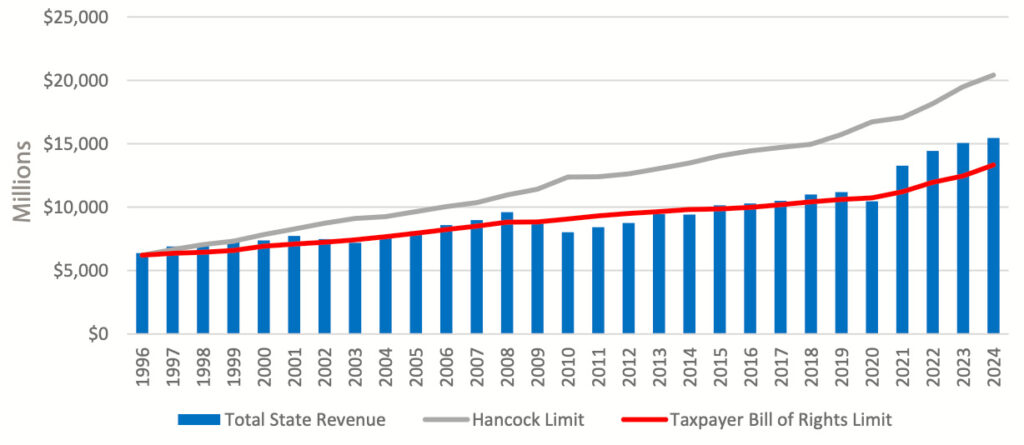
Hancock Amendment Revenue Limit vs. Limits from a Taxpayer Bill of Rights
Missouri is currently more than $4.9 billion below the Hancock-established revenue ceiling.
Policy Recommendations
- Adopt a Taxpayer Bill of Rights that stands the test of time and more effectively realizes the spirit of the Hancock Amendment through robust limits on state spending and revenues.
- Ensure that government cannot grow in scope without voter input, and if revenues exceed the defined limit, taxpayers receive automatic tax cuts or refunds.
- Expand the Hancock Amendment’s property tax rate rollback provisions to include personal property taxes and the commercial surcharge.
- Guard against runaway inflation by protecting taxpayers from drastic property assessment increases.