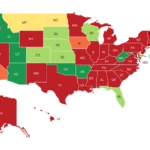
This week, many state departments of education across the country are releasing their annual school accountability report cards and performance ratings. These annual releases measure student proficiency in reading and mathematics, graduation rates, and academic growth across districts. Missouri’s should be out in the next month or so and, for the first time, school and district report cards will have letter grades.
While it’s good for state agencies to publish dashboards that track school performance, the question of what is spent to achieve those results (and how) is much harder to answer. The Missouri Department of Elementary and Secondary Education (DESE) has already submitted its budget request of over $8.5 billion for FY 2028, but that request is not directly tied to how Missouri schools are performing.
The current DESE strategic plan tracks just five measurable indicators to be achieved by 2026:
- 60% of children will enter kindergarten ready to learn
- 50% of students will score proficient or advanced in English Language Arts (ELA)
- 94% of students will pursue gainful training or employment
- 3,850 will be the 3-year average of initial teacher certificates issued
- 2% of teachers will be retained annually
We can already say for sure that a few of these have been missed. But there is no direct line from the 1,200-page budget request and these targets. Rather, agency appropriations function as automatic baselines in Missouri. Last year’s budget is this year’s starting point (this process is known as incremental budgeting), with only requests for additional monies or to fund new items receiving scrutiny. When state assessment scores stagnate or literacy targets are missed, there is no internal evaluation of program effectiveness. In fact, DESE can request additional funding without proving any past return on investment.
Some states, such as Florida and Texas, directly tie their state budget request to comprehensive sets of performance targets—an approach referred to as performance-based budgeting. Missouri does not use this approach. In a time of increased competition for limited state funds, perhaps it should.