Gov. Mike Kehoe recently signed House Bill (HB) 3231, a broad economic development package that revives the Missouri Downtown Economic Stimulus Act, better known as MODESA.
According to the Kansas City Business Journal, the revived program could help finance an expansion of CPKC Stadium, a possible new Royals ballpark, and billions of dollars in additional development connected to Kansas City’s Power & Light District and St. Louis’s Ballpark Village.
There are other provisions in the bill, including incentives for converting vacant office buildings into housing and programs tied to designated “innovation zones.” But the return of MODESA deserves particular attention because Missouri taxpayers already have some experience with the program. In Kansas City, that experience includes the Power & Light District.
Kansas City helped champion the original MODESA program in 2003, when downtown was struggling and city leaders were looking for ways to encourage investment. The program allowed new state tax revenues generated by qualifying developments to help finance projects, including public infrastructure associated with Power & Light.
The new version could be even more generous. The Business Journal reports that MODESA could redirect 50% of incremental state sales and employee income taxes generated by qualifying projects for as long as 30 years. For certain projects, that figure could rise to 70%. Local governments also would be required to provide substantial matching incentives.
Supporters believe the program can unlock investments that otherwise might not happen. The Cordish Companies, for example, says the legislation could help support $2.5 billion in new investment in Missouri, including an expansion that could “basically double” the size of the Power & Light District.
Perhaps. But before Missouri helps double the size of Power & Light, it is worth looking at how the financing of the original project has worked.
The district undoubtedly helped change the face of downtown Kansas City. It brought restaurants, bars, and entertainment venues to an area that badly needed investment. But it didn’t create new investment—it merely redirected economic activity at bars and restaurants from elsewhere in the city to downtown.
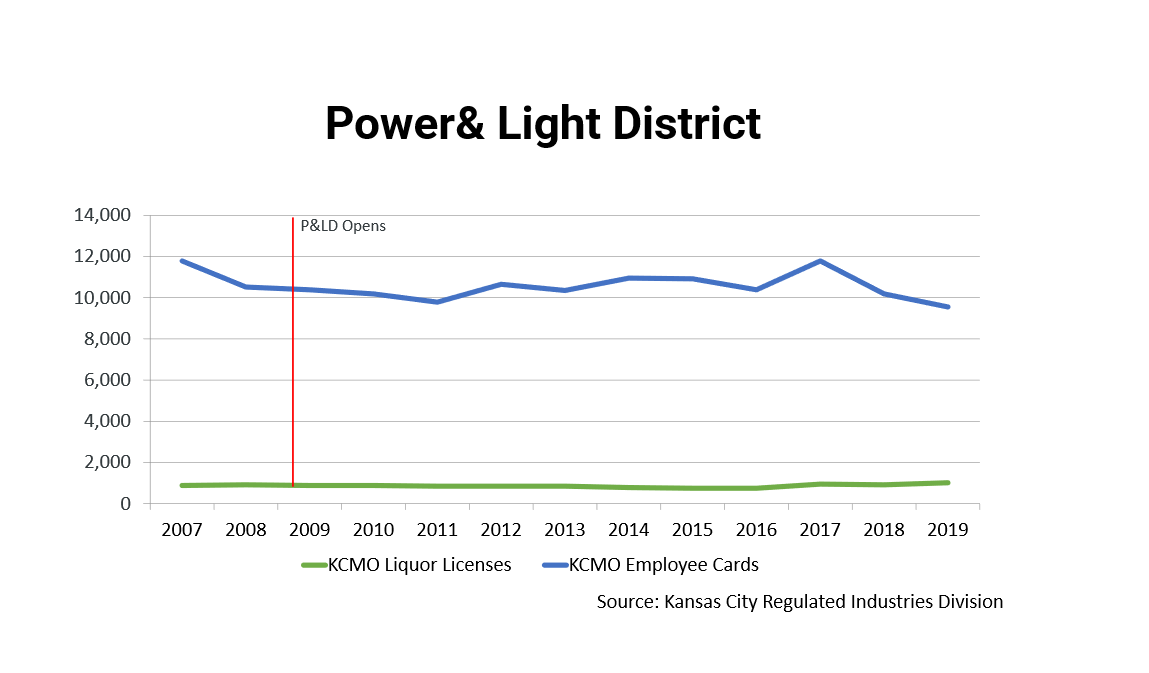
We know this because data provided by the city’s Regulated Industries Division shows us that the number of liquor licenses and employee cards required of bartenders and waitstaff remained flat after Power & Light opened. Despite new shops downtown, there was no growth citywide.
To make matters worse, the district has not generated enough revenue for Cordish to cover its debts. Because then-Mayor Kay Barnes was foolish enough to put taxpayers on the hook for debt payments, Kansas Citians have been paying out about $12 million each year over and above the tax revenue we divert back to the developer.
Kansas City is considering using the revived MODESA program as part of financing packages for an 18,000-seat expansion of CPKC Stadium and potentially a $3 billion Royals ballpark development at Crown Center. The city already has signaled its willingness to consider as much as $235 million in local incentives associated with the current project and $600 million for the Royals.
The state incentives are not insignificant, either. According to the Business Journal, the fiscal note for HB 3231 estimates the legislation will cost Missouri more than $62 million annually once fully implemented in 2034.
As Missouri leaders take on the task of cutting spending so that they may reduce and eventually eliminate the state income tax, these types of subsidies are not a sign of fiscal seriousness.
We’ve been here before. The effort failed. Why are we doubling down?