The Problem
Missouri’s budget is growing faster than the state’s economy, and if this troubling trend continues it could soon prove disastrous for state taxpayers.
The Solution
Limit spending growth, increase accountability, and improve budget resilience through reforms that prioritize Missouri’s long-term financial health.
Key Facts
- Missouri’s government is growing faster than inflation, wages, and the state’s population.
- Currently, state budgeting practices actually encourage greater spending.
- Most state budget documents aren’t easy for citizens to find, nor are they available in a form that is easy to use.
- Missouri awards nearly $1 billion each year in tax credits, which are the fiscal equivalent of state spending, completely outside of the normal budgeting process.
- According to Moody’s Analytics, Missouri is one of the least-prepared states in the nation for an economic downturn.
Spending at Record Levels
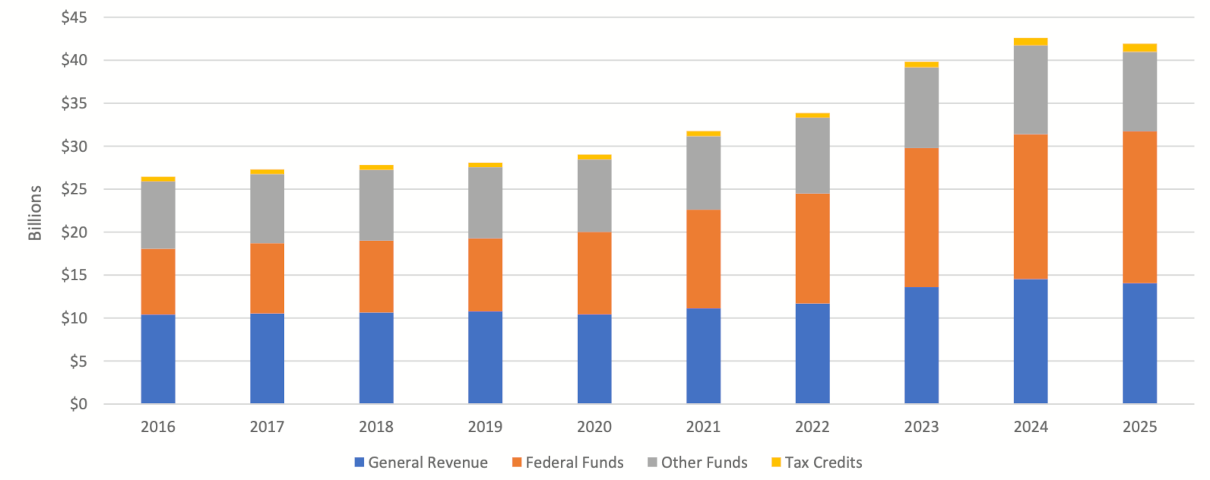
Missouri’s budget has been growing unsustainably for years, and may finally be reaching a fiscal cliff. After a year when a reduction in spending was promised but not delivered, our state is facing a one-billion-dollar shortfall. Missouri’s Hancock Amendment, which was once thought to provide protections against unchecked government growth, has proved incapable of meaningfully constraining spending. In fact, if Missouri’s budget growth hadn’t drastically outstripped both inflation and population growth over the past five years, the current fiscal crisis could have been avoided entirely.
Current Practices Encourage More and More Spending
Missouri currently uses what is called an “incremental” approach to budgeting, which means that budget items from one year automatically roll over into the next and establish the new baseline for state spending. This practice makes budgeting easier for legislators because it allows them to focus attention on new funding requests, but it also allows many old programs and spending items to escape annual scrutiny. The result is snowballing government growth. Missouri should require legislators to evaluate program effectiveness through performance audits and to regularly use “zero-based budgeting,” meaning that lawmakers must build the state’s budget from square one each year.
You Can’t Fix What You Can’t See
Currently, most state budget documents are difficult to find, hard to interpret, and in a form that requires citizens to manually transcribe the data to be studied. Such hurdles mean that lawmakers and state bureaucrats can act with greater impunity and less oversight. There is no good reason why the documents that detail where taxpayer money is going should not be easy for any citizen to access and understand.
Additionally, Missouri leads much of the nation in the subsidization of private entities with state tax dollars, yet there’s little to no mention of these subsidies in the yearly budget. Last year, Missouri awarded nearly $1 billion in various tax-credit programs with little to show for it. These tax credits are the fiscal equivalent of state expenditures, but because the state forgoes revenue instead of spending it, the credits are allocated completely outside the state’s normal budgeting process. The exclusion of tax credits from yearly scrutiny also removes them from the calculations lawmakers must make when tasked with balancing the state’s budget. A truthful accounting of all tax obligations is required if Missouri is to right its fiscal ship.
Missouri Isn’t Ready for the Next Recession
The boom-bust cycles of state finances create budgetary chaos. Each economic downturn forces elected officials to make difficult spending decisions that can be at odds with the state’s long-term funding priorities. As a result of the 2007-2009 Great Recession, general revenues fell by over $1.2 billion, leading to abrupt cuts in education, corrections, and other spending that lasted for several years after the recession. Almost every other state in the country has a rainy-day fund to help weather these situations, but Missouri’s Budget Reserve Fund is too small and too hamstrung by restrictions to be used in a downturn. In fact, it’s never once been used for this purpose.
Policy Recommendations
- Establish clear and meaningful state program performance metrics that allow for objective assessments.
- Implement zero-based budgeting.
- Make all state budget documents available in easily accessible, machine-readable formats (e.g., in Excel or CSV format).
- Include all tax credits, or tax expenditures, in the state’s yearly budgeting process.
- Create a separate budget stabilization fund with the sole task of stabilizing revenues in the event of an economic downturn. The fund should be large enough to fully replace state revenues during a crisis comparable in magnitude to the Great Recession with strong protections against improper use. Repayment to the fund also should be dependent on the pace of economic recovery.
FY 2026 Operating Budget
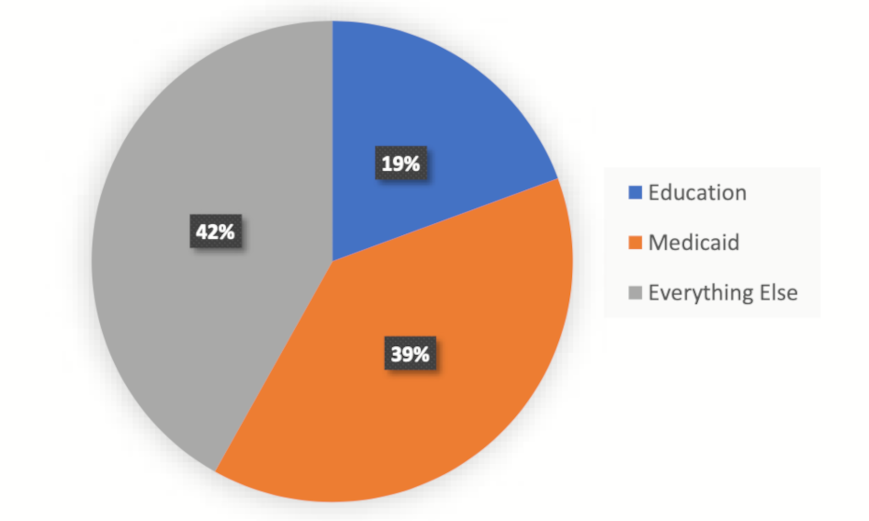
With approximately 58% of all state spending devoted to education and healthcare, continued budgetary growth puts enormous pressure on every other state spending priority.
Budgetary Growth: Fy 2016-2025
Missouri’s state spending has grown by more than 58% over the past decade.