• Publications and Model Policy
    • Blueprint for Missouri
    • Model Policy
    • Report
      • Case Study
      • Policy Study
      • Essay
    • The Missouri School Rankings Project
    • Testimony
    • Newsletter
  • Blog
    • Daily Blog
    • Podcasts and Radio
    • Video
    • Infographics
    • Commentary / Op-Eds
    • Events
  • Events
  • Donate
  • About
    • Our Team
    • Board of Directors
    • Fellows and Scholars
    • Authors
    • Jobs
  • Contact
  • Explore Topics
    • Education
      • Accountability
      • Education Finance
      • Performance
      • School Choice
      • The Missouri School Rankings Project
    • Health Care
      • Free-Market Reform
      • Medicaid
    • Corporate Welfare
      • Special Taxing Districts
      • Subsidies
      • Tax Credits
    • Labor
      • Government Unions
      • Public Pensions
    • State and Local Government
      • Budget and Spending
      • Courts
      • Criminal Justice
      • Municipal Policy
      • Property Rights
      • Transparency
      • Transportation
    • Economy
      • Business Climate
      • Energy
      • Minimum Wage
      • Privatization
      • Regulation
      • Taxes
      • Welfare
      • Workforce
Show-Me InstituteShow-Me Institute
Support the Show-Me Institute
  • Publications and Model Policy
    • Blueprint for Missouri
    • Model Policy
    • Report
      • Case Study
      • Policy Study
      • Essay
    • The Missouri School Rankings Project
    • Testimony
    • Newsletter
  • Blog
    • Daily Blog
    • Podcasts and Radio
    • Video
    • Infographics
    • Commentary / Op-Eds
    • Events
  • Events
  • Donate
  • About
    • Our Team
    • Board of Directors
    • Fellows and Scholars
    • Authors
    • Jobs
  • Contact
  • Explore Topics
    • Education
      • Accountability
      • Education Finance
      • Performance
      • School Choice
      • The Missouri School Rankings Project
    • Health Care
      • Free-Market Reform
      • Medicaid
    • Corporate Welfare
      • Special Taxing Districts
      • Subsidies
      • Tax Credits
    • Labor
      • Government Unions
      • Public Pensions
    • State and Local Government
      • Budget and Spending
      • Courts
      • Criminal Justice
      • Municipal Policy
      • Property Rights
      • Transparency
      • Transportation
    • Economy
      • Business Climate
      • Energy
      • Minimum Wage
      • Privatization
      • Regulation
      • Taxes
      • Welfare
      • Workforce
×

State and Local Government / Criminal Justice

Kansas City Homicide Rate May Be National Leader for 2025
By Patrick Tuohey on Dec 4, 2025

A story in the November 20 issue of The Washington Post examines homicide rates in large cities across the United States, and finds that “the rate of homicides has fallen dramatically for nearly four straight years.” This is good news, of course, but the piece cautions readers that it is difficult to know why—there are plenty of contributors to crime.

The piece focused on five cities: Baltimore, Philadelphia, Chicago, Indianapolis, and Los Angeles, and detailed each city’s experience of homicides.

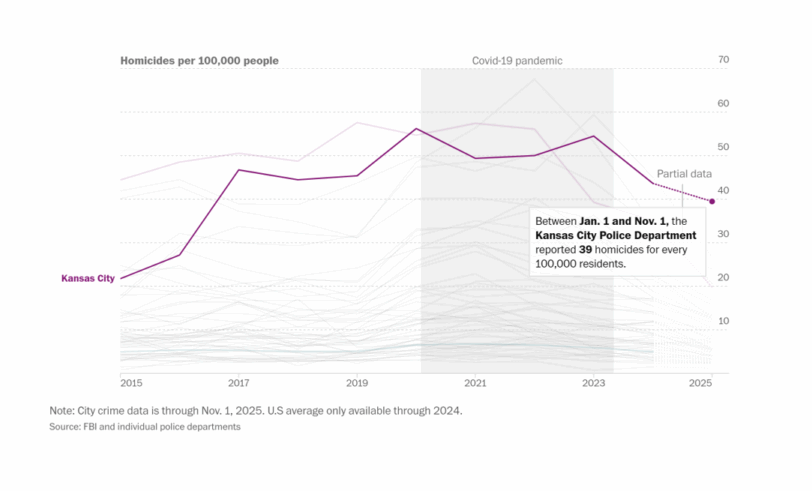
But what is noteworthy for Kansas Citians is that, based on the Post’s reporting of “crime data from 52 of the country’s largest police departments,” it appears that Kansas City may have the highest homicide rate for 2025—notwithstanding a reduction from previous years.

The homicide rate indicates homicides per 100,000 population; it is a useful tool for comparing cities with different total populations. While Kansas City’s total homicides in 2025 will likely be lower from the peak of 182 in 2023, when adjusted for population, it appears we may be on top. (St. Louis will likely have an even higher rate, but was not included in the Post’s analysis due to its size.)

This should serve as a reminder to all Missourians that it is not enough to reduce crime, though that is welcome. We must adopt policies that demonstrate results year over year rather than congratulate ourselves for drops that may have nothing to do with public policy. And if Kansas City does indeed end 2025 with the highest homicide rate in the country (out of the 52 cities selected for the study), it’s a reminder that public safety—and specifically homicide—must become a greater concern.

Topics on this page
MissouriSt. LouisKansas CityChicagoLos AngelesThe Washington PostPhiladelphiaIndianapolisBaltimore
More
  • Share
  • Tweet
  • Share
  • Email
  • Print
About the author

Patrick Tuohey

Senior Fellow

More about this author >
Footer Logo
Support the Show-Me-Institute
Showmeinstitute.org is brought to you by Show-Me Institute and Show-Me Opportunity.
  • Publications
  • Blog
  • Events
  • Donate
  • About
  • Contact

Reprint permission for Show-Me Institute publications and commentaries is hereby granted, provided that proper credit is given to the author. We request, but do not require, that those who reprint our material notify us of publication for our records: [email protected].

Mission Statement
Advancing liberty with responsibility by promoting market solutions for Missouri public policy.

© Copyright 2025 All Rights Reserved