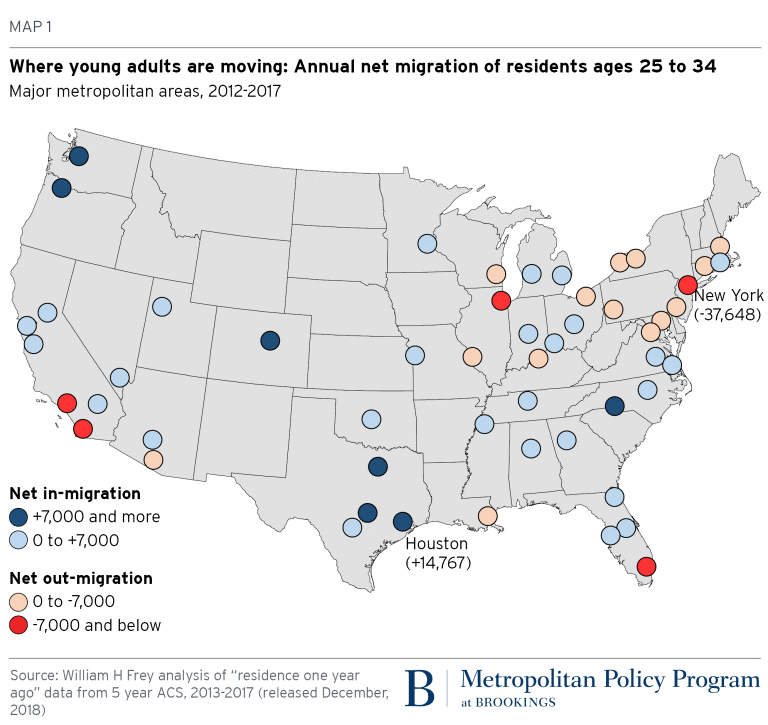
William Frey of the Brookings Institution just published a report entitled “How migration of millennials and seniors has shifted since the Great Recession,” and it has some promising numbers for Kansas City. In the report, Frey writes:
Another feature of young adult migration magnets is their location in the South and West “Sun Belt” region where all except three of the top 20 magnets are located. (Those three—Minneapolis-St. Paul, Columbus, and Kansas City—are among the most highly educated Midwest areas for millennials.)
…Today’s young adults, now encompassing those in the prime millennial ages, show a penchant for “educated places”—including Denver and Seattle—as well as more affordable areas like Minneapolis and Kansas City with pre-recession hot spots like Riverside, Phoenix, and Atlanta showing reduced appeal.
Frey, as do most researchers, uses the term Kansas City broadly, to encompass an entire metropolitan statistical area (MSA). The Kansas City MSA stretches from Independence to Lawrence and includes 14 counties. Its population is 2.1 million, compared to the under 500,000 within the political boundaries of Kansas City, Missouri itself. Knowing whether a statistic describes a city or a metropolitan area is important, lest you conclude, as some would have you believe, that Kansas City gets 25 million visitors a year. It doesn’t.
It’s important to remember the Brookings Institution numbers on millennial migration speak to the broader MSA. Frey doesn’t report how much of the growth is taking place in downtown Kansas City, or how much is taking place in Olathe and Overland Park, two places recently listed as top destinations for millennials. Frey doesn’t report it because he doesn’t know it; I asked him.
As has happened before, it is possible that reports like this will be set upon by groups like the Downtown Council and the City of Kansas City as proof that the billions of dollars spent subsidizing wealthy developers in downtown Kansas City are bearing fruit. But until we know migration numbers within the MSAs, all that optimism is premature and skepticism is warranted.
Below: a map containg data from Frey’s analysis.