A version of this commentary appeared in the Springfield News-Leader.
In terms of education policy, Missouri’s 2026 legislative session was a real dud.
At the outset, there was reason for optimism. Several states—mostly in the South—have implemented literacy and accountability reforms that dramatically improved student outcomes. Our representatives in Jefferson City noticed. There was real momentum behind bringing similar reforms to Missouri.
Governor Kehoe accelerated the accountability effort early in the session by issuing an executive order requiring the Missouri Department of Elementary and Secondary Education to assign letter grades to schools and districts. Soon afterward, lawmakers in both the House and Senate introduced bills mirroring the order’s language.
Lawmakers also introduced literacy reform bills in both chambers. Modeled after successful efforts in states like Mississippi and Louisiana, the proposals emphasized science-of-reading instruction, consistent literacy assessment, and a retention requirement for students unable to demonstrate reading proficiency by the end of third grade. Although literacy reform lacked the governor’s direct backing through an executive order, there was urgency around it just the same.
However, ultimately nothing got done. With the 2026 legislative session behind us, we’re right back where we started. We have no new legislation on accountability or literacy reform.
I attended multiple committee hearings in the House and Senate on both issues. Legislation can fail for many reasons, but one factor stood out above the rest: too many state legislators do not understand how poorly Missouri schools are performing. As a result, they do not act with the urgency necessary to address the problem.
Data demonstrating the poor performance of our schools are publicly available and unambiguous. The best evidence comes from the National Assessment of Educational Progress, or NAEP, which is widely viewed as providing the most credible test data in the country. Here are charts showing the changes over time in Missouri’s national rank on NAEP, in 4th- and 8th-grade reading, since about the turn of the century:
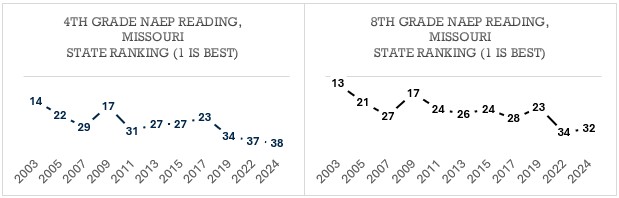
Our 4th-grade reading results are especially discouraging. As of 2024, Missouri ranks 38th among the 50 states, down from the low twenties two decades ago, and 42 percent of Missouri fourth graders score “Below Basic” in reading on NAEP. The lowest NAEP rating level is “Basic.” These children are literally off the chart, and not in a good way.
During one committee hearing, a legislator questioned the credibility of the NAEP data itself. But study after study shows that standardized test performance—and NAEP in particular—is strongly predictive of long-term outcomes. Research links higher NAEP scores to increased educational attainment and earnings, and lower rates of incarceration, arrest, and teen pregnancy. Whatever outcome you care about for our children, NAEP scores predict it.
Notably, the legislator who criticized the NAEP offered no alternative evidence suggesting Missouri students are actually doing well.
Other forms of denial also surfaced. Another representative defended the status quo by noting that his wife is a teacher, and a great one at that. That may very well be true, but individual anecdotes do not change the statewide data.
The bottom line is that too many elected officials fail to grasp the scale of Missouri’s educational decline. Until they do, they will not act with the urgency the situation demands.
Yes, this year’s legislative session featured the usual political infighting and dysfunction. But Missouri lawmakers are fully capable of passing legislation when they decide an issue matters. Their inaction on education sends a troubling message: they fail to recognize the severity of the problem.
Missouri’s children will bear the cost of their continued inaction.