• Publications and Model Policy
    • Blueprint for Missouri
    • Model Policy
    • Report
      • Case Study
      • Policy Study
      • Essay
    • The Missouri School Rankings Project
    • Testimony
    • Newsletter
  • Blog
    • Daily Blog
    • Podcasts and Radio
    • Video
    • Infographics
    • Commentary / Op-Eds
    • Events
  • Events
  • Donate
  • About
    • Our Team
    • Board of Directors
    • Fellows and Scholars
    • Authors
    • Jobs
  • Contact
  • Explore Topics
    • Education
      • Accountability
      • Education Finance
      • Performance
      • School Choice
      • The Missouri School Rankings Project
    • Health Care
      • Free-Market Reform
      • Medicaid
    • Corporate Welfare
      • Special Taxing Districts
      • Subsidies
      • Tax Credits
    • Labor
      • Government Unions
      • Public Pensions
    • State and Local Government
      • Budget and Spending
      • Courts
      • Criminal Justice
      • Municipal Policy
      • Property Rights
      • Transparency
      • Transportation
    • Economy
      • Business Climate
      • Energy
      • Minimum Wage
      • Privatization
      • Regulation
      • Taxes
      • Welfare
      • Workforce
Show-Me InstituteShow-Me Institute
Support the Show-Me Institute
  • Publications and Model Policy
    • Blueprint for Missouri
    • Model Policy
    • Report
      • Case Study
      • Policy Study
      • Essay
    • The Missouri School Rankings Project
    • Testimony
    • Newsletter
  • Blog
    • Daily Blog
    • Podcasts and Radio
    • Video
    • Infographics
    • Commentary / Op-Eds
    • Events
  • Events
  • Donate
  • About
    • Our Team
    • Board of Directors
    • Fellows and Scholars
    • Authors
    • Jobs
  • Contact
  • Explore Topics
    • Education
      • Accountability
      • Education Finance
      • Performance
      • School Choice
      • The Missouri School Rankings Project
    • Health Care
      • Free-Market Reform
      • Medicaid
    • Corporate Welfare
      • Special Taxing Districts
      • Subsidies
      • Tax Credits
    • Labor
      • Government Unions
      • Public Pensions
    • State and Local Government
      • Budget and Spending
      • Courts
      • Criminal Justice
      • Municipal Policy
      • Property Rights
      • Transparency
      • Transportation
    • Economy
      • Business Climate
      • Energy
      • Minimum Wage
      • Privatization
      • Regulation
      • Taxes
      • Welfare
      • Workforce
×

Education / Performance

Missouri’s Stagnant Reading Scores

By Avery Frank on Aug 20, 2025
MAP testing, Missouri reading scores, early literacy reforms, childhood reading, reading to learn, third grade retention
Drazen Zigic / Shutterstock

The COVID-19 pandemic began over five years ago. Students in 7th grade during the initial phase of remote learning are now packing up and moving to college. While those days are thankfully behind us, student achievement has been slow to recover.

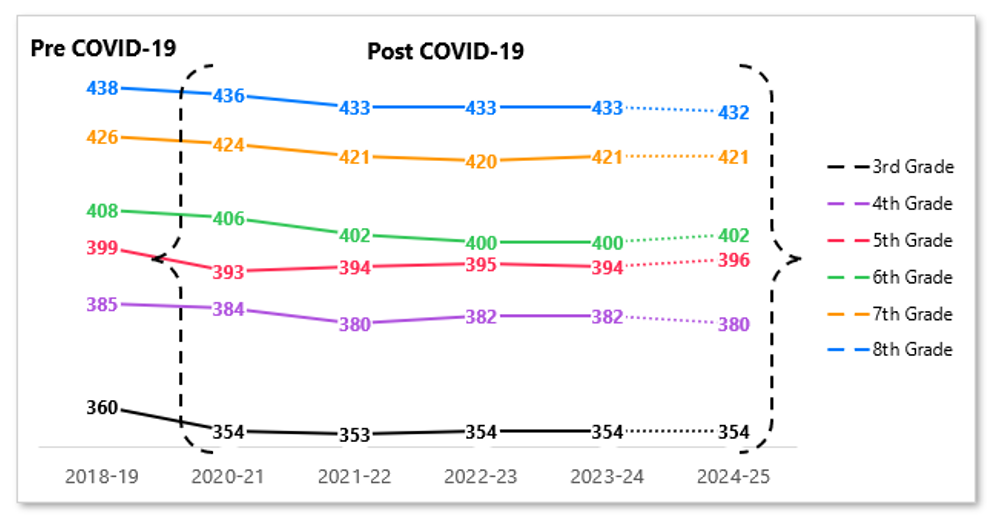
The slow road to recovery is illustrated in the recently released preliminary results of the 2025 Missouri Assessment Program (MAP). The most recent data indicate modest improvements in mathematics, and average scores in at least some grades that are finally eclipsing pre-pandemic levels. However, the state’s stagnant reading scores continue to be a source of concern, as reading scores remain below their pre-pandemic levels in all tested grades.

Figure 1 summarizes MAP trends in the Show-Me State, including preliminary scores from the 2024–2025 school year:

Figure 1: Missouri Assessment Program (MAP) English/Language Arts Mean Scale Scores by Grade Level, 2018–2025
Source: Missouri Department of Elementary and Secondary Education

In Figure 1, the mean scale scores represent the student body’s performance as a whole. There are several important takeaways from this figure:

  • Across all grades, Missouri’s reading scores have yet to return to pre-pandemic levels.
  • Except for scores in the 3rd and 5th grades, reading scores are lower now than they were in 2020–21, when the pandemic was still strongly affecting in-person schooling.

Clearly, there is still work to be done.

Potential Solutions

This post is not meant to be doom and gloom—there is hope. States such as Indiana, Mississippi, Louisiana, and Tennessee have shown that student literacy can improve substantially with the right reforms.

These states have adopted early literacy policies that are effective, though sometimes unpopular: mandatory third-grade retention, eliminating three-cueing for teaching reading, and ensuring teacher preparation programs teach evidence-based reading practices.

Other states have proved that early literacy reforms can work. The 2026 legislative session is an opportunity to take meaningful steps toward improving educational outcomes in Missouri by taking reading reform more seriously.


Topics on this page
MissouriMissouri Department of Elementary and Secondary EducationEnglishTennesseeIndianaLouisianaWorld mapMississippi RiverMissouri Assessment Program
More
  • Share
  • Tweet
  • Share
  • Email
  • Print
About the author

Avery Frank

Policy Analyst

More about this author >
Footer Logo
Support the Show-Me-Institute
Showmeinstitute.org is brought to you by Show-Me Institute and Show-Me Opportunity.
  • Publications
  • Blog
  • Events
  • Donate
  • About
  • Contact

Reprint permission for Show-Me Institute publications and commentaries is hereby granted, provided that proper credit is given to the author. We request, but do not require, that those who reprint our material notify us of publication for our records: [email protected].

Mission Statement
Advancing liberty with responsibility by promoting market solutions for Missouri public policy.

© Copyright 2025 All Rights Reserved