The Missouri House of Representatives recently passed a bill requiring that the Department of Elementary and Secondary Education (DESE) assign A–F letter grades to schools and districts statewide. The bill now heads to the Senate, which is also considering its own version.
The legislation is meant to build on and improve Governor Kehoe’s executive order from January. Unfortunately, it does not improve on the executive order; in fact, the version that emerged from the House is much worse.
The main problem with the House bill is that it has veered off topic. Governor Kehoe’s short and simple executive order mandates letter grades based on academic performance. This is what we need. The House bill adds language that would create new school climate ratings based on surveys of teachers, parents, and students, which would also go on the report card.
This is problematic for three reasons:
Most importantly, it will distract us from academic outcomes. Academics are where our schools are struggling, and until we focus on them, the situation is not going to improve. This is illustrated most easily with data from the National Assessment of Educational Progress, or NAEP, which is widely viewed as providing the most credible test data in the country. Here are charts showing changes over time in Missouri’s national rank on NAEP, in 4th- and 8th-grade reading, since about the turn of the century:
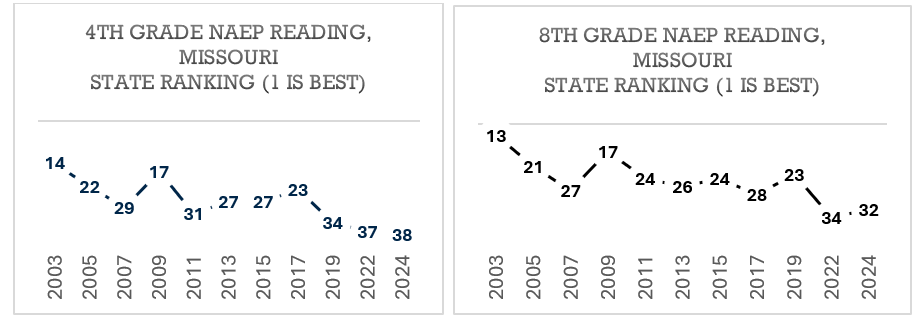
Our 4th-grade reading results are especially bleak—we rank 38th out of the 50 states as of 2024, whereas two decades earlier we ranked in the low twenties. Today, an alarming 42 percent of our 4th graders score Below Basic on NAEP.
Making matters worse, our ranking decline since about 2015 is in the context of generally declining test scores nationwide. Our scores are declining faster than the rest of a declining nation.
Governor Kehoe was correct to focus on academic outcomes, and the focus should stay that way.
Unlike data on academic achievement, which we already collect, survey data for this new school-climate requirement do not exist. It is difficult to develop and implement a high-quality survey with a high response rate. Have our lawmakers considered how we would get these surveys done?
As one of several concrete technical issues, consider the survey response rate. We cannot make parents fill out surveys. So, what if they don’t? What if we end up with schools and districts where fewer than 10 percent of parents fill out a survey (which is very possible)? Are we going to hold a school with a 10-percent parent response rate accountable for negative survey results? If the results look good, are we going to give the school a high rating?
Even if we ignore the first two issues, do we really want to compel DESE to undertake this work? We hear a lot of grumbling around the capitol about how DESE has gotten too big. This is how that happens. Developing and administering surveys to Missouri’s more than 800,000 students and their parents, and 70,000 teachers, across thousands of schools and hundreds of districts would require more administrative expansion. That is far outside the low-cost, straightforward scope of the original report card plan.
Governor Kehoe issued a clear and simple executive order on school and district report cards in January, which properly emphasizes academic performance. The order is fundamentally sound. There’s always room for improvement, but the legislation that came out of the House has moved this effort in the wrong direction. We hope our lawmakers can get it back on track.