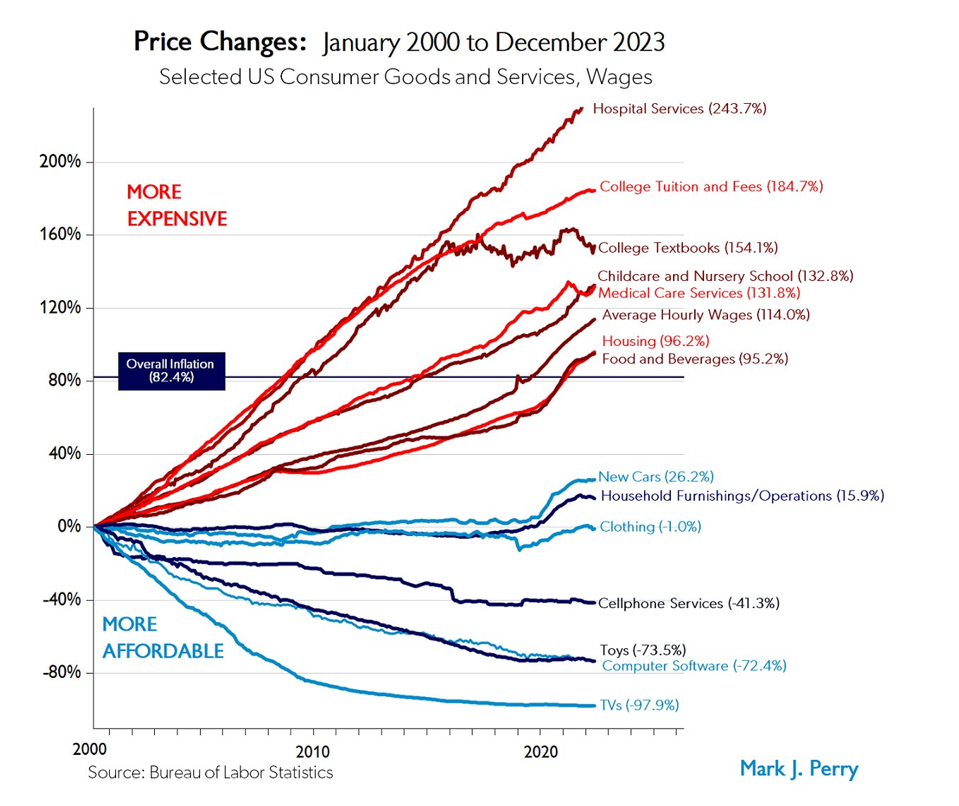
This chart is produced by Mark Perry at the American Enterprise Institute, and this version is an update he released in January of 2024. As he describes in an earlier blog post, there is an important pattern in the price trends: the greater the degree of government involvement in the provision of a good or service, the greater the price increase over time.
If this chart is the answer, the question would be something like “Why are free-market principles so important?”
The chart shows that between 2000—2023, inflation was 82.4 percent. Price changes over this time period greatly exceeded inflation in the following categories: Hospital services, college tuition and fees, college textbooks, childcare and nursery school, and medical care services. Housing and food and beverage prices also increased by more than inflation, but barely.
At the other end of the spectrum, prices on electronics, toys, clothes, cars, cellphone service, and household furnishings have fallen, or grown much less than inflation.
Once you see the stunning gap between goods and services in industries regulated and subsidized by the government versus goods and services in industries where the government is mostly uninvolved, it is hard to unsee it. This is just descriptive data and is not meant to be a rigorous causal analysis of the effect of government. But where there’s smoke, there’s usually fire.
This is a good reminder of the reason we fight for free-market policies in Missouri. Though often well intentioned, the government is just not very good at providing goods and services efficiently. When it gets involved, we all pay the price. Of course, there are some roles the government must handle (national security is an easy example), but for the most part, we’re better off when it stays out of the way.