Missouri could face millions in new food stamp costs by this time next year if the state doesn’t get its act together. As I’ve written previously, funding rules for the Supplemental Nutrition Assistance Program (SNAP) were changed in 2025, requiring states with payment error rates of 6% or higher to begin covering a share of benefit costs starting in October 2027. While recent reports suggest Missouri may be making progress, several neighboring states have already demonstrated that substantially better performance is possible.
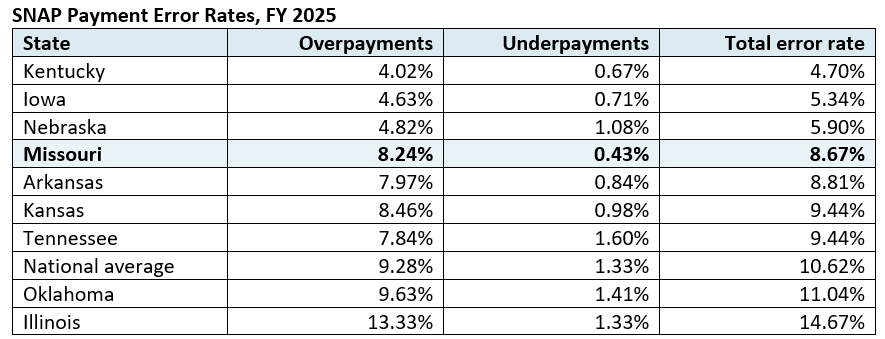
According to the latest official data from the U.S. Department of Agriculture, Missouri’s SNAP payment error rate was 8.67% in fiscal year (FY) 2025, which is very high, but still below the national average of 10.62%. Payment errors include overpayments and underpayments resulting from mistakes in determining eligibility or calculating benefits. Although they are not necessarily evidence of fraud, these errors mean households receive more or less assistance than they are entitled to receive.
Source: USDA, FY 2025 SNAP Payment Error Rates
As the table shows, overpayments account for most SNAP payment errors (meaning more is being paid than should be), including nearly 95% of Missouri’s total error rate. And while Missouri compares favorably with five of its eight neighboring states, Kentucky, Iowa, and Nebraska have already achieved rates below the prescribed 6% threshold.
A high error rate could prove extremely costly for Missouri. Based on FY 2025 error rates, Missouri could be responsible for approximately $156 million in additional program benefit costs next year. Reducing the error rate below 8% would cut that amount in half, while getting the error rate below 6% would eliminate the additional costs altogether.
As I wrote recently, Missouri has already begun taking steps to improve payment accuracy, including new documentation requirements to verify eligibility. Preliminary figures reported by the Missouri Department of Social Services also suggest the state’s FY 2026 error rate may have fallen to approximately 5.9%. If that’s true, Missouri could avoid additional benefit costs in the first year, when states can use the lower of their FY 2025 or FY 2026 rates.
It is important to keep in mind that while Missouri’s reported improvement is encouraging, the figures are not yet official, and the state will need to maintain that accuracy to avoid costs in subsequent years. With neighboring states already demonstrating that lower error rates are achievable, Missouri should continue looking for ways to improve payment accuracy, ensure eligible households receive the correct benefits, and protect taxpayers from unnecessary expenses.