Every child deserves access to a public school that fits their learning needs, regardless of where their parents can afford to buy a home. Yet according to Reason Foundation’s newly released report, Public Schools Without Boundaries 2026, Missouri continues to lag behind other states in tearing down arbitrary attendance boundaries.
In the 2026 edition, Reason evaluates all 50 states on their K–12 open enrollment policies and notes whether public school districts are required to admit non-resident students when classroom seats are open. Once again, Missouri earns an “F” grade (marked in red on the map below), failing to guarantee either mandatory interdistrict or intradistrict transfer options.
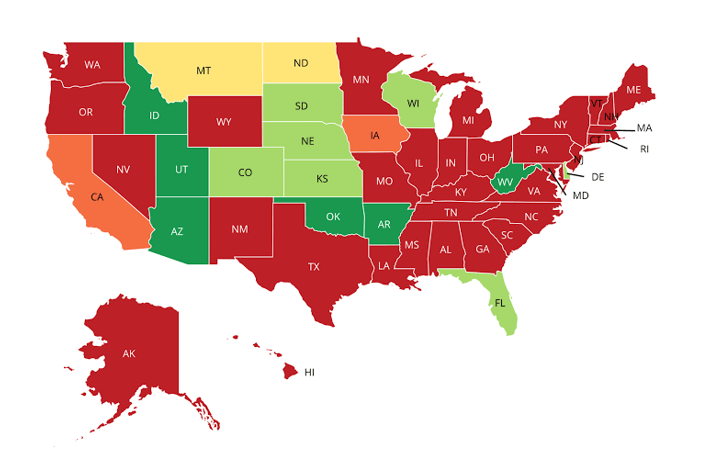
Missouri’s continued resistance to open enrollment is increasingly stark when looking across state lines. Surrounding states have embraced reform to empower families:
- Oklahoma and Arkansas receive A’s (dark green), maintaining robust, mandatory statewide open enrollment laws where dollars follow students and districts can only deny transfers for legitimate capacity reasons.
- Nebraska and Kansas earn solid B grades (light green), showing that open transfer policies can, in fact, be implemented across rural and suburban communities.
- Iowa recently strengthened its open enrollment policies to expand parental options.
Meanwhile, Missouri sits alongside Illinois, Kentucky, and Tennessee as a red wall of residential assignment. Opponents often claim that interdistrict open enrollment causes wild enrollment swings or collapses rural school districts. Yet a recent Show-Me Institute study cited directly in Reason’s report demonstrates otherwise. Interdistrict open enrollment in multiple states caused no widespread volatility, mass closures, or sudden migrations.
Public schools are funded by taxpayers to educate the public. It is time for Jefferson City lawmakers to dismantle residential boundary restrictions and give Missouri children the same freedom enjoyed right across our borders.