In a previous post, I highlighted Missouri’s school districts and charter schools with the highest and lowest expenditures per student using data from MOSchoolRankings.org.
Interestingly, the bottom ten spenders had a higher average academic letter grade than those in the top ten. However, many of the top spenders in the state are tiny rural districts with fewer than 50 students. That raised an important question: Would this pattern hold when comparing districts of a similar type?
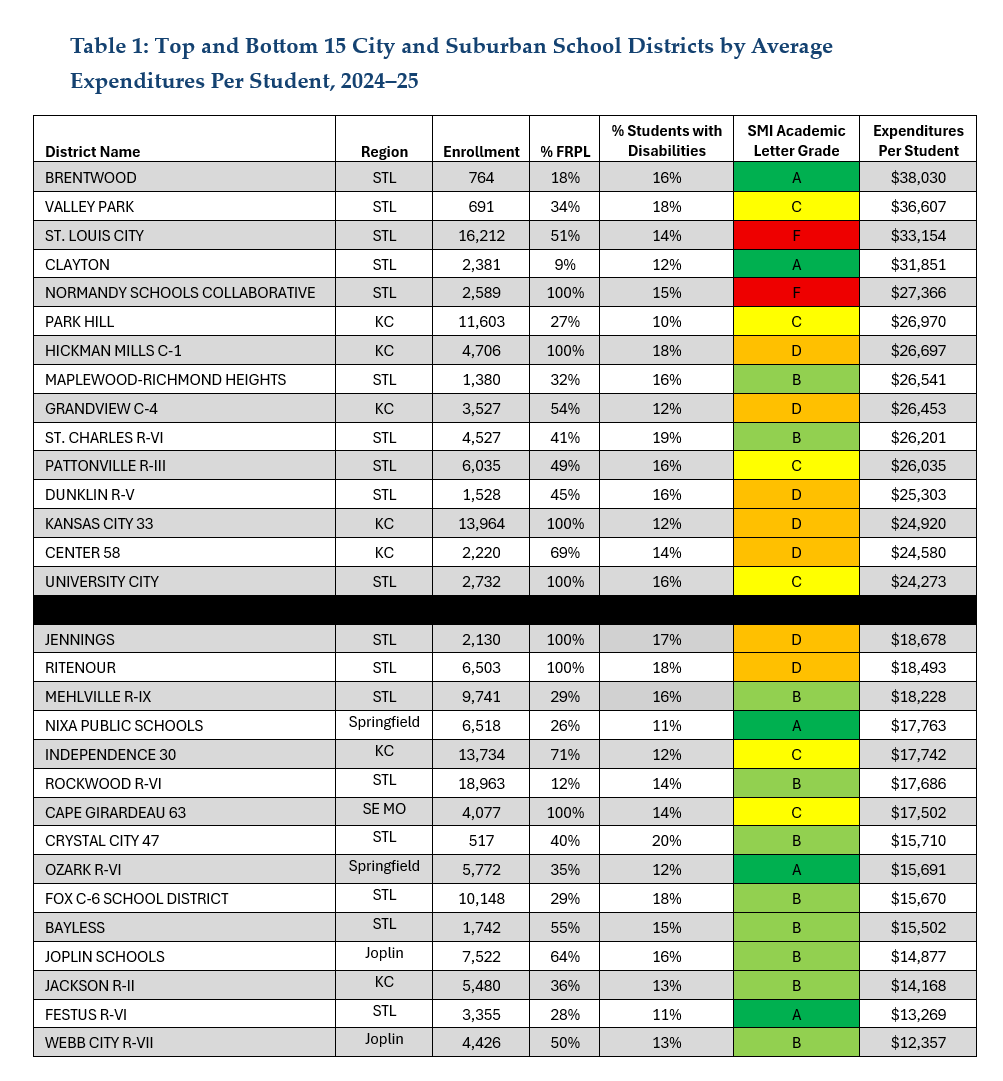
Table 1 begins to answer that question by focusing specifically on suburban and city districts—schools that are far more comparable in size and structure, but still vary widely in student demographics. It should be noted that Table 1 includes non-current spending items like interest and capital outlay (such as constructing a new gym, renovations, etc.).
For reference, in the 2023-24 school year, the average expenditure per student was around $19,500. Of that, about $15,900 were current expenditures and $3,600 were non-current expenditures.
Source: MOSchoolRankings.org
Interestingly, the five highest-performing school districts in the state are split between the highest and lowest total spenders. Table 1 suggests that it is overly simplistic to assume that more money per student automatically leads to better academic outcomes.
Consider Valley Park and Park Hill as examples. Both spend relatively high amounts per student (including non-current expenditures) and serve comparatively lower shares of low-income students, yet neither achieves top-tier academic results. Meanwhile, several lower-spending districts of similar demographics earn strong academic grades.
This does not mean funding is irrelevant, but rather that the process of producing strong academic outcomes is complex and money isn’t everything.