While the Missouri Legislature continues to debate A–F school report cards, the Show-Me Institute recently released our annual report card update on MOSchoolRankings.org.
Our rankings are built on a model that incorporates 10 academic indicators of student success. All data are sourced from the Department of Elementary and Secondary Education (DESE), and all English/language arts (ELA) and math scores are based on the Missouri Assessment Program (MAP). Each component is weighted equally, and a full explanation of the methodology is available online.
Table 1 shows all 24 public school districts and charter schools that received an “A” in the 2024–2025 school year.
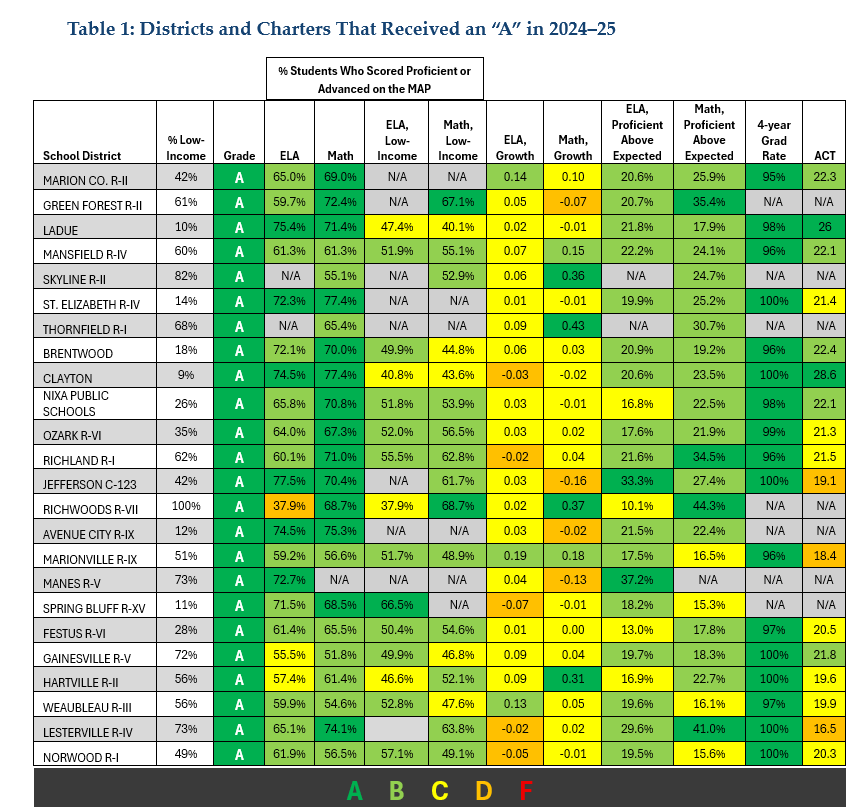
Suburban and rural districts dominate the top rankings, with numerous districts from St. Louis County (Ladue, Brentwood, Clayton). Many of the rural school districts are exceptionally small: Skyline has 81 students and Thornfield has 48. The largest school district on the list is Nixa Public Schools (near Springfield) with 6,518 students.
The suburban districts have relatively low rates of students eligible for free or reduced-price lunch (FRPL)—a common proxy for school poverty rate. Fewer than 10 percent of Ladue and Clayton students were eligible for FRPL, with Brentwood at 18 percent, Nixa at 26 percent, Festus at 28 percent, and Ozark at 35 percent. However, some rural “A” districts have a sizeable number of lower-income students.
Mansfield R-IV, which had 60 percent of its 622 students qualify for FRPL, performed above average in almost every single category (except in ELA growth). Richwoods R-VII, a small rural district about an hour from St. Louis, had 100 percent of its 125 students qualify for FRPL and had particularly impressive scores in math. These examples demonstrate that low-income schools can achieve academic success.
There is a lot more to delve into for academic performance. Table 1 is just one snapshot of what is available on MOSchoolRankings.org. Accountability tools like these can help highlight success stories, identify areas for improvement, and provide a clearer picture of how schools across Missouri are performing.