Until 2025, fire protection districts in parts of Missouri—mostly rural areas—were allowed to impose a sales tax of up to one half of one percent within their district. In the 2025 legislative session, a bill was passed to give all fire districts the ability to impose a sales tax, and also increased the maximum tax to one percent. Have any Missouri fire districts (and the smaller ambulance districts) taken the opportunity to ask voters to approve this new or higher sales tax?
Of course they have. It seems like almost all of them, especially in the five urban counties where fire and ambulance district sales taxes were previously prohibited.
Property taxes were how fire districts were entirely funded in those five urban counties. The rest of the districts also primarily relied on property taxes where the sales tax was limited to one half of one percent. That is apparently going to change. It shouldn’t. Fire protection literally protects your property, and should be paid for as such, through property taxes.
But of course, fire districts (and municipal fire departments) don’t actually fight many fires anymore. They answer medical calls and respond to car accidents, which are not so closely tied to one’s property. Here is a chart from Marginal Revolution.
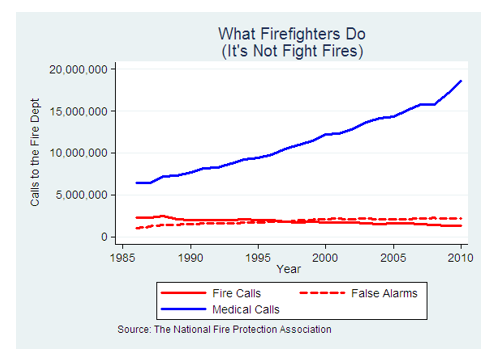
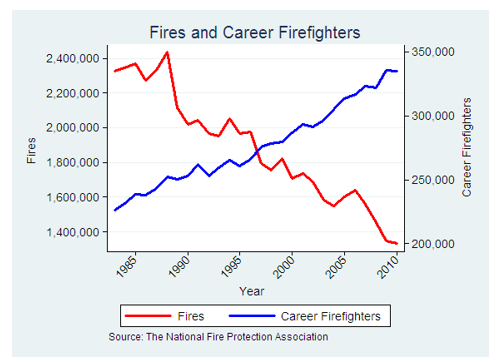
If a higher sales taxes pass, the fire districts are required to reduce their property taxes by an amount equal to half of the new sales tax collections. That’s nice, I guess, but it still means a substantial increase in funds for the fire districts. Fire districts will have to justify all the new spending, which they will mostly do by continuing to send the full fire truck out for a huge number of calls that don’t require a fully staffed fire truck. While this chart and the prior one end in 2010, the changes they noted since 1985 have not reversed in the past 15 years. The number of annual fires has leveled off, simply because it gets harder to reduce something once it has declined dramatically (which is wonderful). The number of career firefighters has continued to increase, reaching 364,000 by 2020.
Fire districts, particularly the larger ones in suburban areas, are often controlled by fireman’s unions. They get their allies elected in low-turnout April elections. Yes, the fire district officials care about public safety. Nobody disputes that. But they are often intensely focused on increasing pay and pension benefits for their members. Unlike city officials who have to fund a municipal fire department along with many other city departments under an umbrella of citywide tax revenues, fire district officials only care about their fire district. They don’t have to put funding into a bigger picture. They just want to maximize funds for the district.
Everyone wants quality fire protection, and firemen certainly deserve good pay and quality benefits. But taxpayers can’t afford to maintain the very generous benefits as is, and expanding the tax base for fire districts by allowing more and higher sales taxes is likely going to end up increasing those salary and benefits substantially. Will it lead to better public safety for the people of Missouri? Maybe. Will it lead to much higher local spending? Definitely.