• Publications and Model Policy
    • Blueprint for Missouri
    • Model Policy
    • Report
      • Case Study
      • Policy Study
      • Essay
    • The Missouri School Rankings Project
    • Testimony
    • Newsletter
  • Blog
    • Daily Blog
    • Podcasts and Radio
    • Video
    • Infographics
    • Commentary / Op-Eds
    • Events
  • Events
  • Donate
  • About
    • Our Team
    • Board of Directors
    • Fellows and Scholars
    • Authors
    • Jobs
  • Contact
  • Explore Topics
    • Education
      • Accountability
      • Education Finance
      • Performance
      • School Choice
      • The Missouri School Rankings Project
    • Health Care
      • Free-Market Reform
      • Medicaid
    • Corporate Welfare
      • Special Taxing Districts
      • Subsidies
      • Tax Credits
    • Labor
      • Government Unions
      • Public Pensions
    • State and Local Government
      • Budget and Spending
      • Courts
      • Criminal Justice
      • Municipal Policy
      • Property Rights
      • Transparency
      • Transportation
    • Economy
      • Business Climate
      • Energy
      • Minimum Wage
      • Privatization
      • Regulation
      • Taxes
      • Welfare
      • Workforce
Show-Me InstituteShow-Me Institute
Support the Show-Me Institute
  • Publications and Model Policy
    • Blueprint for Missouri
    • Model Policy
    • Report
      • Case Study
      • Policy Study
      • Essay
    • The Missouri School Rankings Project
    • Testimony
    • Newsletter
  • Blog
    • Daily Blog
    • Podcasts and Radio
    • Video
    • Infographics
    • Commentary / Op-Eds
    • Events
  • Events
  • Donate
  • About
    • Our Team
    • Board of Directors
    • Fellows and Scholars
    • Authors
    • Jobs
  • Contact
  • Explore Topics
    • Education
      • Accountability
      • Education Finance
      • Performance
      • School Choice
      • The Missouri School Rankings Project
    • Health Care
      • Free-Market Reform
      • Medicaid
    • Corporate Welfare
      • Special Taxing Districts
      • Subsidies
      • Tax Credits
    • Labor
      • Government Unions
      • Public Pensions
    • State and Local Government
      • Budget and Spending
      • Courts
      • Criminal Justice
      • Municipal Policy
      • Property Rights
      • Transparency
      • Transportation
    • Economy
      • Business Climate
      • Energy
      • Minimum Wage
      • Privatization
      • Regulation
      • Taxes
      • Welfare
      • Workforce
×

State and Local Government / Criminal Justice

Statistics Shows Crime Numbers Converging for Major Missouri Cities

By Braxton Steele on Jul 22, 2025

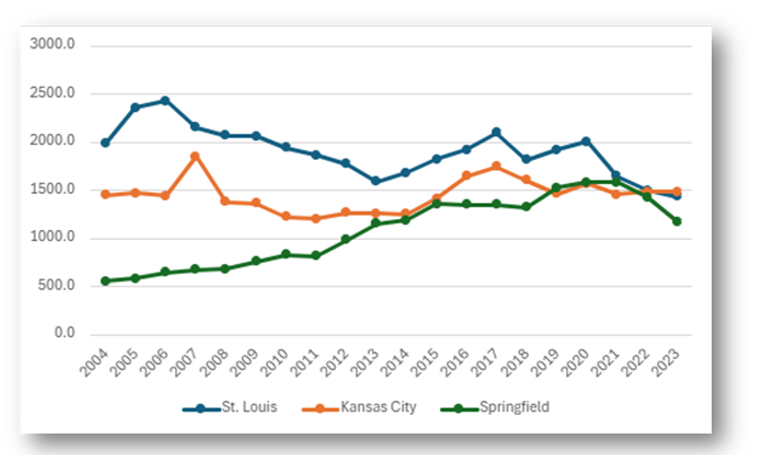
The violent crime statistics in the cities of St. Louis, Kansas City, and Springfield tell a much different story today than they did 20 years ago. In 2005, it would have been unreasonable to compare Springfield and St. Louis on a per-capita basis for violent crime, but recent statistics show they are much closer as of 2023. Kansas City was also far below St. Louis in violent crime per capita in 2005, but that has changed.

Figure 1: Violent Crime Per Capita (St. Louis, Kansas City, and Springfield)

The chart below shows the violent crime per 100,000 people from 2004 to 2023.
Source: FBI Crime Data Explorer (CDE)

The violent crime statistic includes aggravated assault, homicide, robbery, and rape. The chart above displays the convergence in crime numbers between the three largest cities in Missouri. The specific per capita rates in 2023 for the respective cities are: St. Louis (1,439.3), Kansas City (1,483.1), and Springfield (1,178.1).

This would seem like good news for St. Louis when looking at the chart above and seeing a steady decline in violent crime, and it is, but it doesn’t change the fact that the city still ranks within the top 10 most dangerous cities in the United States by many metrics, along with Kansas City.

Crime being down in St. Louis is good. In my opinion, the bigger takeaway from this data is the fact that violent crime in Kansas City has remained stagnant rather than decreasing, and Springfield’s rate has steadily risen over the last 20 years. None of our major cities is close to being considered safe compared to similar midwestern cities like Des Moines or Omaha.

Omaha claims transitioning from its officers using only enforcement (applying the law) to also including intervention (stopping the crime taking place) and prevention (taking preventative measures before crime begins) has reduced violence. Other cities have studied Omaha in hopes of replicating its success, including Kansas City. Unfortunately, based on the data, it hasn’t yet made a difference in Kansas City.

St. Louis should be commended for the drop in violent crime in the city, but major Missouri cities still have a significant problem with violent crime. If we want to become a state that people want to live and work in, our cities need to prioritize fixing this problem.


Topics on this page
MissouriSt. LouisKansas CitySpringfieldOmaha
  • Share
  • Tweet
  • Share
  • Email
  • Print
About the author

Braxton Steele

Intern

More about this author >
Footer Logo
Support the Show-Me-Institute
Showmeinstitute.org is brought to you by Show-Me Institute and Show-Me Opportunity.
  • Publications
  • Blog
  • Events
  • Donate
  • About
  • Contact

Reprint permission for Show-Me Institute publications and commentaries is hereby granted, provided that proper credit is given to the author. We request, but do not require, that those who reprint our material notify us of publication for our records: [email protected].

Mission Statement
Advancing liberty with responsibility by promoting market solutions for Missouri public policy.

© Copyright 2025 All Rights Reserved