State and Local Government
Hancock Amendment Reform

THE PROBLEM
After more than four decades, Missouri’s Hancock Amendment is no longer providing an effective check on government growth.
THE SOLUTION
Improve and expand the taxpayer protections provided by the Hancock Amendment.
Hancock Protections No Longer Effective
In 1980, Missouri voters approved an amendment to the state’s constitution that placed important restrictions on the government’s ability to raise and spend tax dollars, commonly referred to as the Hancock Amendment. Voters added additional taxpayer protections in 1996. But in the more than four decades since its initial passage, serious weaknesses in the amendment’s restrictions have been exposed.
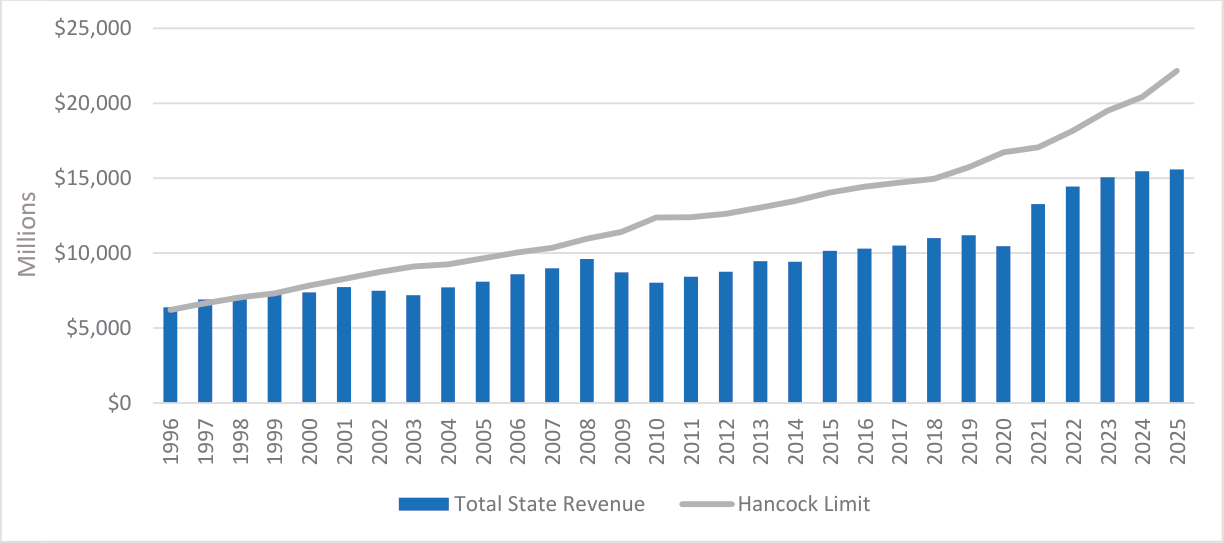
One of the amendment’s main selling points—a state revenue limit with a tax-refund provision—was intended to prevent government from growing faster than Missourians’ incomes. And if it did, state taxpayers would receive a refund of the difference. The problem is that policymakers and an out-of-date compliance formula have made the tax-refund threshold nonfunctional. Even after a historic period of state revenue growth, the threshold remains billions of dollars out of reach.
Once voters realized how easily elected officials could avoid the revenue limit, they passed a tax cap in 1996, which required tax hikes above a certain amount to be submitted for voter approval. This measure too has proven ineffective. Due to insufficiently defined terms and multiple state supreme court decisions, it’s unclear whether any new state tax proposal would require voter sign-off.
A New Standard for Tax and Expenditure Limits
Missourians have repeatedly supported limits on government growth and a public vote before those limits can be exceeded. Tying those limits to inflation plus population growth would allow government to keep pace with rising costs and a growing population while requiring voter approval to expand its size and scope. Missourians should be assured that:
- When tax revenues grow faster than inflation plus population growth, taxpayers will get an automatic tax cut or refund unless voters approve using the money for additional spending.
- State spending—including tax credits—won’t grow faster than inflation plus population growth without voter approval.
- When lawmakers want to substantially raise, change, or extend taxes, there will always be a transparent process for voter approval.
At the local level, the Hancock Amendment includes protections for taxpayers when property values rise. But two property taxes are exempt from the amendment’s requirement that tax rates roll back as assessed valuations increase (three if you count the general exemption from this requirement for all property taxes levied by the Kansas City School District). Personal property taxes on cars and similar items—which Missouri taxes more than most states—are not subject to the rollback rule. Rate rollbacks should apply to personal property as they do to real property. The second exempt tax is the commercial surcharge. It should also be subject to rate rollbacks. Additionally, the amendment’s inflation adjustment and treatment of new construction should be updated to better protect taxpayers when property assessments rise rapidly.
POLICY RECOMMENDATIONS
- Reform the Hancock Amendment to establish stronger limits on state revenues and spending tied to inflation plus population growth, guarantee tax cuts or refunds when revenues exceed the limit, and ensure voter approval for substantial tax increases.
- Expand the Hancock Amendment’s property tax rate rollback provisions to include personal property taxes and the commercial surcharge.
- Update the Hancock Amendment’s inflation adjustment and treatment of new construction to better protect taxpayers from rapid property assessment increases.
HANCOCK AMENDMENT REVENUE LIMIT
Missouri is currently approximately $6.6 billion below the Hancock-established revenue ceiling.