
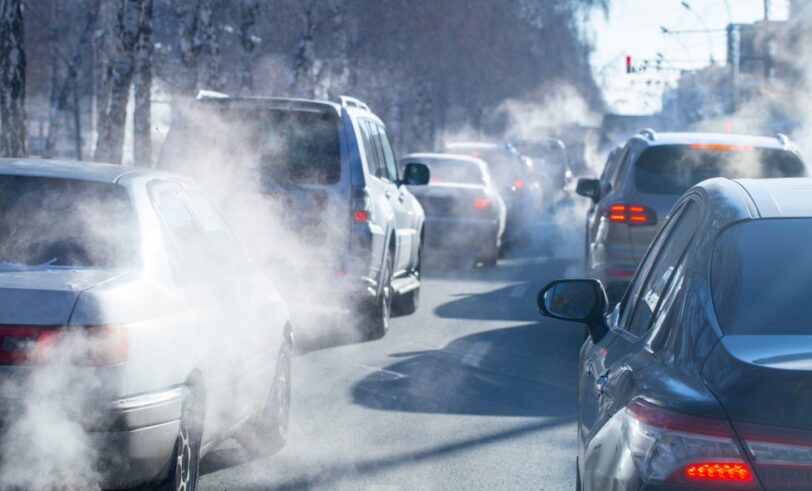
The Environmental Protection Agency (EPA) recently released a proposal to rescind its own 2009 Endangerment Finding that has been used to justify some federal greenhouse gas (GHG) regulations. The outcome could reshape national climate policy, impact the automobile industry, and carry significant implications for Missouri.
Brief Background of the Endangerment Finding
To oversimplify, the Endangerment Finding declares that a mix of six greenhouse gases pose a threat to public health and welfare, primarily because they contribute to climate change. These six gases are carbon dioxide (CO2), methane, nitrous oxide (N2O), hydrofluorocarbons (HFCs), perfluorocarbons (PFCs), and sulfur hexafluoride (SF6). In the finding, the EPA observed that U.S. motor vehicles and engines emitted four of those greenhouse gases, which collectively amounted to 4.3 percent of global GHG emissions in 2005.
Thus, the agency concluded that vehicle GHG emissions also endanger public health and that “contributors must do their part even if their contributions to the global climate change problem, measured in terms of percentage, are smaller than typically encountered when tackling solely regional or local environmental issues.” Prior to this, the EPA did not regulate greenhouse gases.
As a result, the Endangerment Finding has been crucial for allowing the EPA to regulate vehicle GHG emissions and reduce them, which in part has paved the way for electric vehicles (EVs).
The EPA’s 2025 Proposal and Potential Impacts
The recent proposal to rescind the Endangerment Finding leans on a few key arguments:
(1) The authors of the proposal argue that the EPA exceeded its statutory authority under the Clean Air Act, which was designed to regulate “criteria pollutants” that include nitrogen oxides (NOₓ), sulfur oxides (SOₓ), particulate matter, carbon monoxide, ozone (O3), and lead (Pb).
These criteria pollutants have direct effects on human health—eye, nose, throat irritation; aggravation of respiratory diseases such as asthma, coughing and difficulty breathing, cardiovascular disease, heart attacks, chest pain, and more. The proposal argues the effects of GHGs on human health through climate change are indirect, and should not be regulated under the same directive.
(2) The authors of the proposal claim that the Endangerment Finding’s measures of harm, such as more frequent heat waves and extreme weather events, have not borne out despite increases in GHG concentrations (driven primarily by increased emissions from foreign sources).
(3) The authors question whether federal mandates regulating vehicle GHG emissions can meaningfully address climate change as they claim there is no existing technology capable of making a “measurable” impact.
One excerpt from the EPA’s proposal conveys the potential impact on the automobile industry, if finalized:
“In connection with the proposed rescission of the Endangerment Finding, if finalized, this action would remove all existing regulations that require new motor vehicle and new motor vehicle engine manufacturers to measure, report, or comply with GHG emission standards . . .
. . . As a result of these proposed changes, motor vehicle and engine manufacturers would no longer have future or current obligations for the measurement, control, or reporting of GHG emissions for any vehicle or engine, including for previously manufactured [model years] MYs. However, we [EPA] are not proposing to reopen or modify any regulations necessary for criteria pollutant and air toxic measurement and standards, Corporate Average Fuel Economy (CAFE) testing, and associated fuel economy labeling requirements.”
In theory, if the finding is rescinded, we could see lower car prices. (However, this is not guaranteed because car companies have priorities of their own). Repealing the Endangerment Finding, along with the One Big Beautiful Bill’s (OBBB) phase-out of EV tax credits, could bring significant shifts to the transportation sector.

